
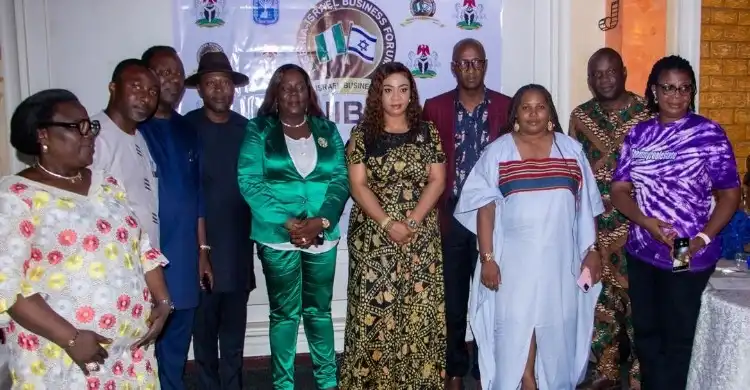
Nkechi Ufochukwu, Nigeria’s Ambassador to Israel has said efforts are underway to deepen the trade agreement between Nigeria and Israel as part of a broader plan to boost bilateral relations and economic cooperation.
Speaking over the weekend in Abuja at the maiden edition of the Nigeria-Israel Business Forum (NIBF) the envoy said strengthening trade ties between both countries remains a top priority of her diplomatic agenda.
“My main point and plan is to strengthen the trade agreement between the two countries, to strengthen bilateral trade agreement between the two countries,” she said.
Ufochukwu noted that beyond trade, her focus would include promoting Nigeria’s culture, agriculture, and investments, as well as facilitating training in cybersecurity and information technology.
She assured stakeholders of her commitment to delivering on her mandate and working collaboratively with partners to achieve results.
“I will put in my best in what is required of me to do the work which has been given to me, let us keep communication open and get the work done.”she said
Stakeholders at the forum stressed the need for Nigeria to address structural challenges hindering business growth, drawing comparisons with Israel’s innovation-driven economy.
Henry Opara, a member of the forum emphasised the need for formal bilateral agreements, noting that existing engagements are largely informal and driven by individual relationships.
“What we have now is more of person-to-person business relationships, which is not ideal. With proper bilateral agreements, it becomes government-to-government engagement guided by laid-down rules,” he said.
Opara added that although some Nigerian businesses already partner with Israeli firms in areas such as security and technology, formalising these relationships would yield greater benefits.
Also speaking, Oseagha Solomon, a member of the forum described Israel as a country that enables growth through clear regulations, reliable power supply, and strong institutional trust, while noting that Nigeria’s environment, though high in potential, is weighed down by operational challenges.
“Nigeria is a high-potential but high-friction environment. Entrepreneurs battle unstable power, policy inconsistencies, foreign exchange volatility, and costly financing,” he said.
Oseagha urged policymakers to prioritise innovation, invest in research and development, and ensure policy consistency, including stable foreign exchange and enforcement of regulations.
He also called for investments in human capital, technology, and infrastructure such as power, agriculture, and logistics, noting that combining Nigeria’s scale with Israel’s efficiency could unlock significant growth.
Speaking on the role of the forum, he said it evolve from a networking platform into one that delivers tangible outcomes, including market access for Nigerian exports, technology transfer, and direct business partnerships.
According to him, such collaboration could attract Israeli investments into Nigerian startups, infrastructure, and small and medium-scale enterprises, while also enhancing capacity through training and knowledge exchange.
Also speaking, the National Coordinator of NIBF, Mrs Florence Osuji called for renewed official trade agreements between Nigeria and Israel, noting that existing arrangements have lapsed and current trade lacks formal backing.
She revealed that efforts to ratify agreements since 2009 faced prolonged delays within government channels, despite renewed push however emphasised the need for stronger institutional collaboration, particularly through the Nigerian Embassy in Tel Aviv, to drive participation in international exhibitions.
Osuji highlighted key Israeli exhibitions such as Agritech and Israel Food, noting Nigeria’s successful debut pavilion led by former Agriculture Minister Akinwumi Adesina, which attracted international business deals.
She pointed to additional opportunities in security and cyber technology conferences, urging Nigeria to actively participate for knowledge transfer and innovation.
Osuji also called for sustained support for NIBF, stressing that the body currently lacks a functional office and secretariat despite its strategic role in Nigeria-Israel relations.
She recounted securing a medical training agreement with an Israeli hospital for Nigerian doctors, but lamented lack of follow-through from Nigeria’s Ministry of Health.
Osuji concluded with an appeal for practical implementation of bilateral agreements, stressing that NIBF remains ready to facilitate trade, training and cooperation initiatives.