
Politics
By Valentine Obienyem
THE death of Christ is not merely an event; it is a profound process – a movement from darkness into light. Darkness represents the forces of evil, while Christ embodies the fullness of light. In that epic struggle, fought on the hill of Golgotha, the central figures are God and Satan.
Yet, the outcome is not in doubt. What appears as defeat in the darkness of the Cross becomes victory in the light of the Resurrection. It is this passage, from suffering to glory, that defines the Christian mystery and offers hope to all humanity. That is what Holy Saturday celebrates, and it is beautifully captured in the Exsultet, powerfully rendered by Fr. Peter Ndianefo.
The Exsultet, which for me reaches its climax in the line that speaks of the “Happy Fault” (Felix Culpa), embodies the Church’s ability to transform the Resurrection of Jesus Christ into a living proclamation of hope, where poetry, theology, and ritual unite to convey humanity’s longing for light, victory, and eternal meaning. As St. Augustine profoundly reflects, echoing the spirit of this mystery: “O happy fault, that earned for us so great, so glorious a Redeemer.”
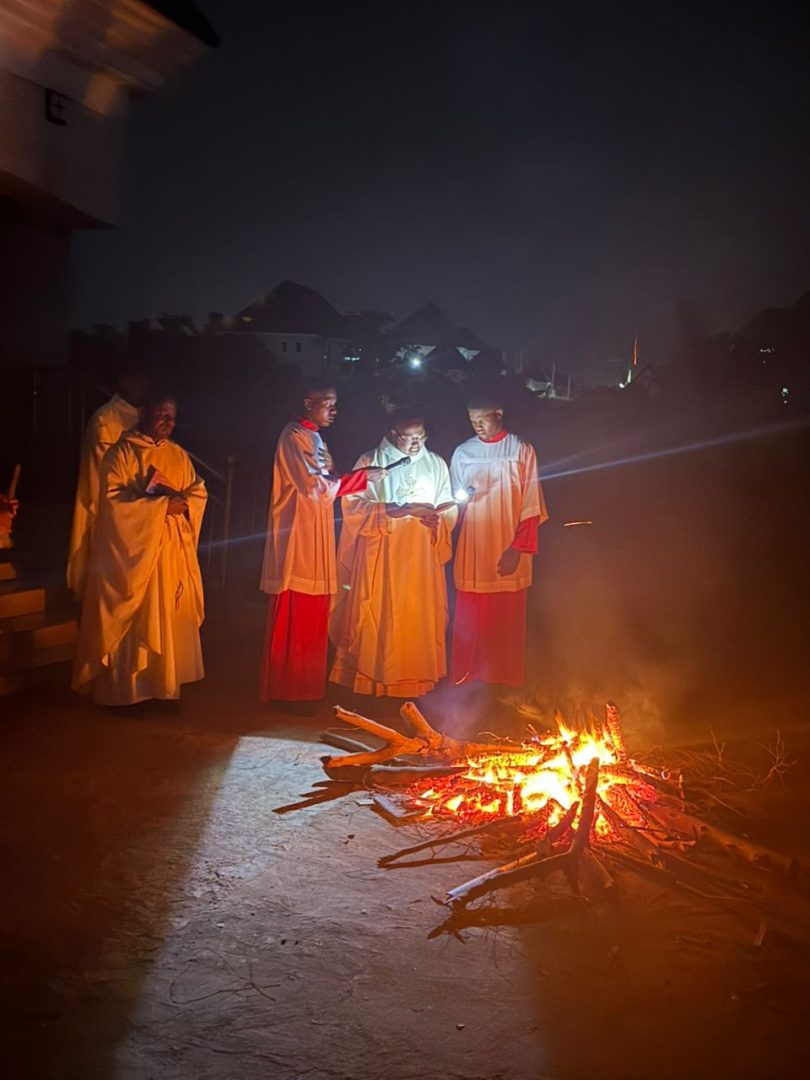
The atmosphere in the church was rich with symbolism. At first, the entire church lay in darkness, while a great bonfire burned outside. The priest, in our case, Frs. Maximus Okonkwo (chief celebrant), Chigozie Jidere, and Peter Ndianefo, blessed the fire and prepared the Paschal Candle, which was then lit as the new light of Christ. From that single flame, the light gradually spread through the congregation, dispelling the darkness and filling the church with a quiet but powerful glow. But something kept happening.
In fact, the practical demonstration of this struggle between darkness and light was striking: the light in the church repeatedly went off, as though threatened by returning darkness. It was so intense that the congregation began to wonder what was happening – until, at last, the light prevailed and took full hold. It was a moving reminder that, no matter how deep the darkness may seem, the light of Christ ultimately prevails.
Then came the Liturgy of the Word, where the Church structured a series of readings recounting the history of salvation: the story of creation, the promises of the prophets, and the fulfillment of God’s plan in the Resurrection. The return of the Gloria and the joyful proclamation of the Alleluia marked the turning point from the silence of Lent to the celebration of Easter.
Quickly following was the Liturgy of Baptism, where water was blessed, catechumens were baptized, and the faithful renewed their baptismal promises. Some also received First Holy Communion. This moment signifies a passage from sin to grace and from death to new life in Christ.
Finally, the celebration reached its summit in the Liturgy of the Eucharist, where the faithful partook of the Body and Blood of Christ, fully entering into the mystery of the Risen Lord. Together, these elements form a profound journey from the stillness of the tomb to the radiant joy of new life.
What does this tell you about the Catholic Church? The fathers of the church did well by reminding us through the priest during the mass of the Church which came to us through the apostles. The Easter Vigil expresses the Catholic Church as a profound synthesis of history, symbolism, and human longing. In this celebration, the life, death, and resurrection of Jesus Christ are not merely remembered but relived, giving meaning to human suffering and awakening hope. The liturgy becomes a true “drama of the soul, in which believers participate in a living story of darkness giving way to light, death to life, and despair to renewal. Through its rich symbols and communal expression, the Church reveals its unique capacity to transform deep spiritual truths into lived experience, preserving a continuous narrative of redemption while offering humanity a powerful vision of new life.
Happy Easter to you all!
A.I
April 5, 2026
Tags: Valentine Obienyem