
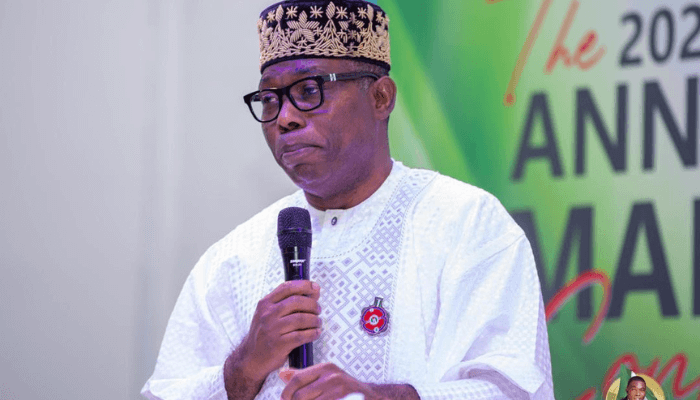
Prince Adewole Adebayo of the Social Democratic Party (SDP) has explained why his party is steering clear of coalition politics ahead of the 2027 general elections, arguing that meaningful change will not come from elite alliances but from broad-based voter mobilisation. He said the SDP is prioritising engagement with millions of Nigerians who have historically stayed away from the polls.
In this interview, Adebayo maintains that many coalition efforts are driven by personal ambition rather than shared principles, warning that such arrangements risk reproducing the same governance failures. He outlines the SDP’s strategy of building a people-centred political movement focused on accountability, participation and systemic reform.
Politics is often described as a game of alliances and numbers. Critics argue that any party outside a coalition risks indirectly strengthening the ruling party, given the difficulty of defeating an incumbent alone. Why, then, is the SDP not part of a coalition?
For us, alliances are not limited to agreements among politicians. The real strategic partners are the Nigerian people themselves.
Within the political class, there are deep contradictions and disagreements. If your goal is governance anchored on accountability and anti-corruption, you cannot build credibility by aligning with actors whose records or conduct undermine those principles. That would be inconsistent.
More importantly, electoral participation data tells a deeper story. In the last general election, about 93 million Nigerians were registered voters, yet nearly 80 per cent did not participate. So the first question in any serious coalition discussion should be: where are those Nigerians, and why are they disengaged?
That is where the SDP is focused—reaching those voters and addressing the barriers that keep them away from the polls. We are also engaging other political parties from time to time, but many of those conversations are not productive. In some cases, actors who have been part of governance failures for decades show little evidence of learning and are simply seeking another opportunity to repeat the same mistakes. We cannot enable that.
There are also coalition advocates driven largely by personal ambition, seeking roles they are not suited for. For us, the real coalition is one that brings Nigerians—those who suffer under bad governance and stand to benefit from good governance—into active participation. That is the alliance the SDP is building.
Your party’s activities are not very visible in the media. What exactly is the SDP doing?
Our focus is grassroots expansion and membership growth. If you move across the country, the evidence is visible.
The limited media coverage is both a challenge and, in some ways, an advantage. For example, we held a major mobilisation in Kano where thousands joined the SDP, yet it received little attention. But ultimately, what matters is not media noise; it is what happens on election day.
The reality is that incumbents have access to state resources and security structures, and they are aware of our activities. Our message to Nigerians is simple: do not wait for any coalition to come and rescue you. That is a mistake. Citizens must take responsibility—engage politically, join parties that reflect their values, and participate actively in elections.
We also caution against passive hope, whether through prayer alone or disengagement from civic responsibility. Nigerians must not be persuaded that change will happen without participation.
In addition, we are engaging religious, civic, and professional organisations, urging them to move beyond benefiting from a flawed system and instead contribute to improving it.
Our membership drive is not about figures alone. In recent months, data shows that in many remote areas, we are recording close to 100,000 new members weekly, up from about 100,000 monthly. But beyond numbers, we are ensuring meaningful participation—not just statistics for INEC.
We remain open to working with political actors willing to learn from past mistakes. However, meaningful coalition discussions will only take place after party primaries, as parties are at different stages of internal organisation.
In some recent engagements, we encountered parties with multiple, conflicting aspirants. We advised them to resolve their internal crises first before engaging in broader talks. Coalition-building must be structured, not chaotic.
Ultimately, our idea of coalition goes beyond political elites. It includes civic groups and Nigerians who were previously disengaged but are now beginning to participate. That is the broad-based alliance we believe can transform the country.
Are you concerned the party now has only one senator?
Not really. One member passed away, and the other has not formally resigned, despite speculation about his political direction.
If he chooses to pursue his governorship ambition elsewhere, we respect that. A party cannot be built around individual ambitions. For every high-profile exit, thousands are joining.
What matters is whether Nigerians understand what the SDP stands for—governance rooted in the principles of Chapter Two of the Constitution. Politics should be about ideas and values, not personalities.
If that message resonates, a national coalition will naturally emerge. Even those currently moving between parties may eventually align with that vision.