
by Ayomide Balogun
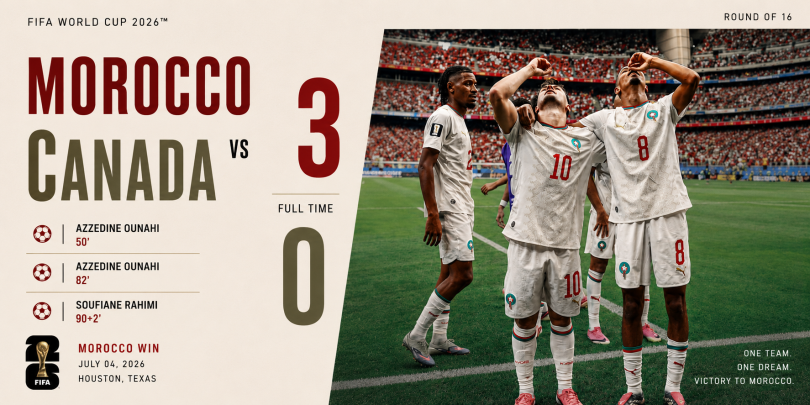
Morocco produced another masterclass in knockout football as they defeated Canada 3-0 to secure a place in the quarter-finals of the 2026 FIFA World Cup. While the scoreline suggests a comfortable victory, the Atlas Lions had to weather an energetic Canadian start before their superior quality, tactical discipline, and clinical finishing proved decisive in Houston. The result also made Morocco the first African nation to reach the World Cup quarter-finals on two separate occasions, further cementing their place among the tournament’s elite.
Canada entered the match riding the momentum of a historic campaign, having reached the knockout stage for the first time. Despite the absence of injured captain Alphonso Davies, Jesse Marsch’s side showed remarkable confidence in the opening half, pressing aggressively and dominating possession. The Canadians pinned Morocco deep inside their own half for long spells, creating several promising opportunities through Jonathan David, Tajon Buchanan, and Stephen Eustaquio.
Yet, for all their attacking intent, Canada lacked the finishing touch. Morocco’s disciplined defensive structure, anchored by Nayef Aguerd and Achraf Hakimi, absorbed the pressure without panic. Goalkeeper Yassine Bounou was rarely forced into spectacular saves, thanks largely to his defenders’ excellent positioning and composure under pressure. Morocco even suffered an early setback when influential forward Ismael Saibari limped off with a hamstring injury, forcing coach Mohamed Ouahbi into an early tactical reshuffle.
READ RELATED STORY
Marsch insists Canada were better despite exit as Ouahbi disagrees
Morocco survive Haiti scare to reach World Cup knockout stage
The first half ended goalless, but the momentum shifted dramatically after the break.
Just five minutes into the second half, Morocco struck with ruthless efficiency. Hakimi delivered a clever freekick into the path of Azzedine Ounahi, who unleashed a low strike through a crowded penalty area and beyond Maxime Crépeau to hand the Atlas Lions a priceless lead. It was Morocco’s first real breakthrough of the afternoon and a reminder of how quickly they can punish opponents who fail to capitalize on their own chances.
Conceding forced Canada to commit even more players forward, but that only played into Morocco’s hands. The North Africans became increasingly dangerous on the counterattack, with Brahim Díaz and Hakimi finding space behind Canada’s advancing full-backs. Canada continued to battle bravely, but their attacks became more desperate as the clock ticked down.
With eight minutes remaining, Morocco delivered the knockout blow. A swift counterattack sliced through Canada’s stretched defence before Ounahi calmly finished for his second goal of the evening. The midfielder’s composure in front of goal capped a superb individual performance and effectively ended any hopes of a Canadian comeback.
There was still time for one final flourish. Deep into stoppage time, substitute Soufiane Rahimi raced clear on another counterattack before calmly rolling the ball into the net to complete a convincing 3-0 victory. The late goal perhaps flattered Morocco slightly, but it perfectly illustrated the clinical edge that separated the two sides.
While Ounahi deservedly claimed the headlines with his brace, Morocco’s success was built on collective discipline. Hakimi was outstanding at both ends of the pitch, contributing an assist while neutralising Canada’s attacking threat. Bounou provided his customary assurance between the posts, and the defensive unit once again demonstrated why Morocco have become one of international football’s most difficult teams to break down.
For Canada, elimination brings disappointment but should not overshadow an unforgettable tournament. The co-hosts reached the knockout rounds for the first time in their history and competed fearlessly against one of the world’s best teams. They controlled large portions of the first half and created enough opportunities to make the contest far more competitive than the final score suggests. Their inability to convert those chances ultimately proved costly against a side that rarely wastes its own.
Morocco, meanwhile, continue to strengthen their reputation as genuine contenders. Having made history by reaching the semi-finals in 2022, they have now backed up that achievement with another quarter-final appearance. Their blend of defensive organisation, tactical intelligence, and attacking efficiency makes them a formidable opponent for anyone left in the competition.
Canada’s remarkable journey ends with pride, but Morocco march on with growing belief. If they continue to defend with such discipline while taking their chances as clinically as they did against Canada, the Atlas Lions will fancy their chances of writing yet another memorable chapter in African football history.