
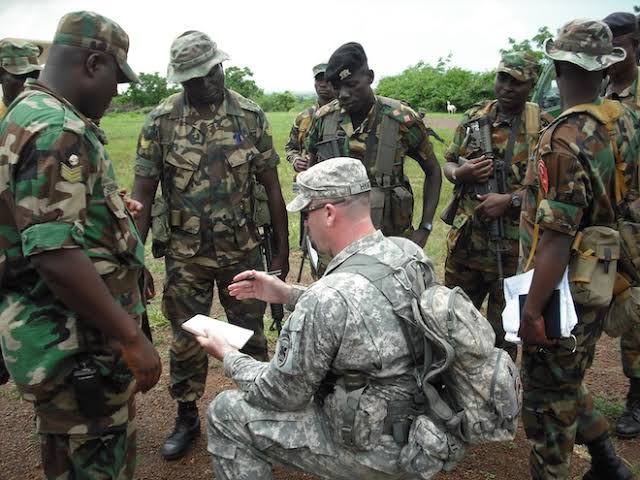
The United States has withdrawn most of its military personnel deployed to Nigeria following the completion of a major counterterrorism mission in the Lake Chad Basin.
Despite the troop withdrawal, security cooperation between both countries remains active, especially in intelligence sharing and counterterrorism operations targeting ISIS and other extremist groups operating in the region.
The development was disclosed by the Commander of US Air Forces in Africa, General Dagvin R.M. Anderson, during a virtual briefing after the African Chiefs of Defence Conference 2026.
Anderson explained that the mission requiring the temporary deployment of US troops had been successfully concluded. He, however, stressed that Washington would continue to support Nigeria’s security operations through intelligence collaboration and other strategic assistance requested by the Nigerian government.
According to him, the operation carried out in the Lake Chad region delivered significant results, not only for Nigeria and neighbouring countries but also for global security efforts against terrorism.
“And so that operation in the Lake Chad Basin of Nigeria not only helped the countries in that immediate region; it also helps countries globally as that disrupts the ISIS network,” Anderson said.
He added that although most of the troops involved in the operation have now left Nigeria, cooperation between both nations remains in place.
“And so — and then we have withdrawn much of our forces that were just there for that operation, but are continuing the partnership that Nigeria has asked for to help continue with the intelligence sharing and the understanding that’s necessary to be able to prosecute these difficult tasks,” he added.
The US commander described Nigeria as one of America’s key security partners in Africa, noting that the country remains strategically important due to its military strength, economic influence and population size.
He said intelligence collaboration between both countries played a major role in recent successes recorded against ISIS-linked networks.
According to Anderson, the partnership helped in carrying out a critical operation that led to the elimination of one of the top leaders of ISIS.
“I think the partnership that we’ve shown recently with Nigeria, where Nigeria’s a very capable and large country — it’s got a strong economy; it’s got a large, educated population; it’s got a very capable military.
“But there are things that we have learned in the counterterrorist fight over several years that we were able to assist and integrate with them to help them with their intelligence and help with the intelligence sharing that eventually led to a cooperative effort to where we were able to bring some unique capabilities that the U.S. brings and be able to prosecute together the number two leader within the ISIS or Daesh organization who is responsible for much of their global operations, their global media, and their recruiting”, he said.
He further stated that the success of the mission reinforces the importance of intelligence-driven operations rather than long-term foreign military presence on the ground.
“So I think as we go forward, that is an example of how we’re looking at engaging with partners to help them be more effective by only bringing unique U.S. capabilities that allow the partner to be effective in these fights,” he said.
Anderson also called for stronger cooperation among African nations in intelligence gathering and security operations to tackle terrorism, drug trafficking and other transnational crimes.
He cited a recent multinational operation involving the interception of a massive cocaine shipment along the West African coastline. According to him, the operation was made possible through coordinated intelligence sharing involving multiple countries.
“I was able to coordinate through our interagency in the United States, through AFRICOM, and then notify some of the partners. And eventually it was a Spanish ship that interdicted the ship that had 31 tons of cocaine on it, and it turns out is the largest interdiction of drugs at sea that we’ve ever seen,” Anderson said.
He noted that stronger partnerships between African governments, international allies and private sector players would be necessary to address growing security threats and improve economic stability across the continent.
The US had deployed about 200 military personnel to Nigeria in February 2026 to support intelligence, surveillance and counterterrorism operations in the Lake Chad Basin. The move came as both countries deepened military cooperation against terrorist groups operating in northern Nigeria and surrounding regions.
Security cooperation between Abuja and Washington expanded further after the US government increased support for Nigeria’s counterterrorism operations.
A major breakthrough was recorded in May 2026 when a joint US-Nigerian operation reportedly killed Abu-Bilal Al-Minuki, identified as the second-in-command of ISIS, during a raid in Borno State.
The operation was seen as a major blow to the extremist group’s activities in West Africa.