
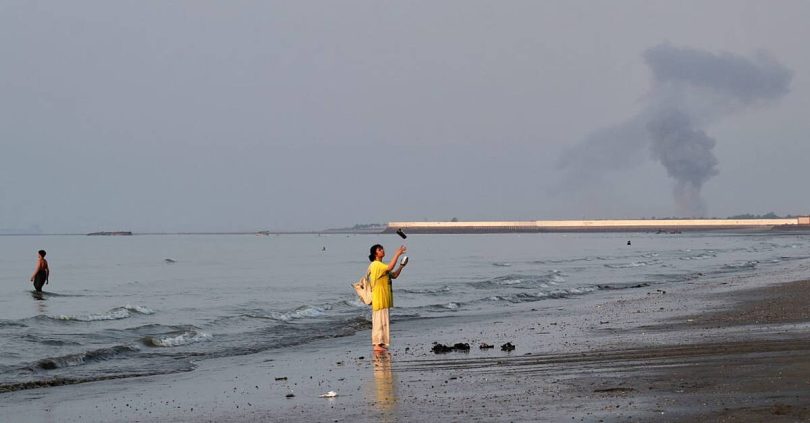
The US military said it has reimposed its blockade of Iranian ports in response to Iran’s attacks on commercial ships in the Strait of Hormuz, as the interim ceasefire deal unravels and concerns grow about a return to all-out war.
The US first imposed the blockade in mid-April and then lifted it in mid-June, a day after the signing of the interim deal aimed at permanently ending the war.
The deal set a 60-day timeline to also negotiate an agreement on Iran’s nuclear programme, but talks have stalled as fighting over the strait has intensified.
When US President Donald Trump announced the return of the blockade on Monday, he also said he would impose a 20% fee on ships passing through the strait. But he dropped the plan to collect fees hours before resuming the blockade, citing requests from allies in the Gulf.
The interim peace agreement was supposed to reopen a waterway that is key to world energy supplies and give negotiators time to hammer out a permanent end to the war.
Instead, fighting has once again engulfed the region, threatened the global economy and brought warnings to commercial airlines.
The US carried out another wave of strikes ahead of reimposing the blockade, an American official told The Associated Press.
Iran’s deputy foreign minister for legal and international affairs, Kazem Gharibabadi, said in an interview aired on Tuesday by IRIB, Iran’s state broadcaster, that the US was seeking to prevent Tehran from exercising what he described as “effective sovereignty” over the Strait of Hormuz.
There are at least 19 US warships in the northern Arabian Sea, including two aircraft carriers and an amphibious assault ship with more than 1,000 marines aboard, to enforce the blockade.
https://x.com/CENTCOM/status/2077122269093249066?ref_src=twsrc%5Etfw
US central command also said that there are “hundreds of military aircraft operating across the Middle East” in a social media post on Tuesday.
A fifth of all traded crude oil and natural gas passed through the Strait of Hormuz before the war, when it was open to all without tolls.
When the US and Israel attacked Iran on February 28, it effectively shut the passage by attacking and threatening ships — a tactic that proved its greatest strategic advantage.
This sent the price of oil, fertiliser and other goods soaring.
Iran has more recently attacked ships moving through the strait on a route overseen by the US military that is outside Tehran’s control, setting off tit-for-tat strikes.
The US has threatened to reopen the strait by force — but experts say that would require a much bigger armada if not tens of thousands of ground troops.
Mr Trump said on Monday that the US would reimpose a blockade on Iranian ports and begin charging ships fees equivalent to 20% of their cargo to defray the costs of securing the strait.
He backed off on the fees a day later, while the blockade is set to come back into force in the coming hours.
Mr Trump said he was called by “kings and emirs” and other leaders who suggested an alternate arrangement.
“They said we’d love to do it a different way. We’d love to invest in the United States with billions and billions of dollars,” Mr Trump told reporters in the Oval Office on Tuesday.
Mr Trump said he preferred that arrangement to charging tolls “because I don’t think anybody should be able to charge a fee for the strait”.
It was unclear if the investment deals would be new commitments relative to what Mr Trump announced after a visit to the Middle East last year.
The US military’s central command said it struck several areas in Iran, targeting “coastal defence systems, missile and drone sites and maritime capabilities”.
https://x.com/CENTCOM/status/2077113071559213498?ref_src=twsrc%5Etfw
Iran acknowledged the strikes but provided no immediate casualty or damage assessments.
“These strikes will continue imposing a heavy cost on Iranian forces and degrade their ability to attack innocent civilians and commercial shipping in the Strait of Hormuz,” the US military said.
Iranian state media reported the sound of explosions on Qeshm Island in the Strait of Hormuz on Tuesday, alongside additional explosions in the south-western city of Ahvaz and the southern port city of Bandar Abbas.
Iran responded with attacks targeting Bahrain, Kuwait, Jordan and three tankers that travelled through the strait.
Two of the targeted ships were associated with the United Arab Emirates and were set ablaze for a time.
The International Maritime Organisation said the attack on the tankers Mombasa and Al Bahiyah killed two mariners and wounded 14 others.
The UAE threatened to retaliate.
Dutch shipping firm Stolt Tankers said that one of its ships came under attack.

The attack on the Stolt Magnesium off Oman sparked a fire in the engine room, but the company said all the mariners were safe.
Iran’s paramilitary Revolutionary Guard said the Mombasa and Al Bahiyah “ignored repeated warnings”.
Iran has targeted ships that use a route through the strait that passes near Oman outside of its territorial waters.
Qatar condemned on Tuesday what it described as repeated Iranian attacks on Jordan, Bahrain and Kuwait, calling them an “egregious violation” of the three countries’ sovereignty and the international rules-based order.
In a statement on X, Qatar’s foreign ministry renewed its call for “dialogue, diplomacy and de-escalation”.
Hours after the US said it ended its campaign of strikes, the Iranian city of Bushehr on the Persian Gulf was hit in at least four locations, the state-run IRNA news agency reported.
The attacks again raised the possibility that Gulf Arab states were retaliating against Iran without discussing it in public.