
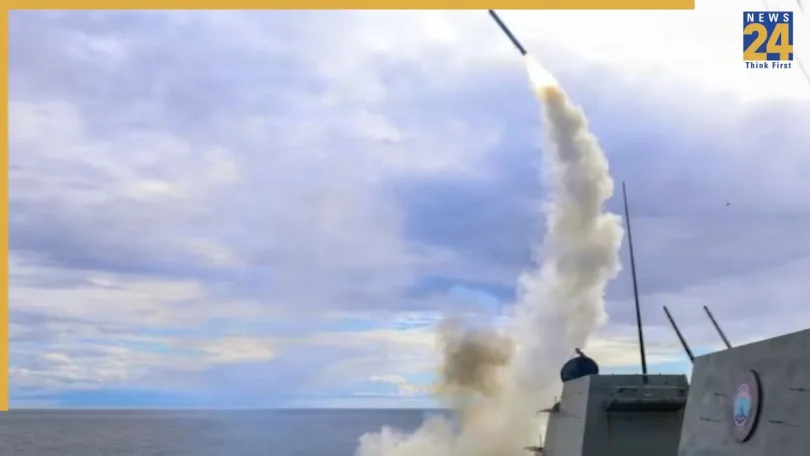
The United States carried out a third wave of military strikes against Iran on Sunday, just hours after Tehran announced the renewed closure of the Strait of Hormuz following an incident involving a commercial vessel.
The latest military operation marks a significant escalation in tensions between Washington and Tehran and further strains the already fragile ceasefire agreement reached between the two sides last month.
Iran said it decided to close the strategic waterway after a commercial vessel travelling through what it described as an ‘unauthorised route’ was met with warning shots.
The US had previously warned that any fresh attacks on commercial shipping in the region would prompt a military response.
US targets Iran’s anti-ship military infrastructure
According to Axios, citing a US official, the strikes focused on key components of Iran’s anti-ship military network.

The reported targets included air surveillance radar systems, missile and drone storage facilities, missile and drone launch sites, surface surveillance radars and surface-to-air missile launchers.
US officials said the objective was to strike every major layer of Iran’s anti-ship capabilities. The operation reportedly targeted systems responsible for detecting ships, storing missiles and drones, launching attacks, and protecting those military assets through air defence networks.
The latest operation marks the third round of US strikes this week and follows the Islamic Revolutionary Guard Corps’ (IRGC) attack on a commercial vessel and its subsequent announcement declaring the Strait of Hormuz closed.
Explosions reported across Southern Iran
According to reports, the strikes affected multiple locations stretching from Asaluyeh to Bushehr, while unconfirmed reports also indicated air defence activity over Tehran.
At least ten major explosions were reported in Bandar-e-Jask. US strikes were also reported in Asaluyeh and Bushehr in southern Iran.
Read More: Iran-US war escalates: Tehran shuts Strait of Hormuz again after…, global trade at risk, know how it will impact the world?
Asaluyeh is regarded as the main onshore hub of the South Pars gas field, one of the country’s most significant energy assets.
The strikes came shortly after the IRGC Navy targeted a commercial vessel, declared the Strait of Hormuz closed and challenged the United States to respond.
Before the latest military operation, US officials had warned that further attacks on commercial ships would lead to retaliation, saying, ‘If they keep on shooting at ships… we’re going to hit ’em back.’
Strait of Hormuz remains the flashpoint
The latest escalation began after Iran once again announced the closure of the Strait of Hormuz following the commercial vessel incident.
The Strait of Hormuz is one of the world’s most important maritime trade routes and serves as a vital passage for global oil and natural gas shipments.

Senior US officials had earlier stated that discussions aimed at strengthening last month’s ceasefire agreement could not move forward unless shipping through the Strait of Hormuz remained secure.
Washington had also expected Tehran to publicly reaffirm that international vessels would continue to move safely through the waterway. Instead, Iran announced that the strait would remain closed until further notice.
Oman continues diplomatic efforts
Despite the renewed military confrontation, diplomatic engagement remains underway.
According to reports, Iranian Foreign Minister Abbas Araghchi is returning to Iran carrying a proposal from Oman intended to help manage maritime traffic through the Strait of Hormuz.
The proposal reportedly recommends dividing the waterway into two separately managed shipping corridors.

Under the suggested arrangement, the southern route would remain open to international commercial shipping, while vessels using the northern corridor would require approval from Iranian authorities. However, ships would not be required to pay any transit fee.
The proposal comes as both countries continue balancing military operations with ongoing diplomatic efforts to ease tensions.
First published on: Jul 12, 2026 10:25 AM IST
Get Breaking News First and Latest Updates from India and around the world on News24. Follow News24 on Facebook, Twitter.
End of Article
Related Story


