
The United States intensified its strikes targeting Iran early on Thursday, hitting targets further north as American forces also fired into a ship it accused of trying to break its naval blockade on the Islamic Republic.
Iran retaliated with missile and drone fire targeting Bahrain, Jordan and Kuwait before dawn.
Days of back-and-forth strikes by the US and Iran across the Middle East — and renewed threats to the Strait of Hormuz — have shredded the interim deal to end the Iran war and could tip the region back into all-out war.
Already, Iranian officials say US strikes have killed more than 35 people and wounded over 300 others.
Strikes also reached into areas around Iran’s capital, Tehran, for the first time during this latest round of violence.
When the US and Israel launched the war on Iran on February 28, Tehran effectively closed the strait to shipping traffic, a move that sent the price of oil, fertiliser and many other goods soaring far beyond the region and gave Iran major leverage in negotiations.
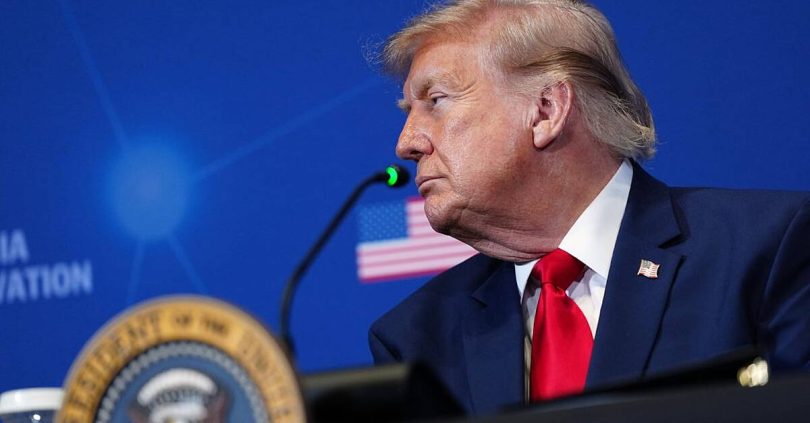
Those rising prices pose a particular challenge to US President Donald Trump and his Republican Party, which hopes to retain control of Congress in elections in November.
But Washington has struggled to successfully reopen the waterway, leading to Trump reimposing the naval blockade on Wednesday.
Iran’s parliament speaker and lead negotiator, Mohammad Bagher Qalibaf, said Iran was prepared for a fuller military confrontation if the US does not live up to the terms of the interim deal, and Iran’s paramilitary Revolutionary Guard threatened to halt all energy exports from the Middle East over the blockade.
“The export of oil and gas from the region will be either for everyone or for no one,” the Guard said.
Mr Trump again insisted Iran was ready to strike a peace deal, but he did not elaborate.
“They don’t like what we’re doing, and they do want to settle. We’ll find out whether or not we settle with them, or we just finish it off,” he said on Wednesday at the US Army War College in Pennsylvania.
Mr Trump separately said on social media that Tehran made a goodwill gesture by releasing an American citizen wrongly detained in Iran since 2024.
He did not release further details.
Human rights lawyer Jared Genser released a statement identifying the detainee as his client Dena Karari, a US-Iranian citizen who runs a non-profit and was charged with espionage.
Iran did not immediately acknowledge the release and her case was not publicly known, as is sometimes the case with detentions in the Islamic Republic.
The US strikes early on Thursday hit around Tehran, state media reported.
It also reported that American attacks targeted Semnan province, home to Iran’s ballistic missile production and space program.
On Wednesday, the US resumed striking Iran during daylight, further showing the increasing tempo of the attacks.
An attack on Greater Tunb Island, a strategic point in the Strait of Hormuz, targeted Iranian defence and missile sites, Central Command said.
Meanwhile, the US military said it opened fire on the Curacao-flagged oil tanker Belma sailing toward Kharg Island, Iran’s main oil export terminal in the Persian Gulf.

After the ship “ignored multiple warnings,” a US aircraft disabled the merchant vessel by firing a missile into the ship’s smokestack.
Another American strike on Wednesday targeted a barracks for Iran’s 388th Mechanised Infantry Brigade, which operates tanks and armoured vehicles, in Sistan and Baluchestan province, Iranian state television reported.
The report said Americans fired at least 13 missiles in the attack and the seven dead included conscripts and career soldiers.
A number of troops were wounded.
Iran retaliated on Thursday with missile and drone attacks on Bahrain, Jordan and Kuwait, authorities in those countries home to US forces said.
There was no immediate acknowledgement of damage or casualties from the attacks.