
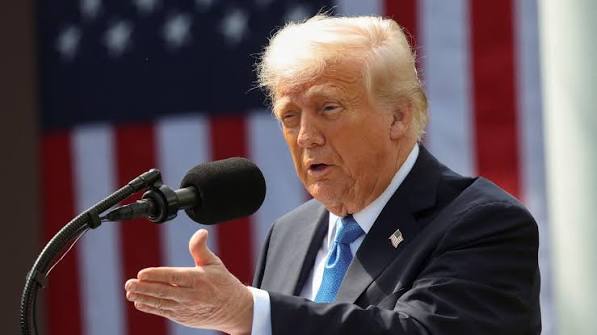
(US President Donald Trump. Photo by BBC)
The administration of US President Donald Trump is reportedly weighing a plan to bar pregnant women from entering the United States, following a Supreme Court ruling that struck down his attempt to end birthright citizenship.
The proposed measure would represent a fresh effort to curb the practice, which the administration says allows foreign nationals to travel to the US late in pregnancy specifically to secure citizenship for their children.
While such travel does occur, experts note it accounts for only a small share of overall births in the country.
The US government does not officially track how many babies are born to foreign visitors, though estimates put the figure at somewhere between 20,000 and 26,000 annually.
The administration has argued that birthright citizenship, a constitutional principle granting citizenship to anyone born on US soil, incentivises illegal immigration and unfairly benefits those who bypass immigration laws ahead of people who follow proper channels.
Senior presidential adviser Stephen Miller said the White House would give serious consideration to barring pregnant foreign nationals from travelling to the US.
The White House Deputy Chief of Staff for Policy and Homeland Security said greater scrutiny was needed over who is allowed into the country, even temporarily, given the potential for so-called birth tourism.
He explained that a woman travelling to the US while heavily pregnant could, within weeks, become the mother of a US citizen for life, granting that child lasting access to American benefits and support, and said this was an issue requiring closer examination.
Following Tuesday’s ruling, White House spokesperson Abigail Jackson said the president remained firmly committed to protecting the significance of natural-born American citizenship and had directed Congress to act swiftly on the matter.
She added that the Department of Justice would prioritise investigations into birth tourism schemes, noting that the administration had multiple tools at its disposal to protect American citizenship.
Homeland Security chief Markwayne Mullin also indicated that restrictions on pregnant travellers were being considered.
Speaking on a television interview, he explained that some visitors obtain tourist visas simply to give birth in the US or its territories, often arriving in the final weeks of pregnancy.
He raised concerns that children born this way could later be raised abroad under different political systems before returning to the US, including for university education, which he described as a national security concern tied in some cases to intellectual property theft.
The Supreme Court ruling overturned Trump’s Day One executive order, which had sought to deny automatic citizenship to children born to parents residing in the US illegally or on a temporary basis.
In a 6-3 decision, the divided court found that denying automatic citizenship to those born on US soil was unconstitutional and breached the 14th Amendment, marking the first major legal test of that amendment in over a hundred years as Trump attempted to use executive power to redefine American citizenship.