
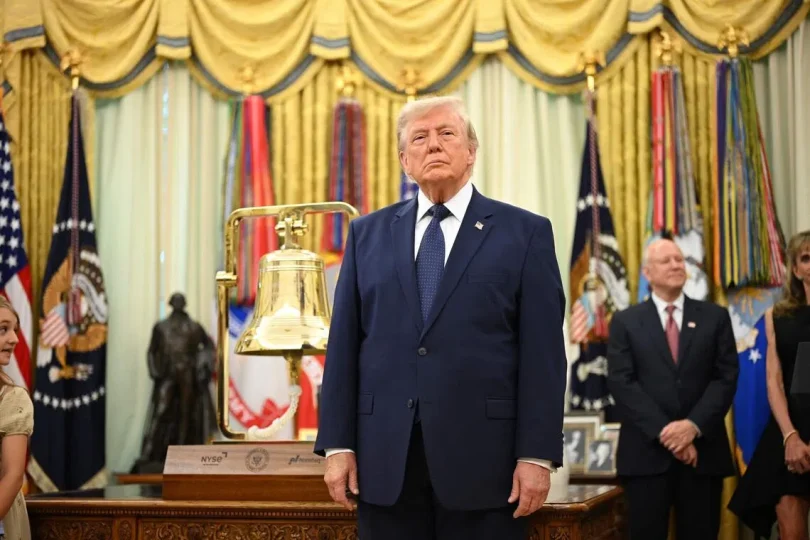
PHILADELPHIA – For the first time in the history of the US stockmarket, the opening bell was rung inside the Oval Office as President Donald Trump celebrated the launch of the ‘Trump Accounts’ on July 6.
Along with the pathbreaking plan enabling newborns to invest, the president was also flagging off a venture that he hopes will pay some political dividends.
Children 18 and under are eligible to sign up for the Trump accounts that are expected to grow over time and turn into retirement accounts when children reach adulthood.
Under the scheme, any child born during Trump’s second term automatically receives US$1,000 from the government once the account is opened. Family and employers can contribute up to US$5000 a year. Six million children are already enrolled.
In addition, some 25 million children ages 10 and under are eligible for US$250 in seed money provided through a US$6.25 (S$8.4) billion donation from tech billionaire Michael Dell if they live in an area where the median income is below US$150,000. Memory chips maker Micron is giving US$250 million while SpaceX is said to be in discussions to donate stock.
A number of companies have announced that they will match the US$1,000 government deposit for the children of their employees. Several philanthropists are also chipping in with money for certain qualifying families.
The money will be invested in US stock funds and the government projects that it could grow to US$6,000 by age 18 and US$243,000 by age 55, if there are no further contributions on top of the initial US$1,000 government deposit.
With an additional US$5,000 contribution each year, the accounts could accumulate US$271,000 by age 18 and US$13 million by age 55.
The growth is predicated on the S&P 500 historical annual average return of over 10 per cent.
Once they cross 18, the beneficiaries can use the money, without penalties, for specific major life milestones, like higher education, down payment on a first-time home purchase or invest in a small business. Early withdrawals before age 59 and a half may be subject to a 10 per cent penalty.
Republicans hope that the Trump Accounts, funded through tax revenues and part of the One Big Beautiful Bill Act which they passed with no support from the Democrats, will better their prospects at the fast approaching Nov 3 midterm elections.
They have pitched the plan as a way to give “every child a stake in the American Dream” and address criticism that the working class does not benefit from Wall Street’s gains.
The Democrats have criticised the accounts as a distraction from the steep cuts to social safety nets, pointing out that millions of families have lost access to health insurance and to food stamps under the same law.
Another critique is that because rich families are far more likely to save the maximum US$5,000 a year in the accounts, they are likely to widen the wealth inequality.
And while the six million children enrolled seems like a high figure, it makes up less than 10 per cent of the total eligible population under age 18, indicating there may be low awareness or trust of the scheme. “Some have been turned off by the name and its affiliation with President Trump,” the New York Times reported.
That polarised view of Trump is a central concern for his party, which currently holds narrow majorities in both houses of Congress. His approval rating stands around 40 per cent, according to an average of recent polls compiled by Real Clear Politics.
Most opinion polls also show that Americans judge him particularly poorly for his handling of the economy, a key lens through which voters judge the incumbent.
With the possibility that a Democratic victory could lead to a swift impeachment push, Trump is losing no time in trying to soften the worst blows felt by the American households – the rising cost of petrol and groceries.
Corporate America has been roped in to advance his quest.
The country’s largest grocer Walmart has agreed to lower prices on a slew of products at the administration’s request, Trump announced on July 6, calling it a “truly patriotic company that loves America”.
Walmart will drop the price of a pound of ground beef by “almost 15 per cent,” Trump tweeted, asking other retailers to follow the lead. Walmart confirmed it dropped the price of ground beef by about 12 per cent and said that it’s lowering prices for other products, but made no mention of Trump’s request.
Trump is also trying to rectify the other pain point in the car-dependent country – petrol prices, which rose sharply in the aftermath of the Iran war launched on Feb 28.
Prices are dropping too slowly, Trump has complained and demanded that they should fall to US$2.25 – $2.50 per gallon to match the fall in crude oil prices after the June 14 truce in the war. His Justice Department has launched investigations into whether oil companies are intentionally inflating prices.
Gas prices will return to record lows seen “before our very successful ‘excursion’ in Iran,” Trump has said. But experts do not rule out a return to higher prices given the tentative progress in peace negotiations.
The paused war is still darkly regarded, recent polls show most Americans say it was not worth the cost.
Trump is also trying to rectify the other pain point in the car-dependent country – petrol prices, which rose sharply in the aftermath of the Iran war launched on Feb 28.
PHOTO: BLOOMBERG
Trump, meanwhile, is moving on to another foreign policy triumph. He is preparing to declare victory, at the July 7-8 Nato summit, in his campaign to make European allies spend more for their own defence. Under his direct pressure, NATO allies agreed to ramp up defence commitments towards 5 per cent of their gross domestic product over the next decade.
Voter reaction to this approach is split along party lines. The Republicans tend to see it as a highly successful exercise in America First foreign policy and proof that his confrontational approach works where conventional diplomacy failed.
Most Democratic and moderate voters view his transactional “burden-sharing” push with concern that it is resulting in a strain or even a permanent rupture in America’s traditional partnerships.
Four months before the midterms, it is not clear that Trump’s efforts will be enough to stave off midterm blues.
Luckily for the Republicans, voters also do not appear to like the Democratic Party. A Pew survey in May 2026 showed that 58 per cent of US adults have an unfavorable view of the Republican Party while a nearly identical share (59 per cent) regard the Democratic Party dimly.
The historical trend favours the Democrats, however. The party of the president almost always loses in midterm elections.