
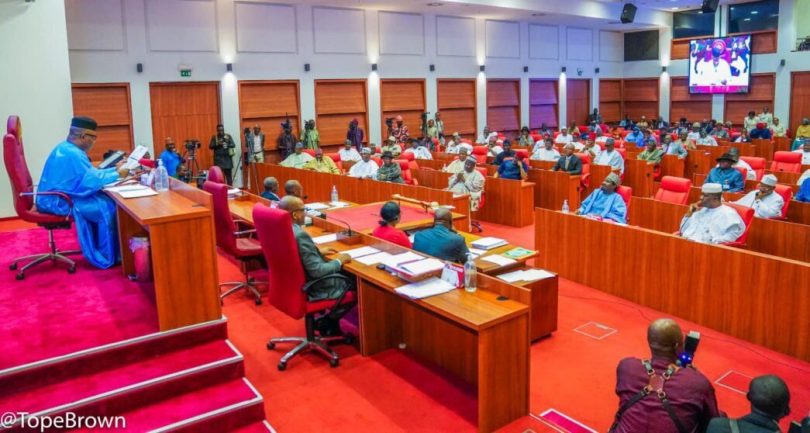
External auditors of the Nigerian National Petroleum Company Limited (NNPC Ltd.) have been given one week to provide a detailed breakdown of over N210 trillion recorded in the company’s audited financial statements but which lawmakers said remained unexplained.
The Ultimatum was given on Wednesday by the Senator Ibrahim Dankwambo-led Senate Committee on Public Accounts.
The controversy centred on two major balance sheet entries in the audited financial statements approximately ₦107 trillion classified as receivables and ₦103 trillion recorded as payables that Senators said had not been adequately explained despite repeated engagements with the national oil company.
Trouble started on Wednesday when questions were asked that the Company should provide the detailed schedules supporting the figures and this point, representatives of the external audit firm informed the committee that the documents formed part of their working papers and requested additional time, saying they might need about two weeks to retrieve them.
At this point, members of the Committee raised objection to the points made.
On his part, Senator Ibrahim Dankwambo who asked why the auditors were unable to produce documents backing figures they had already certified, said, “When you have figures in the financial statements, there must be supporting schedules showing how those figures were arrived at. If you already have them in your working papers, why do you need to go back before presenting them to this committee?”
READ RELATED NEWS
Senate Declines PFIPC Budget Investigation
Senate to meet Tinubu as killings of retired military officers trigger alarm
According to the auditors, under professional practice, NNPC Ltd. remained their principal and that explanations relating to the figures should ordinarily come from the company, just as they recalled that during an earlier appearance before the committee, it had been agreed that NNPC officials would provide explanations on the figures contained in the accounts.
That position, however, was rejected by members of the committee.
On his part, Senator Abdul Ningi, Bauchi Central who cited Sections 88 and 89 of the 1999 Constitution (as amended), explained that the National Assembly has extensive investigative powers to summon any individual or organisation and compel the production of documents relevant to an investigation.
Ningi said, “The Constitution empowers this committee to invite any person and request any document necessary for our investigation. You are before this committee as independent auditors. Do not tell us you must first seek permission from your client before complying with the lawful request of Parliament.”
Lawmakers stood their ground that auditors were appearing before the committee in their own capacity and were individually responsible for defending the audit opinions they had issued on the NNPC financial statements.
At this point, Senator Adams Oshiomhole, APC, Edo North who reminded the auditors that the figures currently generating nationwide public concern originated from the audit work they had carried out,
Senator Oshiomhole argued that NNPC Ltd., being wholly owned by the Federal Government on behalf of Nigerians, could not rely on commercial secrecy to deny Parliament information required for constitutional oversight.
He said, “NNPC is not a private family business. It belongs to the Nigerian people. We represent those people, and we are entitled to know how every kobo is accounted for.
“There can be no secrecy between an auditor and a wholly government-owned company when Parliament is carrying out a constitutional investigation.”
Senator Babangida Useni added that neither professional ethics nor confidentiality agreements could override the investigative powers vested in the National Assembly.
He further reminded the auditors that the committee’s Standing Orders expressly empower it to summon any person, demand documents and examine the accounts of government-owned corporations.
He said, “If you cannot produce the detailed schedules supporting these figures, then it raises serious questions about whether the audit work was actually done. If it was done, the supporting documentation should already exist. We believe 48 hours should even be sufficient, but certainly not an indefinite period.”
The committee also faulted the continued inability of both NNPC Ltd. and its auditors to reconcile the receivables and payables.