
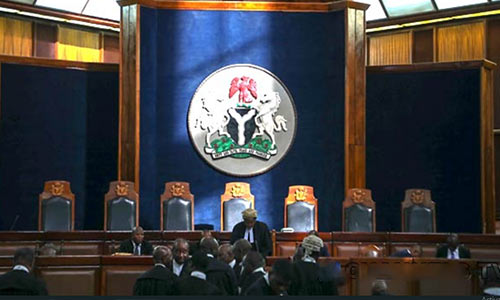
The Supreme Court of Nigeria has established an important principle on the legal status of banks whose licences have been revoked, holding that the mere revocation of a banking licence by the Central Bank of Nigeria does not, by itself, bring the life or legal existence of the bank to an end, that a bank whose licence has been revoked remains a juristic person competent to sue and be sued, and that it is only upon the making of a winding-up order by a court that the bank ceases to exist as a juristic person.
The decision was delivered in the case of Oredola Okeya Trading Co. & Anor v. Bank of Credit and Commerce International & Anor (In Re: Amolegbe), by a five-member panel comprising Justices Muhammed, Fabiyi, Peter-Odili, Ariwoola, and Muhammad, JJ.SC.
The ruling arose from a Motion on Notice filed by Mr Sakiru Amolegbe seeking to substitute two parties in a pending appeal: the late Alhaji Yesufu Alabi Amolegbe (the deceased 2nd Appellant) with himself as successor in interest, and the Bank of Credit and Commerce International (BCCI) (the 1st Respondent) with the Nigeria Deposit Insurance Corporation (NDIC).
The Facts
The Bank of Credit and Commerce International (BCCI) was, until July 1991, affiliated with Bank of Credit and Commerce International (Holdings) Luxembourg S.A. Following the liquidation of its parent company, the bank changed its name to African International Bank Limited (AIB) and continued banking operations until sometime before 2005, when it eventually ceased operations. Its banking licence was subsequently revoked by the Central Bank of Nigeria.
A dispute involving the bank had progressed through the High Court and the Court of Appeal and was pending before the Supreme Court when the applicant filed the motion seeking substitution. The application was filed in June 2013, more than two decades after the 1st Respondent had ceased banking operations.
The Arguments
The applicant’s counsel argued that since the banking licence of the 1st Respondent had been revoked, the NDIC, by operation of the applicable statutory provisions, became the provisional liquidator of the bank and assumed responsibility for managing its affairs, including defending legal proceedings. Counsel submitted that the NDIC should therefore be substituted for the 1st Respondent to enable the appeal to proceed to a just and final determination.
The 2nd Respondent’s counsel opposed the application on multiple grounds. First, that the application was filed after “an inordinate and unexplained delay” of more than two decades. Second, that no application for substitution had been made before the trial court or the Court of Appeal despite the 1st Respondent having been continuously represented by counsel throughout the proceedings. Third, and most critically, that the revocation of a company’s banking licence does not extinguish its legal personality, and a company remains a juristic person until it is formally dissolved in accordance with the law.
Counsel for the 2nd Respondent further argued that the NDIC’s role is merely that of a statutory liquidator acting on behalf of the company in liquidation, not a body that assumes the bank’s liabilities or automatically becomes a substitute party in pending proceedings.
The 2nd Respondent also contended that if any substitution was required, it should properly have been AIB, being the corporate entity in liquidation, rather than the NDIC.
The Supreme Court’s Decision
The Supreme Court resolved the issue in favour of the 2nd Respondent, establishing several important principles on the legal status of banks whose licences have been revoked.
Licence Revocation Does Not Equal Corporate Death
The court held that the mere revocation of a bank’s licence by the Central Bank of Nigeria does not, by itself, bring the life or legal existence of the bank to an end.
This principle draws a clear distinction between regulatory authorisation and corporate existence. A banking licence is the regulatory permission granted to a corporate entity to carry on banking business. Its revocation means the entity can no longer conduct banking operations. But the entity itself, the company incorporated under the Companies and Allied Matters Act, does not cease to exist simply because it has lost its licence to carry on a particular type of business.
The company was brought into existence by incorporation. It can only be brought to an end by a formal winding-up order made by a court pursuant to the applicable statutory provisions. Between the revocation of the licence and the making of a winding-up order, the company continues to exist as a legal person with all the attributes of corporate personality, including the capacity to own property, to enter into contracts, to sue, and to be sued.
Cessation of Operations Does Not Extinguish Personality
The court further explained that the cessation of banking operations or the closure of a bank’s business does not extinguish its corporate personality.
This principle addresses a common misconception. Many people assume that when a bank closes its doors, shuts its branches, and stops transacting business, it has ceased to exist. The Supreme Court held that this is not the case. A bank that has closed its business and has had its licence revoked is no longer authorised to carry on banking business, but it retains its legal existence. It remains a juristic person. It can still be sued for pre-existing obligations. It can still institute proceedings to recover debts owed to it. It remains subject to the jurisdiction of the courts.