
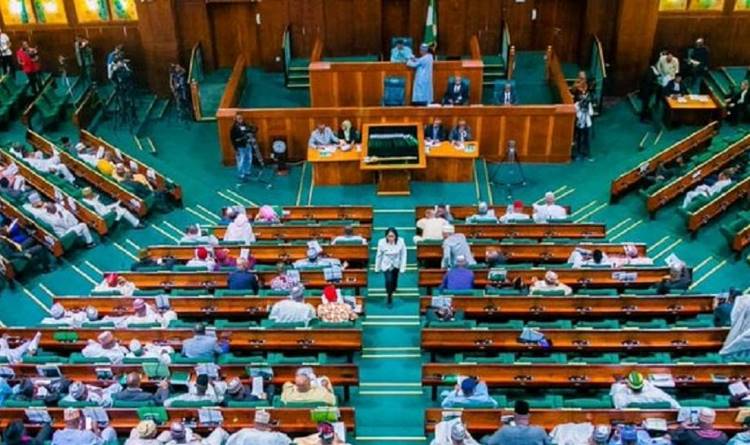
The house of representatives on Wednesday rejected a proposal to summon President Bola Tinubu to explain the alleged suspension of funding for constituency projects, opting instead to direct relevant government agencies to address delays in the release of budgeted funds.
The decision followed a heated debate during plenary over the implementation of the 2026 Appropriation Act, after lawmakers expressed concern over slow releases of capital funds to Ministries, Departments and Agencies (MDAs).
The controversy began when the lawmaker representing Okpe/Sapele/Uvwie Federal Constituency of Delta State, Benedict Etanabene, drew the attention of the House to a circular reportedly issued by the Office of the Accountant-General of the Federation suspending payments for zonal intervention, popularly known as constituency projects, pending fresh verification requirements.
Urging the House to invoke its oversight powers, Etanabene called for President Tinubu and members of his economic management team to appear before lawmakers to explain the development.
“I want to urge this House to agree that we summon President of the Federal Republic of Nigeria together with his financial team to please come to this House to brief Nigerians exactly what is happening because the stories are not complimentary at all,” he said.
He lamented that lawmakers were unable to explain the funding delays to their constituents, adding, “Presently, in Nigeria today, we are implementing 2024, 2025 and 2026 budgets running concurrently. This is not in the best interest of everybody.”
The proposal sparked sharp exchanges across the chamber as members shouted from opposing sides during the debate.
Leading the substantive motion, the member representing Aba North/Aba South Federal Constituency of Abia State, Alex Ikwechegh, argued that the effectiveness of the appropriation process depended not only on passing the budget but also on the prompt release of approved funds.
“The powers of appropriation in the national assembly, and the credibility of the budget rests not only on the size of the figures appropriated, but on the fidelity and timeliness with which appropriation funds are released, cash-backed and utilised for ministries, departments and agencies,” Ikwechegh said.
He disclosed that during the 2026 budget defence sessions, several ministers and heads of MDAs informed lawmakers that many agencies received little or no capital releases under the 2025 budget, despite approved allocations.
Ikwechegh also recalled President Tinubu’s earlier directive approving the immediate settlement of verified contractor liabilities estimated at about ₦1.5 trillion through an inter-ministerial committee established to harmonise records and facilitate payment.
According to him, the slow release of funds has continued to stall critical infrastructure projects and worsen the financial burden on contractors.
He further criticised a Treasury circular dated June 29, 2026, issued by the office of the accountant-general of the Federation, which introduced a requirement for contractors handling constituency projects to obtain a Certificate of Verification and Compliance from the Federal Ministry of Special Duties and Intergovernmental Affairs before payments could be processed.
He warned that the additional requirement could create fresh bureaucratic bottlenecks and further delay project execution nationwide.
However, Speaker Tajudeen Abbas ruled Etanabene’s request to summon the President out of order, maintaining that it fell outside the scope of the motion before the House and did not comply with parliamentary procedure.
Following the ruling, the House adopted the substantive motion and urged the federal ministry of finance, the Budget Office of the Federation, the Office of the Accountant-General of the Federation and the Central Bank of Nigeria to prioritise the timely release and cash-backing of funds appropriated in the 2026 budget.
Lawmakers also demanded a clear timetable for the release of capital funds and called for the speedy settlement of verified contractor liabilities.
In addition, the House asked the Office of the Accountant-General to review the June 29 Treasury circular and align it with the President’s directive to prevent further delays in the execution of constituency projects.
To strengthen legislative oversight, Speaker Abbas constituted a 12-member ad hoc committee headed by the Chairman of the House Committee on Appropriations, Abubakar Bichi, with a mandate to engage relevant fiscal authorities and submit its findings to the House within four weeks.