
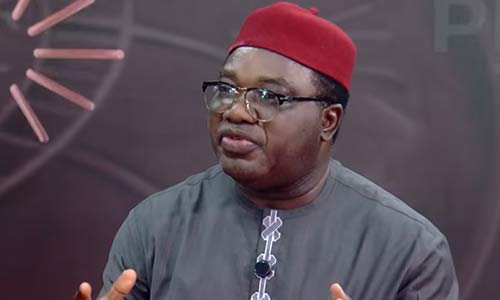
The Executive Secretary of the National Human Rights Commission, Chief Tony Ojukwu, SAN, has described Peter Obi’s statement that he may not be alive to contest the 2027 presidential election as deeply worrisome, warning that Nigeria’s civic space is shrinking as political tension rises ahead of the polls.
Ojukwu, who spoke during an interview on ARISE News, said the Commission had begun considering an appropriate response immediately after learning of the former Anambra State governor’s statement.
He said the right of opposition figures to operate freely, canvass for support and participate in the political process without intimidation was a legitimate democratic right that must be protected.
“When I read that news and listened to it, I had to call my team and ask, ‘What should be our response to this?’ The issue of the opposition being able to have space to do their bit is a legitimate right,” he said.
According to him, Obi’s statement must be viewed against growing concerns about freedom of expression, political participation and the gradual restriction of civic space as the country moves closer to another general election.
“The statement made by Peter Obi is a very worrisome statement, and every person who means well for this country should take it seriously,” Ojukwu said.
Ojukwu said the Commission did not necessarily have to wait for a formal petition before responding to a matter of national human rights concern.
He disclosed that the NHRC was considering issuing an advisory to the government and other political actors on the need to create an open and secure environment in which every prospective candidate could undertake political activities without fear.
He, however, distinguished between issuing a general advisory and commencing a detailed investigation into Obi’s specific allegations.
According to him, Obi had made the statement publicly but had not lodged a formal complaint with the Commission or provided it with details that could form the basis of an investigation.
Ojukwu said the Commission would investigate if Obi formally approached it, adding that the level of response triggered by a public statement differed from what would follow a direct complaint.
“He has not complained to us. He has complained to every Nigerian. Our approach to a case like this is to issue an advisory both to the government and the players on how to ensure that, going forward, there is free space for everybody to do their politicking without fear,” he explained.
He added that the Commission would have to consider whether Obi’s experience formed part of a broader pattern of shrinking civic space and restrictions confronting opposition politicians.
Ojukwu said Obi had alleged that his businesses were being targeted and had referred to an incident involving his vehicle at an airport, but maintained that further particulars would be required for a specific investigation.
“If he complains to us, we will investigate,” he said.
The NHRC chief maintained that the Commission was sufficiently independent and empowered to investigate allegations involving powerful state actors where evidence justified such action.
He cited the Commission’s investigation into allegations by Reuters concerning the Nigerian military in the North-East, saying senior military officers appeared before the investigative panel and gave evidence.
According to him, the Commission eventually concluded that the allegations were not substantiated, demonstrating its willingness to investigate sensitive matters involving major state institutions.
Speaking on the NHRC’s human rights situation dashboard, which recorded more than 326,000 complaints in one month, Ojukwu described the number of reported violations as alarming.
Violations of the right to life reportedly topped the complaints recorded during the period.