
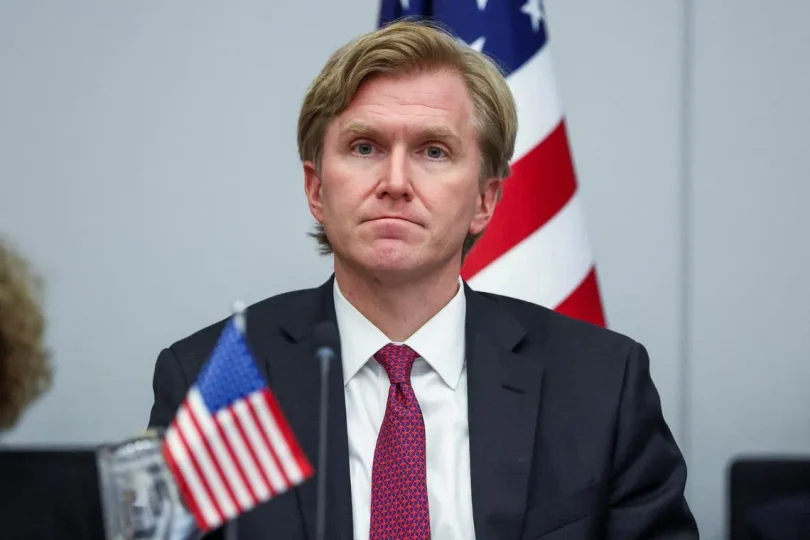
WASHINGTON – President Donald Trump’s administration sought on July 8 to rally Latin American nations behind a revamped Monroe Doctrine, the 19th-century policy asserting US primacy across the Americas that critics associate with decades of US intervention.
Invoking the so-called “Donroe Doctrine” – a play on Trump’s name – in the Peruvian city of Cusco, Pentagon policy chief Elbridge Colby explained a dramatic policy shift in which the US military started striking drug boats in the fall and deposed Venezuelan president Nicolas Maduro in January.
The Pentagon is also planning to carry out joint counter-narcotics strikes with like-minded countries, a policy already under way in Ecuador.
“No longer do we separate America’s defence strategy from the concerns of regular Americans – from the flood of lethal drugs into their communities and the accompanying horrendous violence, or from the impact of unchecked illegal migration into our nation,” Colby said, according to prepared remarks.
US says new doctrine is about empowering others
Colby acknowledged concerns over Trump’s invocation of the Monroe Doctrine, but said these were based on a “distorted” view.
“The best tradition of the Monroe Doctrine is about protecting our own security and interests by empowering and enabling Latin American nations,” Colby said, addressing the Conference of Defence Ministers of the Americas, which also includes Canada.
Critics say the US rhetoric represents modern-day imperialism. But Colby said the US cannot be compared to imperial states like Britain or Portugal – smaller nations that exploited colonies to accumulate wealth and power.
“The fact is that America doesn’t need your assets or your dependency,” Colby said.
“America is an enormous country, by far the world’s most powerful state, with the world’s largest and most dynamic market, its most productive economy, its dominant currency, splendid stores of raw materials.”
He later added: “We seek your success in securing our neighbourhood.”
His speech comes as elections usher in right-wing, pro-Trump governments across the region.
That includes conservative Keiko Fujimori in Peru and Abelardo de la Espriella in Colombia.
These join Argentina, Chile, Ecuador, Bolivia and Panama in moving rightward in a stark reversal of the “pink tide” that brought several leftist governments to power in the early 2020s.
Across the region, once-fringe hard-right candidates have gained traction by promising crackdowns.
Trump favours right-wing leaders in Latin America
In Colombia, the United States had imposed sanctions on leftist president Gustavo Petro, accusing him of failing to curb the drug trade.
His successor, De la Espriella, has vowed to join Trump’s Shield of the Americas, crack down on drug traffickers, ease business regulations, lower taxes and revive oil and gas projects halted under Petro.
Trump has urged like-minded governments to fight China’s growing influence in Latin America. They include Panama with its strategic canal, which Trump has threatened to take back by force if necessary.
Colby urged Latin American nations to “protect your critical assets” from external actors, presumably referring to China.
Echoing US demands of European and Asian allies, Colby also urged Latin American nations to invest more in defence, adding that some allocate less than 1 per cent of GDP.
“There is no reason why any country, particularly those facing significant narco-terrorist threats, should spend so little on defence,” Colby said. REUTERS