
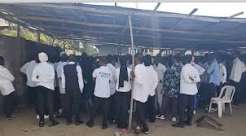
(Students of the fake Lagos University during the raid by NSCDC. Photo Credit: Punch News)
An alleged phony university operating out of a three-bedroom apartment in Ilado, Olorunda Local Council Development Area, Lagos State, was discovered by the Nigeria Security and Civil Defense Corps, NSCDC, Badagry Area Command, and 106 young people who were reportedly tricked into the scheme were saved.
The suspected owner of the institution, which allegedly recruited young people from various parts of Nigeria and neighboring West African countries with promises of admission to a foreign university, was also detained by the Corps.
The operation, carried out in the early hours of Monday after days of intelligence gathering and covert surveillance, exposed what security officials described as an alleged fraudulent academic and recruitment scheme.
The youths, mostly aged between 19 and 24, were taken into protective custody by the Nigeria Security and Civil Defence Corps (NSCDC) for profiling and further investigation.
Speaking on the development, the Badagry Area Commander of the NSCDC, Chief Superintendent Gbenga Ekunola, said the operation followed credible intelligence received by the command regarding activities at the apartment, explaining that officers had monitored the location for days before moving in.
He said the proprietor had been arrested and was assisting with investigations, while the students had been taken into protective custody.
Investigations, however, revealed that the alleged institution had no official name, signboard, registration or known campus, and was reportedly being operated from a rented apartment while presenting itself online as a distance learning centre affiliated with a foreign university.
The youths reportedly came from different parts of Nigeria, including Kogi, Oyo and several northern states, while others travelled from Niger, Cameroon and Togo after allegedly being recruited online.
Preliminary investigations indicated that unsuspecting young people were allegedly persuaded to pay admission and processing fees after being promised placement in a foreign tertiary institution.
The victims reportedly paid between N200,000 and N1.5 million, while some foreign nationals and other participants allegedly paid between $400 and $500.
The alleged admission scheme reportedly came with a recruitment condition, with participants encouraged to bring in more people in exchange for commissions, operating in a manner similar to a chain marketing or Ponzi arrangement, where participants were promised increasing financial rewards based on the number of new students they recruited.
One of the victims reportedly told investigators that after paying $400, he persuaded his brother in Kogi State to enrol and had already begun receiving commissions from referrals.
The NSCDC also uncovered another dimension to the alleged operation, noting that some of the youths were reportedly involved in promoting unidentified products online while earning percentages from sales and recruitment.
Ekunola expressed concern that several parents were unaware of the real reason behind their children’s presence in Badagry, disclosing that the command had begun contacting affected families, with one parent reportedly informed by her child that he had travelled to Badagry to learn a trade rather than attend a university, an indication that many parents were completely unaware of what was actually happening.
According to him, the command would profile all the youths involved and work towards reuniting them with their parents and guardians after the necessary investigations, assuring that anyone found culpable in operating the alleged fake institution would be prosecuted according to the law.
The development has raised fresh concerns over the growing activities of fraudulent online admission schemes targeting young people in search of educational opportunities, particularly foreign academic programmes.
The NSCDC is expected to expand its investigation to determine the full extent of the alleged network, identify other collaborators, and establish whether similar operations are being run elsewhere in the country.
For the 106 youths rescued in Ilado, what they allegedly believed would be the beginning of an international academic journey has instead placed them at the centre of a major criminal investigation.