
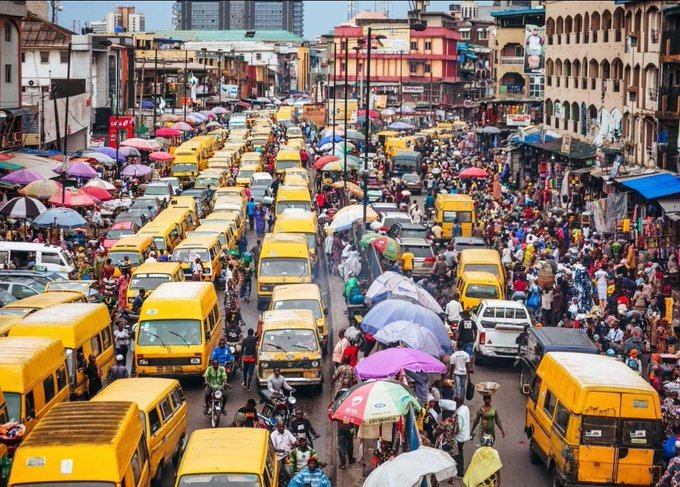
(Nigeria population. Photo by Naija)
With an expected population of 242.4 million in 2026, Nigeria continues to hold the title of most populated country in Africa, according to Worldometer’s most recent demographic predictions.
Nigeria is far ahead of Ethiopia and Egypt, which are the second and third most populated countries in Africa, respectively, according to the most recent data, which confirms Nigeria’s demographic hegemony on the continent.
Experts predict that by 2050, there will be more than 2.5 billion people living in Africa due to the continent’s continued fast population expansion.
High fertility rates, young populations, better healthcare systems, and longer life expectancies in many African nations are the main drivers of the development.
Nigeria’s current population estimate marks a substantial rise from the figure recorded during the country’s last official census in 2006, when the National Population Commission put the population at 140.4 million.
Since that census, no fresh nationwide headcount has been conducted, meaning present-day figures are derived from demographic projections based on birth rates, mortality rates, migration patterns and overall population trends.
World Bank data shows that Nigeria’s annual population growth rate stood at roughly 2.1 per cent in 2025, contributing to the country’s ongoing demographic expansion.
The latest estimate suggests Nigeria gained about 4.9 million people within the past year alone, further widening the gap between it and other African nations.
A defining characteristic of Nigeria’s population is its youthfulness.
With a median age of around 18 years, the country has one of the youngest populations in the world, a factor expected to continue driving economic activity, labour force growth and consumer demand in the years ahead.
Its fertility rate, estimated at about 4.2 children per woman, also remains a major contributor to its rapid population increase.
Demographers say Nigeria’s growing population brings both major opportunities and considerable challenges.
While its expanding youthful workforce could boost productivity, innovation and economic growth if properly supported through investment in education, healthcare, job creation and infrastructure, the rapid growth also continues to strain housing, healthcare, transportation, education, food production and employment.
Ethiopia held on to its position as Africa’s second most populous nation, with an estimated 138.9 million people and an annual growth rate of about 2.53 per cent, translating to an increase of more than 3.4 million people over the past year.
Its large, youthful population continues to underpin the country’s agricultural, manufacturing and infrastructure development efforts.
Egypt ranks third with an estimated 120.1 million people, making it North Africa’s most populous country.
It added about 1.74 million people over the past year, with a growth rate of approximately 1.47 per cent, a comparatively slower pace attributed to ongoing family planning efforts amid rising demand on public services and urban infrastructure.
The Democratic Republic of Congo takes fourth place with an estimated 116.5 million people, recording one of the fastest growth rates among Africa’s largest nations at about 3.21 per cent annually.
Experts note that despite its vast natural resources, the country’s rapid population growth continues to pose significant development challenges, particularly in healthcare, education and infrastructure.
Tanzania occupies fifth position with an estimated 72.6 million people and a growth rate of about 2.86 per cent. Like Nigeria, it has a youthful population with a median age of around 18, a factor expected to sustain labour force growth going forward.
South Africa ranks sixth with an estimated 65.5 million people, recording a comparatively slower growth rate of about 1.09 per cent, reflecting declining fertility rates and shifting population dynamics linked to urbanisation and socioeconomic development.
Kenya follows in seventh place with an estimated 58.6 million people, supported by a steady annual growth rate of about 1.92 per cent.
Its youthful workforce continues to fuel growth in technology, manufacturing, financial services and digital innovation.
Sudan takes eighth position with an estimated 53.3 million people. Despite ongoing political and humanitarian difficulties, it continues to record one of the continent’s fastest growth rates, at roughly 3.14 per cent annually, adding more than 1.6 million people over the past year.
Uganda ranks ninth with an estimated 52.8 million people and one of the youngest populations globally, with a median age of just 17.
Experts say this youthful population holds strong potential for future economic growth provided investments in education, healthcare and employment are sustained.
Rounding out the top 10 is Algeria, with an estimated population of about 48 million and a moderate growth rate of around 1.25 per cent, reflecting demographic patterns similar to other countries across the Mediterranean region.
Analysts believe Africa’s rapidly expanding population will continue to reshape global economic and investment patterns in the coming decades, with its growing labour force, expanding consumer markets and rising urbanisation positioning it as one of the world’s key centres for economic growth.
Nigeria, in particular, is expected to remain central to that transformation given its large population, strategic economic standing and expanding domestic market.
However, experts caution that translating this demographic growth into economic prosperity will depend heavily on effective governance, sustained investment in education and healthcare, infrastructure development, industrialisation, food security and job creation.
With nearly a quarter of a billion people already within its borders, Nigeria’s demographic weight is expected to keep shaping Africa’s economic, political and social landscape for decades to come.