
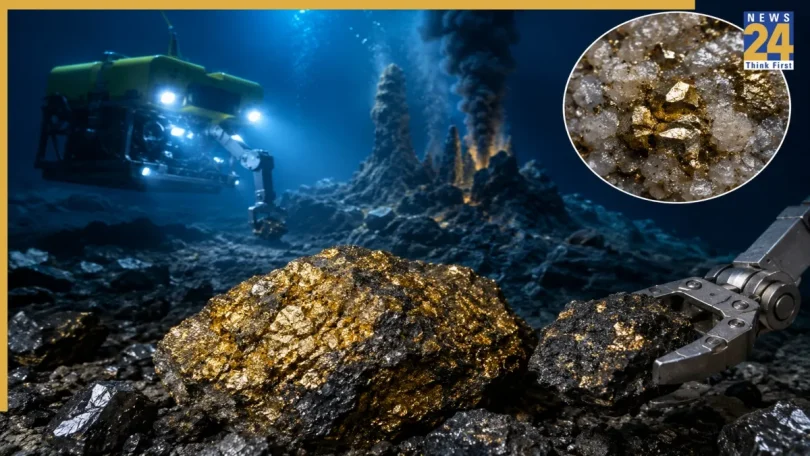
Scientists have uncovered a remarkable hidden source of gold deep beneath the Pacific Ocean, around 360 kilometres from Tokyo, Japan. The discovery was made about 700 metres below the sea surface, where researchers found real gold trapped inside pyrite, commonly known as ‘fool’s gold’.
Unlike traditional gold deposits, this gold is not visible to the naked eye. Instead, it exists at the atomic level within the crystal structure of the rock. The discovery could change how scientists search for gold deposits in the future.
Gold Found Near Underwater Volcanoes
The research was carried out at the Higashi-Aogashima Caldera, an underwater volcanic crater on the seabed. Scientists collected rock samples using robotic submarines operating near active hydrothermal vents.
Laboratory tests revealed that the pyrite rocks contained an unusually high concentration of gold, surprising geologists studying deep-sea mineral deposits.
What Is ‘Fool’s Gold’?
Pyrite is an iron sulphide mineral that closely resembles real gold because of its bright yellow colour and metallic shine. For this reason, it is commonly called “fool’s gold”, as inexperienced people often mistake it for genuine gold. However, this time the mineral lived up to its appearance by hiding real gold inside its crystal structure.
How Scientists Detected the Hidden Gold
Researchers examined the rock samples by drilling tiny holes into them and analysing their composition using secondary ion mass spectrometry, an advanced laboratory technique capable of detecting elements at an atomic level.
The analysis found gold concentrations of up to 1.9 per cent by weight, which is considered exceptionally high for this type of deposit.
Why This Gold Is Different
In conventional gold mines, gold usually appears as visible grains or nuggets. The newly discovered gold is very different. Instead of forming separate particles, the gold atoms are woven directly into the crystal lattice of pyrite, making them invisible without specialised scientific equipment.
The findings, published in a scientific journal, challenge long-held theories about how gold forms in nature.
Underwater Volcanic Activity Created Ideal Conditions
The Higashi-Aogashima Caldera contains three active hydrothermal fields where superheated, mineral-rich fluids rise from beneath the Earth’s crust.
These fluids create sulphide-rich deposits around underwater volcanic vents, often called “black smokers”. Scientists believe these unique geological conditions helped concentrate gold inside the pyrite crystals.
Years of Research Led to the Discovery
Researchers first began studying the area in 2015. Early samples contained an average of 102 parts per million (ppm) of gold, far higher than most other deep-sea deposits, which typically contain between 0.01 and 43 ppm.
For the latest study, scientists collected samples from all active hydrothermal sites and analysed them using mass spectrometry and electron beam imaging to map metals such as arsenic, lead and copper.
Why Arsenic Plays an Important Role
The researchers found that gold was not trapped as tiny particles but incorporated atom by atom into the pyrite crystal. This process occurs when elements such as arsenic, lead and copper alter the crystal structure, creating spaces where gold atoms can fit.
The study also found that higher arsenic levels were linked to higher gold concentrations, suggesting arsenic is a key factor in forming these hidden deposits.
Not Every Rock Contains the Same Amount of Gold
Scientists discovered that gold levels vary depending on where and how the pyrite formed. The richest samples came from the Central Cone hydrothermal site, where hot mineral-rich fluids mixed with cold seawater.
These conditions appear to create the ideal environment for gold-rich pyrite crystals.
Why This Discovery Matters
Researchers believe advanced micro-analytical techniques could help identify valuable gold deposits that were previously overlooked.
By studying the texture and chemical fingerprint of pyrite, scientists may be able to locate new gold-rich regions more accurately, potentially transforming future mineral exploration around the world.
First published on: Jul 15, 2026 09:47 AM IST
Get Breaking News First and Latest Updates from India and around the world on News24. Follow News24 on Facebook, Twitter.
End of Article
Related Story


