
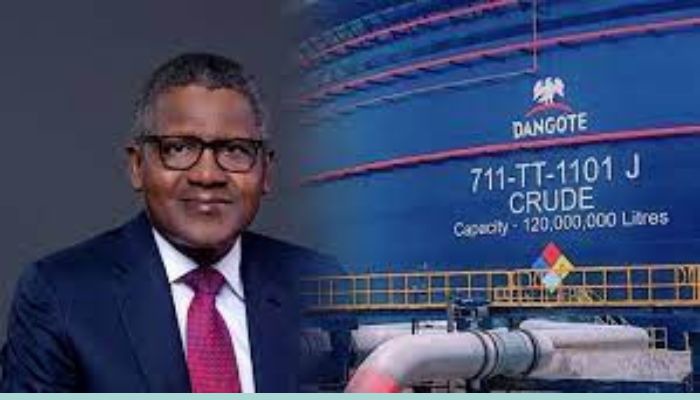
According to a report by The Vanguard on Wednesday, July 22, 2026, the Dangote Petroleum Refinery has explained why it is increasing exports of refined petroleum products even as it continues to supply fuel to the Nigerian market in naira.
According to the company, reduced crude oil allocations under the Federal Government’s naira-for-crude arrangement and difficulty accessing foreign exchange have forced it to rely more on imported crude, making exports necessary to sustain operations. Watch D Video Here ➤
Speaking with Vanguard, the Group Vice President, Oil & Gas at Dangote Industries Limited, Engr. Devakumar Edwin, said the refinery is operating at full production capacity despite the challenges.
“We are operating at full capacity and exporting part of our production because we are receiving very little crude under the naira-for-crude arrangement,” Edwin said.
He further explained that although the refinery continued selling petroleum products in naira to support the local market, it has struggled to convert those earnings into U.S. dollars required to purchase crude oil from international suppliers.
“Although the management took a major risk to support the country by continuing to sell petroleum products in naira, we have been unable to convert those naira proceeds into U.S. dollars.
While dollars are being made available to importers of petroleum products, we have been unable to access the foreign exchange we need,” he added.
The development comes as international crude oil prices continue to rise. Brent crude traded at $89.43 per barrel, while West Texas Intermediate stood at $82.83 per barrel.
Murban crude reached $83.78 per barrel, and the OPEC Basket climbed to $84.17 per barrel. Gasoline futures also recorded gains, reflecting continued global demand for refined products.
Higher crude prices are expected to increase the refinery’s production costs because crude oil remains the largest component of refining expenses.
However, stronger international prices for refined petroleum products are helping to support refining margins despite the rising cost of feedstock.