
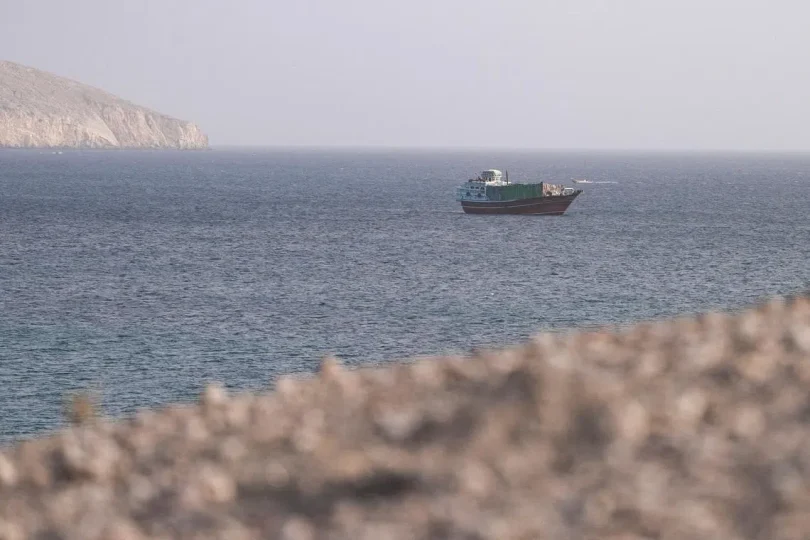
DUBAI – Iran has said the Strait of Hormuz is an inviolable “red line”, and warns that, if US President Donald Trump carries out his threat to attack Iran’s infrastructure, it will strike all infrastructure across the Gulf region.
The United States launched a fifth night of attacks on July 15 and reimposed a naval blockade of Iran’s ports, which Washington says is aimed at reopening the Strait of Hormuz, closed by Iran on July 11 after a fragile truce collapsed.
After the first strikes on the night of July 15, Tehran’s top negotiator, Mohammad Bagher Ghalibaf, issued a statement saying: “We are in an essential and existential war with America”.
Iranian army spokesman Brigadier-General Mohammad Akraminia said on July 16 the Strait of Hormuz, which carried about a fifth of global oil and gas shipments before the war, was a “red line” for Iran over which it maintains firm control.
“The Americans thought that by attacking some of our bases on the southern coasts of the country, they could take control of this strategic strait,” Akraminia said.
“However, the Islamic Republic of Iran has the ability to exert control over the Strait of Hormuz from every single point of its territory, and this matter is never dependent on coasts and islands,” he added.
Three US officials said the US strikes aimed at forcing open the strait are also targeting Iranian military capabilities that the Americans want to destroy before executing more complex operations.
Iran’s army earlier said in reference to the strait: “We will undoubtedly resist until the end and will neutralise American interventions in the region”.
Iran’s military spokesman has said the only way to reopen the Strait of Hormuz is for the US to comply with the 14-point memorandum of understanding that the two sides signed in June, and the implementation of “Iranian regulations” regarding ship traffic in the strait.
Trump threatened on July 14 to hit Iranian power plants and bridges unless Tehran resumes negotiations.
Akraminia said that if Trump carries out the threat, Iran’s armed forces will strike “all remaining infrastructure” across the region, and the response will be more severe, wider in scope and more destructive than previous attacks.
Iran said on July 16 it targeted US bases in Kuwait and Jordan, warning its neighbours that allowing the US to launch attacks against it will not go unanswered.
“Our neighbours should know that providing a base to the Americans and allowing them to fire on Iranian soil is unacceptable and will not go unanswered,” Iran’s army said in a statement.
By early on July 16 in the Middle East, sirens sounded in Bahrain, and Kuwait said it was responding to “hostile drone threats”.
Iran’s army said it targeted the Al Azraq Air Base in Jordan with ballistic missiles, while Iran’s Revolutionary Guards said they destroyed the satellite communications centre and early warning radar at the Ali Al Salem Air Base, as well as a US military pier in the Al Shuaiba area of Kuwait.
Bahrain’s Defence Ministry said Bahrain’s air defence systems intercepted and destroyed a number of Iranian aerial attacks targeting the kingdom on July 16.
The latest escalation and Iran’s threats to shut off more regional energy exports and possibly strike regional infrastructure raise the spectre of a return to full-scale war in the region.
Analysts say Iran has signalled it may use its Houthi allies in Yemen to shut the Bab el-Mandeb gateway to the Red Sea, opening a new front against Washington and putting a second of the world’s most vital energy arteries at risk.
The war has killed thousands of people and displaced millions, mainly in Iran and Lebanon, where conflict restarted between Israel and Iran-backed militant group Hezbollah. REUTERS