
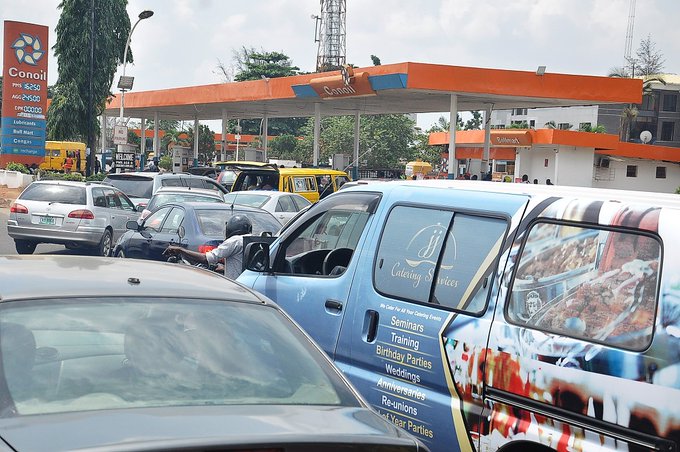
(Motorists queue to buy fuel at a filling station. Photo: Daily Trust)
Nigeria’s downstream petroleum sector may be heading for another showdown as independent fuel marketers have pushed back against the Federal Government’s demand for a cut in pump prices.
The marketers have threatened to shut down filling stations nationwide if the government imposes price controls despite the country’s deregulated fuel market.
The warning followed recent comments by the Minister of State for Petroleum Resources (Oil), Senator Heineken Lokpobiri, that government agencies would not tolerate profiteering by operators even though petrol pricing had been liberalised.
But the National Publicity Secretary of the Independent Petroleum Marketers Association of Nigeria (IPMAN), Chinedu Ukadike, said any attempt to impose price controls would violate the principles of deregulation and force marketers to suspend operations across the country.
“If the government tries to enforce price control, we will shut down our filling stations nationwide.
You cannot operate a deregulated market and at the same time dictate the price marketers should sell their products without considering the cost of purchase,” Ukadike said.
He maintained that marketers were not exploiting Nigerians but were instead grappling with mounting financial losses arising from frequent downward adjustments in depot prices, particularly by the Dangote Refinery.
According to him, many marketers purchase products at higher rates with bank financing, only for depot prices to decline before their existing stock is exhausted, leaving them to absorb significant losses.
Ukadike said the Petroleum Industry Act (PIA) provides for a market-driven pricing system, warning that government interference would discourage investment and undermine confidence in the downstream sector.
Rather than fixing prices, he urged the Federal Government to strengthen competition by supporting local refining, reviving state-owned refineries and creating an enabling environment for more importers and refiners to operate.
The National President of the Petroleum Products Retail Outlet Owners Association of Nigeria (PETROAN), Billy Gillis-Harry, adopted a more conciliatory position.
He said the minister had the authority to intervene in the interest of consumers but should first engage stakeholders, calling for an emergency meeting involving the Federal Government, regulators, refiners and marketers to resolve the pricing dispute through dialogue.
The disagreement comes amid increasing public pressure for lower petrol prices after international crude oil prices retreated from recent highs following easing geopolitical tensions in the Middle East.
Despite the decline, pump prices in Nigeria have remained largely unchanged, prompting concerns among consumers and labour groups.
In recent days, Lokpobiri publicly urged marketers to reflect the fall in global crude oil prices in retail petrol prices, insisting that Nigerians should benefit from lower international energy costs.
While reiterating that the downstream sector remains deregulated, he warned that deregulation must not be used as a cover for profiteering or practices that unfairly burden consumers.
The Federal Competition and Consumer Protection Commission (FCCPC) has also entered the debate.
The commission recently questioned why reductions in global crude oil prices had not translated into significant cuts in petrol pump prices, noting that only marginal adjustments had been recorded across the supply chain.
FCCPC Executive Vice Chairman, Tunji Bello, said although the commission does not fix fuel prices, it has a legal responsibility to protect consumers from exploitative conduct, warning that the agency would continue to monitor the market and investigate any evidence of price manipulation, anti-competitive practices or consumer exploitation.
Petrol currently sells for between ₦1,140 and ₦1,210 per litre across different parts of the country, with price variations.