
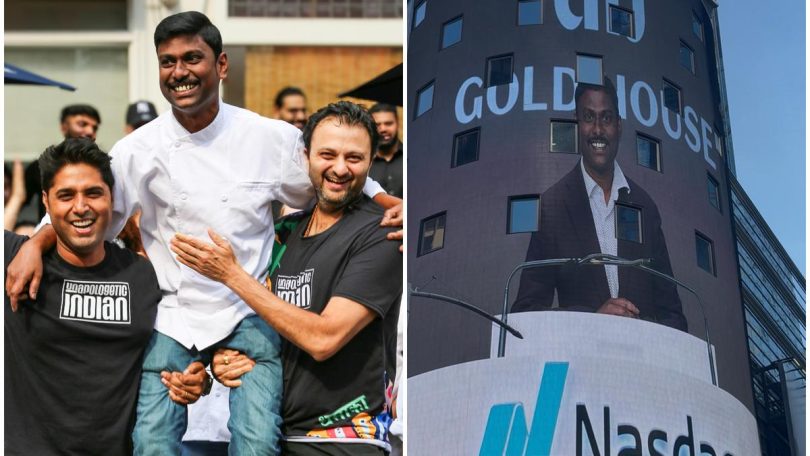
I rang the closing bell at Nasdaq, an American Stock Exchange in New York on May 1. This was as part of an event by Gold House, an organisation in the US that selects the Gold100: a group of 100 leaders responsible for shaping global culture over the past year.
It was one of those moments when you look back and think, “How did I get here?”
I’ve been having a lot of those moments lately. The James Beard Awards, Michelin, North America’s 50 Best Restaurants — each recognition has been incredibly meaningful, but has also given me an opportunity to pause and reflect on my journey.
I did not have a ‘grand plan’ when I started cooking. If you had told me as a child growing up in Tamil Nadu that one day I would be standing in Times Square, recognised as a representative of South Indian food, I would never have believed you.
From Samudirapatti to Wall Street
I grew up in Samudirapatti near Natham, in Tamil Nadu’s Dindigul district, a 45-minute drive from Madurai city, where food was simply part of everyday life. Nobody talked about regional cuisine or culinary heritage. It was just what we ate — the fish curries my grandmother made, tamarind forward meen kuzhambu, vegetables like drumstick, brinjal, snake gourd, cluster beans, ridge gourd and more. Aviyal, poriyal, kootu, vatha kuzhambu were made with vegetables that came from our farm, and signature dishes like mulaikattiya thaniyam, curd rice kanji often eaten with thuvaiyal appeared during festivals, weddings, and family gatherings.
Back then, I never imagined that those foods would become the foundation of my career, or that they would help reshape how people think about Indian food in America.

Nathai pirattal, Semma’s signature food
| Photo Credit:
Special Arrangement
For years, I worked in kitchens where I was proud to cook Indian food, but I rarely saw the dishes I grew up eating represented on menus. Tamil cuisine is incredibly diverse, yet outside of South India, many people had never encountered it.
Why Semma had to exist

I remember conversations before we opened Semma when people questioned whether dishes like nathai pirattal, our snail dish, belonged on a restaurant menu in New York. To me, that dish represented exactly why Semma needed to exist. Snails were part of the food culture where I grew up, they were not exotic or provocative, they were simply food. The same could be said for many of the dishes on our menu and I believed that if we cooked these dishes honestly, people would connect with them. Thankfully, they did.
When you’re in the restaurant every day, it can be difficult to step back and recognise the impact of the work you’re doing. You focus on the next service, the next prep list, and the next challenge.
Moments like ringing the closing bell force you to look up for a second and realise that people are paying attention, they are connected. Tamil food has reached places I never imagined it would.

Vijay at the age of 23 with his mother, Kanthammal and late father Chinnalagu, who passed away in 2006. Taken at Kaleeshwarar temple at Kalaiyar Kovil in Sivaganga district
What has surprised me most is the impact this journey has had on my family. My mother still asks the same questions she always has. “Have you eaten? Are you sleeping enough?” Some things never change. But I know she follows everything from the same home she has lived in for decades. Whenever there is an article or an award, the news often reaches her before I have a chance to tell her myself. One of the benefits of growing up in a small village.

I remember speaking to my family after some of the recognition Semma received, after it launched in October 2021. Today, at Semma the waitlist is approximately 1,200 people, and we do 200 covers a night. Of course my family is happy for me, but what makes them happiest is seeing people appreciate our food.
These are dishes we have cooked, shared, and celebrated our entire lives, and knowing that people halfway around the world value those traditions means more to me than any award ever could.

Gutti vankaya at Semma, with baby eggplant, ground peanuts and sesame
Looking deeper into Tamil Nadu
As for what’s next, Semma is only the beginning.
Tamil Nadu has an endless number of dishes, ingredients, and techniques that deserve attention such as pirandai, a herb that is worked into a chutney and mocha, which is close to edamame. As we continue to evolve the menu, I find myself looking deeper rather than wider.

There are recipes from villages and communities across the State that rarely leave their place of origin. There are dishes like fish kuzhambu, offal preparations, regional vatha kuzhambu and millet-based dishes that I grew up eating, which I have never seen represented outside Tamil Nadu. These are dishes that are disappearing, they carry the identity of specific villages and communities. These are the stories that interest me most.

Left to right: Roni Mazumdar, Vijay Kumar and Chintan Pandya, the trio behind Unapologetic Foods
No matter how things evolve, my goal will always be the same: to cook honestly, respect where the food comes from, and tell the story as accurately as possible. Everything else is a bonus.
When I stood at Nasdaq that day, I wasn’t thinking about awards or accolades. I was thinking about the journey. I was thinking about my family, my teachers, and all the people who shaped me along the way.
Most of all, I was thinking about how far a simple plate of food can travel.
Chef Vijay Kumar is the executive chef and partner at New York’s Michelin-starred Semma. He won the 2025 James Beard Award for Best Chef: New York State and has become one of the world’s leading champions of regional Tamil cuisine.
Published – July 02, 2026 07:12 am IST