
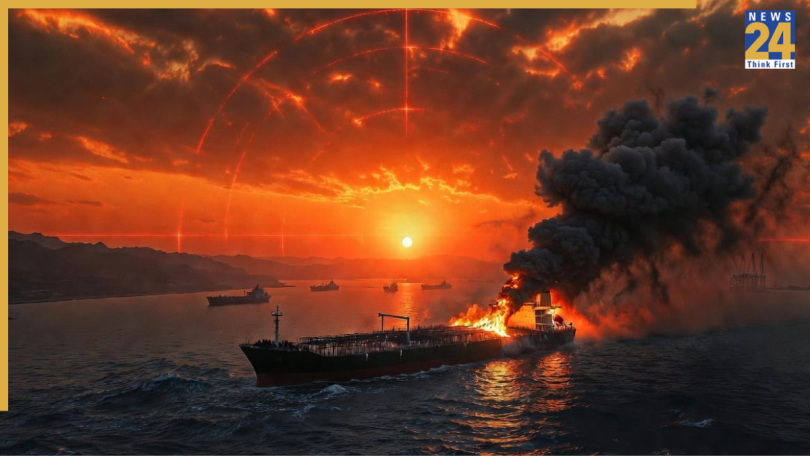
The Middle East is once again on the edge. Early on Wednesday, the United States carried out dozens of airstrikes on Iran, hitting more than 80 targets. America says this was in response to Iran attacking three commercial ships in the Strait of Hormuz — a narrow sea passage between Iran and Oman through which nearly one-fifth of the world’s oil flows every single day. Even a small problem here can shake fuel prices and economies across the globe.
To understand why this keeps happening, let’s go back a little. In February this year, the US and Israel began a war against Iran. In the very first hours, Iran’s Supreme Leader Ayatollah Ali Khamenei was killed. After months of fighting, both sides signed a 60-day ceasefire agreement — a written promise to stop shooting and try to make peace. Iran agreed to let ships pass freely through the Strait of Hormuz. In return, America eased some of its economic sanctions on Iranian oil. For a short time, things seemed calm.
But trust between the two sides is very weak. As reported by Al Jazeera, Iran claims the ships ignored its warnings and entered a “safe route” near its coast where teams were clearing sea mines. America says Iran broke the promise by firing on innocent civilian ships. Whatever the real reason, the result was the same — the bombs started falling again.
The US did not stop at airstrikes. It also cancelled the special permission that allowed Iran to sell its oil and brought back full sanctions. For Iran, oil is its main source of money. So this double blow — bombs and economic pressure — hurts the country badly.
Iran hit back strongly. Its powerful Revolutionary Guards (IRGC) claimed they attacked 85 American military sites in nearby Bahrain and Kuwait. Sirens rang out across both countries early in the morning. Iran also said it shot down an American drone. US President Donald Trump, speaking at a NATO summit in Turkey, declared that the peace deal now appears “finished,” though talks may continue.
Why does this same story keep repeating? The simple reason is that neither side fully trusts the other. Iran wants the world to accept its control over this important sea route and uses it as a bargaining tool. America wants the Strait to remain open and free for everyone and refuses to let Iran hold the world’s oil supply hostage. Both sides are testing each other’s limits without wanting a full-scale war. It is like two people shouting next to a gas cylinder — one spark can cause a big explosion.
**What should India watch out for?**
This crisis is very close to us. India buys a large part of its oil and gas from the Gulf region, and most of it passes through the Strait of Hormuz. When oil prices jumped 6% in just one day this week, it was a clear warning. Higher crude oil prices mean costlier petrol, diesel, cooking gas (LPG), and soon after, higher prices for vegetables, transport, and almost everything in our markets.
We must also think about our people. Nearly nine million Indians live and work in Gulf countries like the UAE, Saudi Arabia, Kuwait, and Qatar. Their safety and the money they send home (remittances) depend on peace in the region.
India also maintains friendly relations with both Iran and Israel. We have important projects like Chabahar Port in Iran. New Delhi therefore has to walk a tightrope protecting our oil supplies, our citizens, and our diplomatic friendships all at once.
The good news is that most experts believe neither side actually wants an all-out war. They may just be posturing ahead of an important August deadline in the talks. For now, India’s best approach is quiet diplomacy, smart planning for oil supplies, and keeping a close watch on developments in the Gulf.
Because when the Gulf catches fire, the smoke eventually reaches our kitchens and affects every Indian family.
(Girish Linganna is an award-winning science communicator and a Defence, Aerospace & Geopolitical Analyst. He is the Managing Director of ADD Engineering Components India Pvt. Ltd., a subsidiary of ADD Engineering GmbH, Germany.)
First published on: Jul 08, 2026 08:33 PM IST
Get Breaking News First and Latest Updates from India and around the world on News24. Follow News24 on Facebook, Twitter.
End of Article
Related Story


