
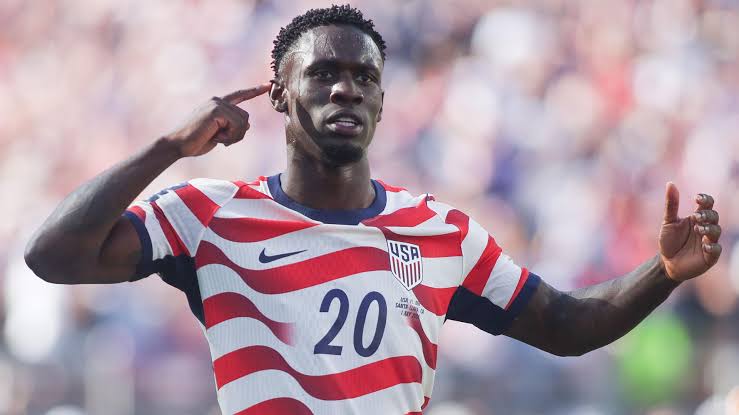
FIFA’s decision to clear United States striker Folarin Balogun for the FIFA World Cup Round of 16 clash against Belgium has become one of the tournament’s biggest talking points….
FIFA’s decision to clear United States striker Folarin Balogun for the FIFA World Cup Round of 16 clash against Belgium has become one of the tournament’s biggest talking points.
Many fans were left confused after Balogun received a straight red card in the United States’ final group-stage match, an offence that ordinarily carries an automatic one-match suspension under the FIFA World Cup Regulations.
Yet, just days later, FIFA confirmed that the striker would be eligible to face Belgium.
The decision immediately sparked criticism from the Royal Belgian Football Association (RBFA), drew condemnation from UEFA, and ignited debate across the football world over whether FIFA had ignored its own rules.
READ ALSO: Ex-FIFA President Blatter Questions Folarin Balogun’s Ban Reversal
Here’s why Balogun is still available:
The Red Card Was Never Cancelled
Contrary to widespread belief, FIFA did not overturn Balogun’s red card.
The dismissal remains part of the official match record, and FIFA has not ruled that the referee made an error or rescinded the sending-off.
Instead, the world football governing body relied on Article 27 of the FIFA Disciplinary Code, a provision that allows FIFA’s disciplinary bodies, under certain circumstances, to suspend the enforcement of a sanction on a probationary basis.
What Article 27 Actually Does
Under the FIFA World Cup Regulations, a player shown a direct red card is automatically suspended for his team’s next match.
Normally, Balogun would have missed the Round of 16.
However, FIFA did not cancel the suspension.
Rather, it suspended the enforcement of the sanction.
As a result, Balogun is immediately eligible to play against Belgium, while the one-match ban has effectively been placed on hold during a one-year probationary period.
Unless the United States forward commits another qualifying disciplinary offence within that period, the suspended sanction may never be enforced.
In simple terms, the punishment still exists—it is simply not being served now.
Why Belgium Objects
Belgium has strongly challenged FIFA’s interpretation of its disciplinary rules.
The Royal Belgian Football Association argues that Article 27 cannot override provisions contained in both the FIFA World Cup Regulations and Article 66.4 of the FIFA Disciplinary Code, which provide that a player sent off must automatically miss his team’s next match.
According to Belgium, postponing the enforcement of the suspension undermines the principle of sporting fairness during the World Cup.
The RBFA has demanded an explanation from FIFA over the ruling.
UEFA also criticised the decision, describing it as unacceptable and saying FIFA had crossed “the red line.”
Trump’s Reaction
The controversy soon reached the political arena after United States President Donald Trump publicly welcomed FIFA’s decision.
“Thank you to FIFA for doing what was right, and reversing a great injustice!” Trump wrote on his Truth Social platform.
His comments led to widespread speculation that he had influenced FIFA’s review process.
Trump has since denied interfering with the governing body’s decision.
Responding to the allegations, he said:
“All I did was ask for a review.”
Speaking specifically about the incident that led to Balogun’s dismissal, Trump added:
“I’ve never seen anything like it. I saw the play… that wasn’t a foul. That wasn’t even an infraction. That was two guys running full speed that happened to crash into each other… So yes, I asked for a review by FIFA.”
While Trump’s remarks intensified the debate, there has been no evidence presented that he influenced FIFA’s judicial bodies.
Infantino Defends FIFA
FIFA President Gianni Infantino has also defended the governing body’s handling of the matter.
Speaking after the controversy erupted, Infantino insisted that FIFA’s judicial bodies operate independently and that the decision was reached strictly in accordance with the FIFA Disciplinary Code.
He maintained that the ruling followed established disciplinary procedures and rejected suggestions that outside pressure influenced the outcome.
Infantino also stressed that FIFA remains committed to applying its regulations consistently while safeguarding the integrity of the competition.
FIFA Says There Is Precedent
FIFA maintains that its decision is not unprecedented.
According to the governing body, Article 27 has been applied before, including in the case of Cristiano Ronaldo, whose suspension following a red card in a qualifying match was placed on probation, allowing him to participate at the World Cup.
FIFA argues that the disciplinary sanction was never erased; only its immediate enforcement was suspended in accordance with its rules.
The Bottom Line
Balogun’s red card still stands.
His automatic one-match suspension has not been cancelled, overturned or removed from the official record.
Instead, FIFA invoked Article 27 of its Disciplinary Code to suspend the enforcement of that suspension, making the United States striker eligible to face Belgium in the Round of 16 while leaving the sanction hanging over him during a one-year probationary period.
That distinction—between cancelling a suspension and suspending its enforcement—is the legal basis for FIFA’s decision.
Whether Belgium’s challenge succeeds or not, the case has already become one of the most debated disciplinary rulings in recent World Cup history, raising wider questions about how FIFA’s regulations should be interpreted and applied during football’s biggest tournament.