
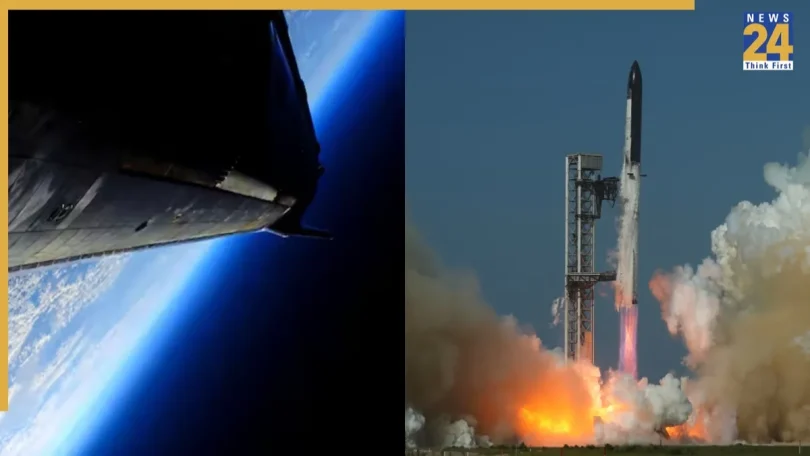
SpaceX successfully launched its Starship Flight 13 on Saturday, marking another important milestone in the company’s mission to develop a fully reusable rocket for future Moon and Mars missions.
The world’s tallest and most powerful rocket lifted off from Starbase in Boca Chica, Texas, at 4:21 am IST on July 25 after a smooth countdown. The launch came just days after a previous attempt was called off at the last moment due to an engine startup issue.
The mission carried 20 next-generation Starlink Version 3 satellites on a suborbital test flight. It also aimed to demonstrate several technologies needed for future operational missions, including satellite deployment and engine relight in space.
What happened during Starship Flight 13?
The launch progressed through several major phases. Around two minutes after liftoff, the Super Heavy booster separated from the upper-stage Starship spacecraft as planned.
After separation, the booster turned around and attempted a controlled splashdown in the Gulf of Mexico. However, the landing did not go as planned. SpaceX said Booster 20 experienced a partial engine ignition problem during the landing burn, with too few Raptor engines successfully restarting. As a result, the booster failed to complete a controlled soft splashdown.
Meanwhile, the upper-stage Starship continued its journey into space. After shutting down its engines, it entered the coasting phase, where it travelled without engine power.
Did Starship deploy the satellites successfully?
Yes. During the coasting phase, Starship successfully released all 20 Starlink Version 3 satellites into space. The satellites then began unfolding their solar panels and testing their laser communication systems.
More than an hour after launch, the Starship spacecraft re-entered Earth’s atmosphere before making its planned splashdown in the Indian Ocean.
Why is Flight 13 important?
Flight 13 is another major step towards making Starship a fully operational launch vehicle. The rocket is expected to play a key role in deploying larger Starlink satellites, supporting NASA’s Artemis programme, and eventually carrying astronauts and cargo to the Moon and Mars.
Unlike earlier test flights that mainly focused on launch and re-entry, this mission expanded Starship’s capabilities by testing payload deployment and engine relight in space. SpaceX will now study data from the booster landing attempt, satellite deployment, upper-stage performance and controlled re-entry to improve future missions.
First published on: Jul 25, 2026 10:23 AM IST
Get Breaking News First and Latest Updates from India and around the world on News24. Follow News24 on Facebook, Twitter.
End of Article
Related Story


