
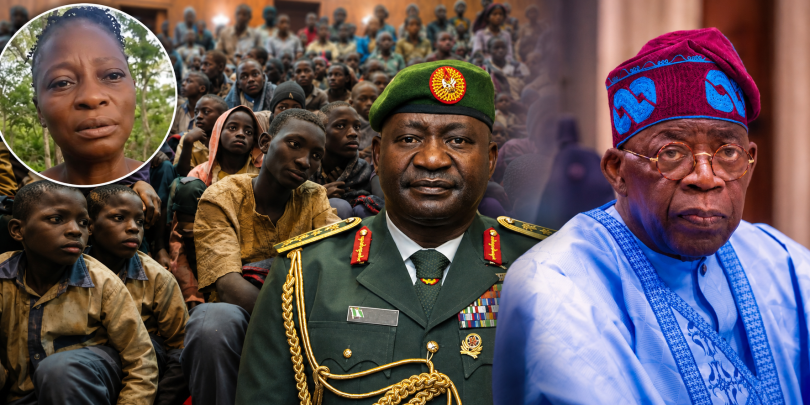
The Nigerian Army says 44 abducted Oyo pupils and teachers were freed on Friday, 10 July 2026, after spending 56 days in captivity. The survivors are receiving medical care before being reunited with their families, while the public has been urged to follow verified updates, avoid rumours and give credible information to security agencies.
PrimeTimes earlier reported that the kidnapped Oyo pupils and teachers regained their freedom after 56 days, bringing relief to parents and communities that had waited for nearly eight weeks.
The Army said the rescue followed an intelligence-led operation involving troops from its 2 Division and personnel from several military, police and intelligence units.
The operation was led by the General Officer Commanding 2 Division, Major General Chinedu Nnebeife. The soldiers worked with the Department of State Services, Nigeria Police Force, National Intelligence Agency, Nigeria Security and Civil Defence Corps and other federal security bodies.
Local security groups, including the Amotekun Corps, vigilantes and hunters, were also involved. According to the Army, the joint operation lasted for more than a month and extended beyond Oyo State.
Rather than concentrating only on the place where the captives were believed to be held, security teams tried to identify the suspected leaders behind the attack and disrupt the wider network supporting them.
The Army said investigators targeted informants, supply routes, logistics links and hideouts connected to the kidnappers. Some of the locations were said to be inside the Old Oyo National Park forest, an area whose size and terrain made the search difficult.
Several suspects were arrested in Oyo and other states during the operation. The Army claimed these arrests weakened the group, increased pressure on its members and eventually forced the captors to release the pupils and teachers without conditions.
The release came shortly after Defence Minister Christopher Musa revealed that the captors had threatened to kill the children if security forces moved closer. He said the abductors wanted the authorities to release detained commanders in exchange for the hostages.
Those threats had placed security forces under pressure to avoid a direct attack that could endanger the captives. PrimeTimes also reported the government’s explanation of its cautious rescue strategy during the hostage crisis.
The Army said the operation was planned to prevent harm to the hostages and other civilians. It disclosed that there were casualties among security personnel but did not state how many officers were killed or injured.
The Presidency separately said eight suspected kidnappers were arrested and placed in the custody of the DSS. It also said other members of the group were “neutralised”, a term commonly used by security agencies to mean that suspects were killed or stopped from continuing an attack.
The official statement did not name those arrested or disclose whether formal criminal charges had been filed. The arrested individuals remain suspects unless they are prosecuted and convicted by a court.
PrimeTimes previously reported that eight suspected kidnappers were arrested during the rescue operation and that the government denied exchanging any detained militant for the hostages.
President Bola Tinubu also said that “no ransom was paid” and “no concession was made”. However, the authorities have not yet published a complete operational account showing the exact location of the rescue or the full sequence of events that led to the captives’ release.
Earlier official accounts said 39 pupils and seven teachers were taken when gunmen attacked three schools on 15 May. That placed the original number of captives at 46.
The victims were taken from Community Grammar School, Baptist Nursery and Primary School and L.A. Primary School in the Esiele and Yawota communities of Oriire Local Government Area.
Two teachers were reported dead during the crisis. Assistant headteacher Joel Adesiyan was said to have been killed while attempting to escape during the initial attack, while Michael Oyedokun was killed in captivity.
The deaths appear to explain why the Army later announced that 44 people were rescued, although officials have not formally reconciled the figures or released a full list of those who returned.
Before the breakthrough, PrimeTimes covered parents’ anger and fear over the delayed rescue. Families had demanded clearer information while urging the government not to take action that could place the children in greater danger.
The rescued pupils and teachers were taken to an undisclosed hospital for medical checks. They are expected to be handed over to the Oyo State Government before being reunited with their relatives.
President Tinubu directed emergency agencies to work with the state government to provide medical treatment and other support. After more than seven weeks in captivity, some survivors may also require counselling and longer-term care to help them return to school and daily life.
The rescue was welcomed by Governor Seyi Makinde, opposition parties, education leaders and other Nigerians. PrimeTimes reported that Makinde, Sowore and the PDP welcomed the victims’ release, while also calling for measures to prevent another school attack.
The Army said further operations would continue against people linked to the abduction. It also asked residents to remain alert and provide timely, credible information that could help security personnel find remaining suspects and dismantle their networks.