
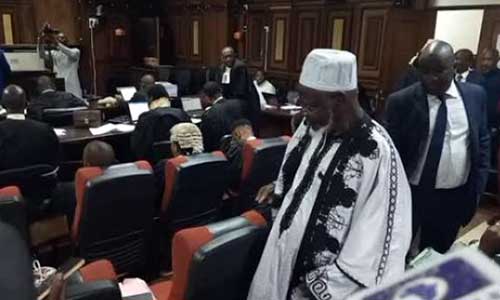
The Federal High Court sitting in Abuja has adjourned proceedings in the trial of six alleged coup plotters until July 20, 2026, following repeated disputes over the interpretation of the Hausa testimony of the sixth defendant, Abdulkadir Sani.
Justice Joyce Abdulmalik adjourned the matter on Tuesday after defence counsel, Sanusi Musa, SAN, repeatedly complained that the interpreters provided in court were not accurately translating Sani’s testimony.
Sani, a Zaria-based Islamic cleric, is challenging the voluntariness of a statement which the prosecution is seeking to tender in evidence.
Following the disagreement, the judge directed the parties to produce a neutral interpreter from the defendant’s exact linguistic background, rather than relying on a general Hausa interpreter.
“Find out exactly where this witness is from,” Justice Abdulmalik said, explaining that the court required an interpreter who could accurately interpret the witness’ evidence for both the court and the parties.
The Federal Government had, on April 22, arraigned a retired army general, Mohammed Ibrahim Gana, and five others over an alleged conspiracy to topple the administration of President Bola Tinubu.
The other defendants are Erasmus Ochegobia Victor, a retired navy captain; Ahmed Ibrahim, a police inspector; Zekeri Umoru, an electrician at the Presidential Villa; Bukar Kashim Goni; and Sani.
All six defendants pleaded not guilty to the charges.
During Tuesday’s proceedings, disputes arose repeatedly over the interpretation of Sani’s evidence.
Musa first challenged the interpretation by a young man, alleging that he was not accurately translating the testimony. The court then allowed a female interpreter to take over, but the defence again complained that her interpretation did not properly reflect the witness’ evidence.
A third interpreter, a young lawyer associated with the defence team, was later called to assist. Before he began, Musa informed the court that if the lawyer took up the role of interpreter, he would no longer act as counsel in the proceedings.
As Sani continued testifying, the defence again complained that the witness was not understanding the questions put to him.
Justice Abdulmalik observed that an interpreter owes duties both to the court and to the witness, after which she adjourned the trial-within-trial to allow the parties produce a neutral interpreter.
The trial-within-trial was ordered on May 11 after defence lawyers objected to the admissibility of statements and video recordings the prosecution sought to tender, arguing that the statements were not made voluntarily.
Before the objection, the prosecution had called four witnesses. One of them, an army officer identified by the codename “AAA” for security reasons, tendered video recordings of the defendants’ interrogations before the trial-within-trial commenced.
The prosecution closed its case in the trial-within-trial on June 23, while the defendants began their defence on June 25.
Led in evidence by Musa on Tuesday, Sani insisted that his statements were not made voluntarily.
He told the court that before his video statement was recorded on December 11, officers took him from the Economic and Financial Crimes Commission office, covered his face with a black cloth and also placed a black cloth over the face of a young man who had accompanied him.
“They later told the boy he could go. I was left with only them in the vehicle,” he said.
According to him, he was then driven to the Defence Intelligence Agency headquarters, where an officer who questioned him first reviewed the statement he had made at the EFCC before setting it aside.