
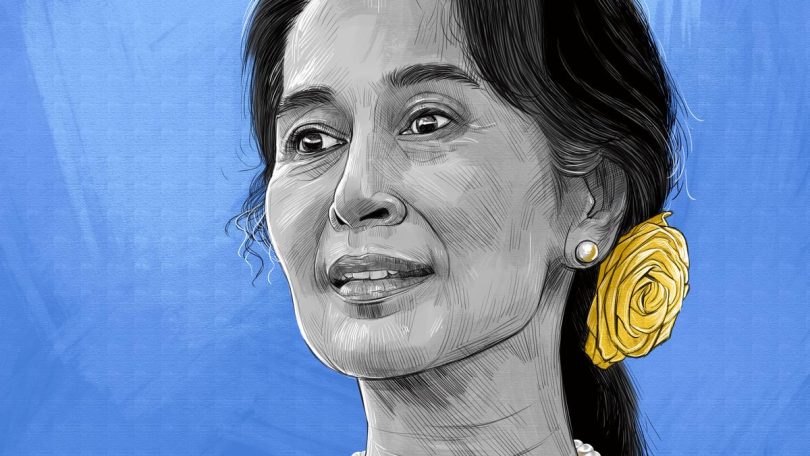
When Thailand’s Foreign Minister Sihasak Phuangketkeow met Myanmar’s newly designated President Min Aung Hlaing in April 2026, he was told that the regime in Naypyitaw was “considering good things” for Daw Aung San Suu Kyi. This was the same general who, as chief of the dreaded junta, had deposed the country’s civilian government yet again in 2021, plunging Myanmar into a protracted civil war before refashioning himself into a “civilian” leader.
Ms. Suu Kyi — the former State Counsellor and the symbolic head of the pro-democracy movement — had meanwhile been jailed in a high-security prison in the capital, Naypyitaw, after a sentence of close to three decades was handed to her in a farcical trial that followed the coup. The junta sought to legitimise its rule through a stage-managed election, which was held with a low-turnout vote, largely in areas the military controlled, and handed victory to its proxy Union Solidarity and Development Party. After the “victory”, it reduced Suu Kyi’s sentence several times. Yet when ASEAN asked for access to her, it refused outright.
The 81-year-old is understood to have been moved to “house arrest” somewhere within Naypyitaw, though very few even among the junta know her whereabouts. This led to a “proof of life” campaign online demanding details of her detention. Ms. Suu Kyi’s limbo is symbolic of the state of the pro-democracy movement, which still regards her as its icon, even in an ethnically fractured country that has been at war with itself since the coup.
Ms. Suu Kyi, President Win Myint, released only recently, and other leaders of the National League for Democracy (NLD) were arrested in 2021, months after the party’s landslide victory in the 2020 elections. But the movement did not collapse with them. Ousted parliamentarians and party figures regrouped to form a government in exile, the National Unity Government (NUG), which took up armed resistance against the junta by raising People’s Defence Forces in the Bamar-majority heartland and fighting alongside ethnic armed organisations that had renewed their own wars against the military.
Today, more than five years on, the civil war has claimed more than a lakh lives. While the junta has regained the initiative after heavy setbacks, the resistance remains formidable.
Hard-won authority
Ms. Suu Kyi’s authority as the symbol of the pro-democracy movement was hard-won, even if it was later tarnished by the stances she took as State Counsellor. The daughter of the independence hero Aung San, assassinated when she was two, she was educated in New Delhi and later at Oxford. She married a British academic and raised two sons abroad before returning in 1988 to a Burma going through a revolt against military rule. She soon led that uprising in a role that would cost her nearly 15 years of house arrest across two decades, and make her an international cause célèbre. She won the Nobel Peace Prize in 1991 while confined. Her release in 2010 came only after the dictator Than Shwe staged a controlled election and began cautiously opening the country to Western investment and legitimacy. The NLD swept by-elections in 2012 and then won a genuine landslide in 2015.
The military, forever wary of her clout and her intent to widen the democratic space, had sought to keep her from the presidency through a clause in the 2008 constitution barring anyone with foreign-national children. But she outwitted the generals by getting the NLD to use its parliamentary majority to legislate a new office, the State Counsellor, placed above the president and serving as effective chief executive.
Working pragmatically within a parliament where the military still held a quarter of the seats, Ms. Suu Kyi contained the generals politically but her accommodation of them carried a heavy cost. When the military, then commanded by Min Aung Hlaing, led a genocidal campaign against the Rohingya in Rakhine State in 2017, leading to an exodus of more than 7,00,000 and killing thousands, she did not condemn it. In 2019, she personally defended Myanmar against the genocide charge before the International Court of Justice.
This pragmatic accommodation did not benefit her. The junta did not want to share power and wanted all of it. As the veteran analyst Bertil Lintner argues, the military had expected the NLD to lose in 2020, convinced that it had shed support in the cities and ethnic-minority areas. It was proven spectacularly wrong and refused to accept the result when the NLD won another landslide. It manufactured claims of mass fraud and orchestrated violent protests through its proxy USDP, using the “crisis” as a pretext to seize power in the coup.
After losing vast territory during the civil war in 2023 and 2024, the junta has now turned the tide, clawing back some of what it lost. Propitious circumstances made that possible — China’s changed stance in particular. Having earlier indirectly enabled the gains of ethnic armies in the north, Beijing swung behind the regime once prolonged war began to threaten its border stability and economic corridor. It pressured the Ta’ang National Liberation Army and the Myanmar National Democratic Alliance Army — two members of the Three Brotherhood Alliance, the third being the Arakan Army — to accept ceasefires and pull back from crucial towns they held in Shan State and neighbouring areas.

With pressure easing in the north, and a forced-conscription law bringing new recruits, the junta could redirect its forces to other fronts, against the People’s Defence Forces and ethnic armies such as the Kachin Independence Organisation and the Karenni forces, among others. Fielding a large number of Russian and Chinese military drones after drone-equipped ethnic armies had forced its withdrawal during Operation 1027 in late 2023, the junta seized a renewed airpower advantage. On the strength of that advantage, it retook the strategic Mandalay–Myitkyina highway, recaptured Falam in Chin State, and pushed the resistance into the defensive across Sagaing, Magwe and Mandalay.
Yet the more entrenched forces have proven hard to dislodge. The Arakan Army, insulated by geography from Chinese pressure and now in control of most of Rakhine, and the well-resourced KIO — which taxes the jade and rare-earth trade across its zones of influence — have held firm.
Seeking legitimacy
It is now trying to regain international legitimacy through the civilian-government route. On taking the presidency, Min Aung Hlaing installed loyalists in the high command, elevating former intelligence chief Ye Win Oo to commander-in-chief of the armed forces. Among his first visits as President was one to New Delhi, where he met Prime Minister Narendra Modi. India, wary of Beijing’s outsized sway over Naypyitaw and eager to revive its stalled connectivity projects and secure access to rare earths, has sought re-engagement with the regime. ASEAN nations, too, are slowly doing the same.

Does this mean Myanmar’s pro-democracy and pro-federal forces are facing defeat? Some developments suggest the military will not have it easy. The NUG and other Bamar democratic forces have joined with key ethnic organisations to form a Steering Council for the Emergence of a Federal Democratic Union (SCEF), which many observers term an improvement over the National Unity Consultative Council formed after the coup. It may be a key step to centralise the resistance against military rule and its proxies. Led by a battle-hardened younger generation of activists still inspired by Ms. Suu Kyi’s example, the initiative may still depend on fissures within the junta, and on the indulgence of a perennially frayed and somewhat insular ethnic resistance, for a genuine breakthrough. But it has something the junta lacks, and that Ms. Suu Kyi has always symbolised: the popular support of the long-suffering people of Myanmar.
Published – July 05, 2026 03:14 am IST