
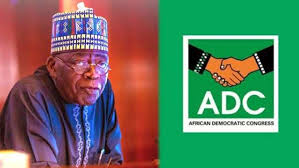
(President Bola Tinubu. Photo Credit: Nigeria Eye)
Concerns have been voiced by the African Democratic Congress on what it called a “appointment fiasco” in the administration of President Bola Tinubu.
Bolaji Abdullahi, the party’s National Publicity Secretary, stated in a statement that the National Assembly must decide if the President is still capable of carrying out his official duties.
It voiced concern about allegations that a man who was publicly dismissed from office by a presidential order still holds the same position and meets with high-ranking government officials.
The party argued that if reports concerning the Border Communities Development Agency are accurate, then the situation goes beyond a single disputed appointment.
It questioned who is truly in charge of the Nigerian presidency, arguing that when a president announces an appointment only for another person to disregard that directive and remain in office, what Nigeria is witnessing is no longer mere administrative confusion but a struggle for control of the presidency itself.
The ADC insisted that the BCDA episode cannot be viewed in isolation, describing it as part of a broader and troubling pattern.
It referenced the earlier controversy surrounding the so-called Presidential Foreign Intervention Promotion Council, a body it said officially did not exist yet operated at the highest levels of government with apparent legitimacy, noting that the matter only drew attention once allegations surfaced linking its purported Director-General to the President’s Chief of Staff.
Taken together, the party said these episodes point to a presidency steadily losing control over one of government’s most fundamental powers, the constitutional authority to appoint and remove public officers, adding that Nigerians can no longer be certain whether an announced appointment is final, whether a dismissal takes actual effect, or whether some other authority exists capable of overturning presidential decisions without explanation.
The ADC further argued that the Tinubu administration has increasingly become a space where official announcements compete with unofficial influence, and where rival interests contest over appointments and patronage, likening the situation to the presidency, much like the economy and the security landscape, operating on a survival-of-the-fittest basis.
It added that this is compounded by a recurring pattern of policy reversals, citing the swift suspension of the Cybersecurity Levy following public backlash, the withdrawal of the Expatriate Employment Levy after investor pushback, and repeated policy flip-flops across various sectors, describing a government that tends to announce first, retreat later, and explain only afterward.
It warned that a government unable to consistently stand by its decisions risks losing not just credibility but authority, creating uncertainty for investors, confusion within the bureaucracy, and encouraging public institutions to test the limits of their power.
The party maintained that Nigerians deserve answers beyond carefully worded press statements, posing questions on who truly exercises the President’s constitutional powers, who authorises appointments, who may have countermanded the BCDA directive if indeed that occurred, and who allowed a fictitious agency to operate under the guise of the presidency.
It stressed that these were not partisan questions but constitutional ones, touching directly on the integrity of executive authority and the stability of the nation.