
In the memorandum of understanding signed by the U.S. and Iran to end the war, Tehran has pledged never to develop a nuclear bomb in return for U.S. sanctions relief and access to a $300 billion development fund. Beyond that commitment, the MoU offers few details on how the U.S. and Iran intend to solve the nuclear dispute.
Iran still possesses hundreds of kilograms of highly enriched uranium and retains the technical capacity to produce more. While the modalities of a final agreement are to be negotiated in the second phase of talks, the MoU states that both sides have agreed to take steps to downblend Iran’s uranium stockpile. U.S. President Donald Trump said last week that the U.S. would “go and get” Iran’s highly enriched uranium “at some point” and “dilute” (downblend) it either in America or in Iran.
Paragraph 8 of the MoU states: “The Islamic Republic of Iran reaffirms that it shall not procure or develop nuclear weapons… The two parties also agreed to resolve the disposition of stockpiled enriched material pursuant to a mechanism… with the minimum methodology to be down-blending on site under the supervision of the International Atomic Energy Agency.”
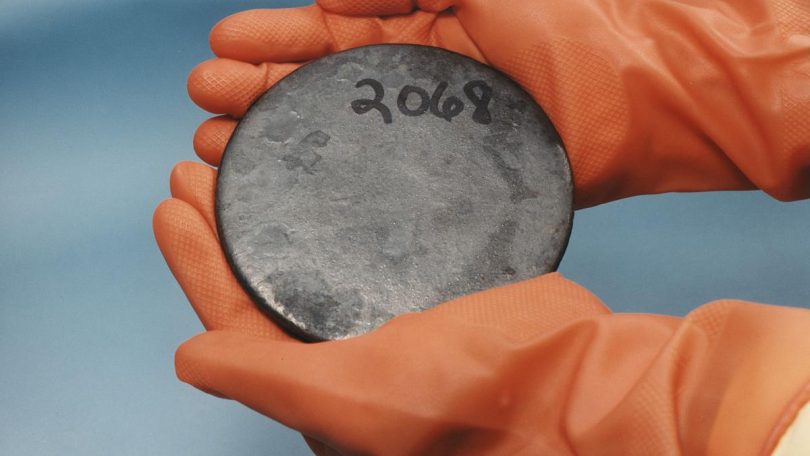
Downblending is a technology used to make uranium less pure. It is difficult to purify uranium, and highly pure uranium can be used to make nuclear bombs. So downblending removes the amount of uranium-235 available to make a bomb and increases the time required to do so. This duration, called the breakout time, is a cornerstone of modern nuclear non-proliferation.
Thus, the international community’s trust in Iran’s promise to not pursue a nuclear weapon depends on how well it implements downblending in the coming months, among other factors.
Uranium in nature consists mainly of two isotopes: uranium-238 and uranium-235. Of these, only uranium-235 is fissile, meaning it can sustain a nuclear chain reaction. However, the natural concentration of uranium-235 in uranium is only 0.72%. The remaining 99.28% is uranium-238. Purification means enriching the concentration of uranium-235 to higher levels.
Downblending is the opposite of enrichment. Here, enriched uranium is mixed with depleted (opposite of enriched) or natural uranium to produce uranium with less than 5% uranium-235. E.g. the 2015 Iran deal allowed Iran to enrich uranium up to 3.67%. Uranium of this purity can be used in some simple reactors to produce electricity but not to make a bomb.
The enriched uranium feedstock is usually stored as the compound uranium hexafluoride (UF6), which is a solid at room temperature. In the first step, the steel cylinders containing UF6 are placed in an industrial oven called an autoclave and heated to 80-110° C, turning the compound to gas. Gases are easier to mix than solids.
Second, another source of uranium called the blendstock is prepared. It can have 0.7% uranium-235 (natural uranium), 0.2-0.3% (depleted uranium), 1% uranium-235 (slightly enriched) or a different level. The level is based on need. For instance, downblending 90% enriched uranium to 5% will need a larger quantity of depleted uranium than natural uranium. The blendstock is also gaseous.
The enriched feedstock and the blendstock are pumped into a junction called a blending tee. The main challenge here is mass flow control: to achieve a target enrichment, the ratio of the two gases must be perfect. If too much feedstock gets in, the final gas will be too high in uranium-235.
Engineers use thermal mass flow meters, which determine the masses by measuring the heat transfer characteristics of the flowing gases. Then automated values adjust the flow. To ensure the gases mix, the blending tee uses internal mixers, called baffles, to create turbulence.
When the mixed gas exits the blending tee, it passes through an online enrichment monitor (OLEM). The OLEM uses sodium iodide to sense the amount of gamma rays emitted by the gas. Uranium-235 has an energy signature at 186 keV (around 3 × 10^-14 joules). OLEM tracks the intensity of gamma rays with this signature. If it exceeds an agreed-upon limit, the system will trigger failsafe valves that shut off the entire flow. This is done to keep the facility from producing more of the non-compliant material.
In fact, the facility is also fit with cameras housed in tamper-proof casings and which record 24/7.
The gas is then solidified by cooling it in a product cylinder.
This is not the last step, however. The downblended uranium still exists as UF6 — which is also the feedstock for the process that enriches uranium. Since the purpose of downblending is to increase the amount of effort needed to make a bomb, the UF6 is finally moved to a reconversion plant, where the gas reacts with steam and hydrogen. The reaction replaces the fluorine atoms with oxygen, producing uranium dioxide (UO2), a dark powder.
The uranium in UO2 can’t be enriched directly. It has to be converted to UF6 first in a conversion plant. The emissions from such a plant can be detected by satellites and on ground inspections.
The very last step is IAEA verification. IAEA inspectors collect a small physical sample of the UO2 powder and ship it to their laboratory in Seibersdorf, Austria, where thermal ionisation mass spectrometry is used to confirm the level of uranium-235 to four decimal places. Second, the IAEA applies seals on the cylinders that can’t be tampered without leaving back signs.
While the crux of downblending is the physical mixing, downblending the process includes the control systems so that it can provide verifiable proof that the uranium has indeed become less pure. And that in turn is why the U.S.-Iran memorandum will rest as much on diplomatic assurances as on the technical implementation.
Published – June 19, 2026 09:14 am IST