
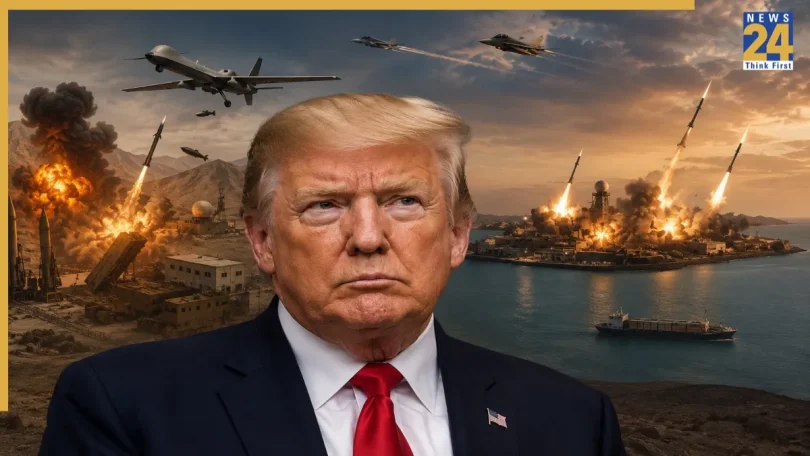
Tensions between the United States and Iran sharply escalated after the US carried out military strikes inside Iran, accusing Tehran of attacking a commercial cargo ship in the Strait of Hormuz. The exchange marks the first direct US military response since both countries reached a fragile memorandum of understanding in Switzerland.
What exactly happened?
Soon after the US strikes, Iran’s Islamic Revolutionary Guard Corps (IRGC) reportedly launched attacks on US military zones in the region. According to Reuters, the IRGC had earlier warned that the American action would not go unanswered and promised a “decisive response.” However, details about the targeted military positions have not yet been made public.
Before the strikes, US President Donald Trump hinted that military action was imminent. When asked by reporters whether Washington would respond to Iran’s alleged actions, Trump simply said, “You’ll find out.”
Minutes later, US Central Command (CENTCOM) confirmed that American forces had carried out precision strikes on Iranian missile and drone storage facilities, along with coastal radar sites. The US said the operation was launched after Iran allegedly used a one-way attack drone to strike the Singapore-flagged cargo ship M/V Ever Lovely on June 25 while it was sailing near the Omani coast after exiting the Strait of Hormuz.
Why did the US launch strikes on Iran?
CENTCOM described the operation as a “powerful response” to what it called Iran’s “unwarranted aggression” against commercial shipping. The US accused Tehran of violating the ceasefire understanding and threatening freedom of navigation in one of the world’s busiest maritime trade routes.
The American military also said it would continue ensuring the safe passage of commercial vessels through the Strait of Hormuz.
Why is the Strait of Hormuz so important?
The Strait of Hormuz carries nearly one-fifth of the world’s oil and liquefied natural gas supplies. Any disruption in the narrow waterway can affect global energy markets and international shipping.
Iran has also warned Gulf countries against siding with Washington and insisted that the strategic waterway should remain under regional oversight. Meanwhile, Bloomberg reported that Oman informed allies that transit fees for ships using the Strait of Hormuz could be introduced in the future.
First published on: Jun 27, 2026 06:47 AM IST
Get Breaking News First and Latest Updates from India and around the world on News24. Follow News24 on Facebook, Twitter.
End of Article
Related Story


