
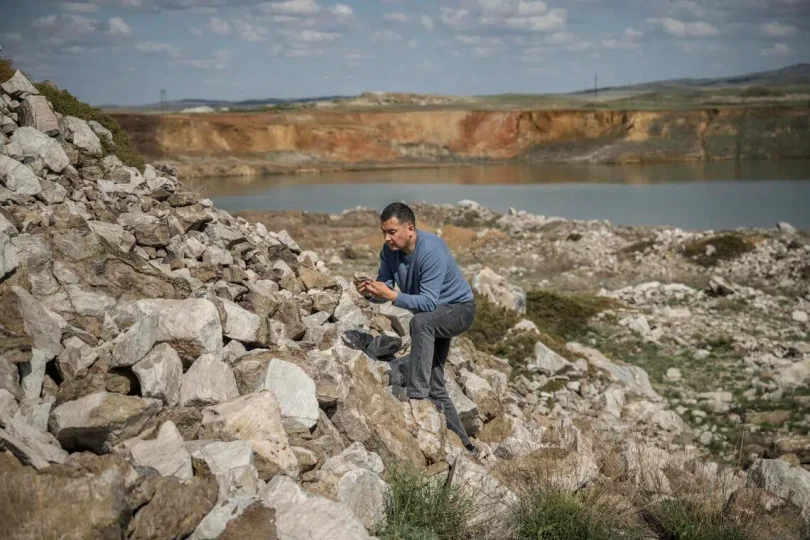
UNREK, Kazakhstan – When Commerce Secretary Howard Lutnick met Kazakhstan’s president at the St Regis Hotel in September 2025 in New York, US President Donald Trump jumped in by phone as the men sealed a deal on a top priority for Washington.
During the call, Trump and his team won an agreement from the Kazakh leader to give a little-known US company access to one of the world’s largest untapped reserves of tungsten, a metal that the United States desperately needs for the production of missile warheads, fighter jets, computer chips and other critical goods.
Ahead of the deal, the Trump administration approved preliminary applications for as much as US$1.6 billion (S$2.07 billion) in federal financing for the US company, now called Kaz Resources, which plans to break ground on the project in rural Kazakhstan.
It was not only Trump and Lutnick who saw an opportunity.
Their sons were soon doing business with partners in a deal that their fathers were negotiating, continuing a pattern of self-enrichment in the second Trump administration that has few precedents in US history.
Within weeks of the St Regis negotiations, investors with a firm called Dominari Securities, which is housed at Trump Tower in New York and partly owned by the President’s two eldest sons, Donald Trump Jr and Eric Trump, joined with other partners to take a 20 per cent stake in a corporate entity related to the Kazakhstan project.
Around the same time, Cantor Fitzgerald, an investment company controlled by Lutnick’s family and overseen by his sons Brandon and Kyle Lutnick, helped one of the lead investors working with Dominari on the Kazakh deal raise US$210 million in new capital for a related entity. Such rounds of fund-raising typically net Cantor millions of dollars in fees.
The Kazakh deal was ultimately signed on Nov 6, six days after the investment involving the Trump sons and their partners, which was not publicly disclosed at the time.
The arrangement is hardly an outlier. One or both families have financial ties to at least 14 companies that are actively working with the federal government on critical mining deals, including the Kazakhstan project, according to federal filings examined by The New York Times.
All 14 of these companies have either benefited directly from offers of financial assistance from the Trump administration, or have pending permit applications before the Commerce Department, which Lutnick oversees, the Times found.
The total amount of federal funding that the Trump administration has provided or is considering providing to the companies exceeds US$8.9 billion, according to public statements by the companies and the federal government.
This emboldened mixing of federal policymaking and personal business began shortly after Trump returned to office in 2025, when the Trump and Lutnick sons played a role in billions of dollars of cryptocurrency deals as the fathers helped set policies that supercharged the crypto industry.
Now, the families’ ethically tangled pursuit of profits is extending to the new arms race for critical minerals.
These kinds of deals are a warning sign, said Representative Maxine Dexter, a Democrat from Oregon, who sits on the House panel that investigates accusations of wrongdoing in the mining industry.
“Congress needs to make sure that taxpayer dollars are being used in the public’s interest and not to benefit family members or those closely tied with the Trump administration,” Dexter said in an interview.
The White House and the Commerce Department, in separate statements, rejected any suggestion that the Trump administration was improperly mixing government actions with family business.
“The only special interest guiding the Trump administration’s decision-making is the best interest of the American people,” Kush Desai, a White House spokesperson, said in a statement to the Times.
“Securing and reshoring America’s critical supply chains has been a top priority for President Trump, and Secretary Lutnick along with the rest of the administration continue to take historic action to safeguard America’s national and economic security.”
At the centre of the Kazakhstan deal is an Australia-born rabbi named Pini Althaus, who moved to the US years ago and set his sights on critical minerals.
Althaus is the executive chair of Kaz Resources and the related company that will mine the Kazakh tungsten deposit, and he remains a shareholder in another critical minerals firm he founded that secured up to US$1.6 billion in Commerce Department financing in June.
He has proved to be a savvy player, soliciting – and receiving – direct support from top-level federal officials, including Lutnick, in his efforts to secure deals.
In a series of interviews, he said his discussions with the US government about the tungsten deal started during the Joe Biden administration and did not benefit from any political favours.
Althaus said that in the weeks after the St Regis meeting, he was approached by new investors, but that he had never met Trump’s sons and did not know they were involved. He later came to learn about the Trump family’s participation and understood how that might generate questions, he said.
“I can see how the optics might be disturbing to some people,” Althaus said. “But that’s unfortunate because this company and this project goes way beyond any one president, let alone any family.”
Since Trump returned to office, the federal government has given conditional or final approval to 60 critical minerals projects worldwide backed by US$18.6 billion in federal loans, loan guarantees or other financing, according to a count in May by BMO Capital Markets, a leading bank in the sector. That is the largest amount in US history, a bank executive said.
The Pentagon and the Export-Import Bank, where Lutnick sits on the board, are among the federal agencies bankrolling the push. The moves have created a modern-day gold rush in the critical minerals industry, as start-ups seek to get a chunk of the federal largesse.
For example, Donald Trump Jr is a partner at another investment firm that last summer took a stake in a tiny start-up mining company called Vulcan Elements. Months later, the company signed a nearly US$700 million deal with the federal government to help finance the expansion of its production in North Carolina.
“The level of activity compared to, say, 2023 is like night and day,” said Max Yerrill, a BMO vice-president. “It has been one of the hottest sectors.”
For Kazakh officials, such deals offer their landlocked nation a new calling card in foreign affairs and an entree with Trump.
The country can produce and process 25 of the 60 commodities on the US critical minerals list, according to Olzhas Alibekov, a top official at Kazakhstan’s Ministry of Industry and Construction.
“Kazakhstan is positioning itself as an important player in the global rare and rare-earth metals market,” said Nurlan Zhakupov, chief executive officer of the Kazakh sovereign wealth fund, which owns the state mining company that is partnering Kaz Resources on the tungsten project.
That project will require a huge investment, which Althaus estimates will total about US$650 million initially and US$1.1 billion over the life of the project. According to his firm’s own calculations, the tungsten there might be worth as much as US$80 billion.
His company could not make the project happen by itself. He needed the US government to cut a deal with Kazakhstan at the highest levels, and to pledge financing to make the maths work. In return, the US could get access to an estimated 12,000 tonnes of tungsten a year, about as much as is now imported annually.
At the St Regis Hotel that day in September 2025, Kazakh President Kassym-Jomart Tokayev was in the middle of a speed-dating-like procession of meetings with executives from corporate giants such as Citigroup, Amazon and Chevron.
Among Tokayev’s corporate guests was Althaus, who was there to push Kazakhstan to approve the mining project. Lutnick had his own audience with the Kazakh president at the hotel that day.
“You have great critical minerals that we can invest in together,” the commerce secretary told Tokayev, according to a recording of parts of the meeting that the Kazakh leader posted on social media.
“President Trump, Secretary Lutnick and Secretary Rubio all personally got involved,” said Althaus, who did not attend the closed-door meeting. “President Trump did the final negotiation with President Tokayev for this deal.”
Chinese bidders were also looking to get access to the Kazakh tungsten site, which is one reason Althaus needed help from the US government.
The final signing took place on Nov 6, during a high-profile summit in Washington, where Trump welcomed the five leaders of Central Asia and highlighted his interest in their critical minerals.
Under the terms of the deal, Althaus’ firm now owns 70 per cent of the venture, and the Kazakh state mining company will own 30 per cent.
Investors involved in the Kazakh deal have several different business plans slated to benefit from Trump administration support – and that also do business with Cantor Fitzgerald.
In June, for example, the Trump administration committed to provide up to US$1.6 billion in financial support to USA Rare Earth, the other mining company Althaus founded and in which he remains a shareholder.
That deal gives the Commerce Department 16 million shares of the company’s stock. Cantor Fitzgerald separately earned millions of dollars in fees by helping USA Rare Earth in a series of deals since 2025 that ultimately raised US$1.5 billion for the company.
Cantor Fitzgerald, which Lutnick ran before he became commerce secretary, has long had a division that helps mining companies raise capital. But it has seen a surge in its business helping to launch or finance mining companies, especially those benefiting from Trump administration support.
Democrats in Congress have called for an investigation into the proposed Commerce Department stake in USA Rare Earth. They told Lutnick in a letter that it was “the latest example of how official Commerce Department business has intersected with Cantor Fitzgerald’s financial interests during your tenure”.
In a statement, the Commerce Department said that neither Lutnick nor anyone at the department had “interacted with or had any discussions whatsoever with Cantor Fitzgerald regarding the rare-earth minerals industry”. It noted that Lutnick had sold his ownership stake in Cantor.
The Trump brothers’ ties to the Kazakhstan deal started at their father’s tower on Fifth Avenue in New York.
That is where Dominari Securities, a small financial services firm, had set up its offices after Trump’s first stint in the White House ended.
Such proximity to the Trump Organization’s headquarters afforded Dominari executives the chance to form friendships – and then business relationships – with Trump’s sons.
“That’s how the relationship started and developed,” Allan Evans, one of Dominari’s business partners, said in an interview.
After Trump returned to the White House, Dominari hired Donald Trump Jr and Eric Trump as paid advisers, giving them stock now worth about US$7 million, representing about 10 per cent of the company’s total shares.
The firm launched an explicit effort to invest in companies aligned with the President’s agenda, ranging from military drones to critical minerals.
To carry out the Kazakh tungsten investment, Dominari relied on the sort of complex corporate manoeuvring that is a hallmark of its deals.
First, Dominari partnered Paul E. Mann, a British investor and entrepreneur who more recently has also been looking to get into the critical minerals sector.
Using a subsidiary of Mann’s nuclear energy company, ASP Isotopes, the group of investors last summer bought a controlling amount of shares in a failing road construction firm called Skyline Builders.
That might seem like an odd move, but they did so for a reason – Skyline is listed on the Nasdaq exchange. So the ASP subsidiary now controlled a publicly traded company.
Dominari and the Trump sons joined this effort through what is known as a Special Purpose Vehicle, which took a stake in Skyline, as was first reported by the Financial Times. The Trump sons have a second small interest in the deal, through an investment they made directly in the ASP subsidiary in late 2025, according to Mann.
In late September, the Trump administration secured the verbal agreement from the Kazakh government for the tungsten rights.
That set their move into play.
In October, Cantor Fitzgerald helped raise US$210 million for ASP Isotopes.
By Oct 31, Skyline, now controlled by ASP, took a 20 per cent stake in Althaus’ Kazakhstan-focused corporate entity, for US$20 million. The former road-building company was suddenly in the mining business.
Six days later, the final deal with the Kazakh government was signed in Washington by Lutnick.
Mann, in an interview, insisted the money that Cantor raised for ASP Isotopes was not used in the mining deal. Nevertheless, Cantor – the investment firm overseen by Lutnick’s sons – was fundraising for Mann’s company at the same time that its subsidiary was preparing to invest in a deal that Lutnick was negotiating as commerce secretary.
In December, Mann approached Althaus with a proposal for a manoeuvre known as a “reverse merger”, which would replace Skyline Builders on the Nasdaq exchange with a new entity known as Kaz Resources, Althaus said. The merger, which will essentially take the mining operation public, was announced in April.
The listing will allow investors to profit on the Kazakhstan project by trading its stock before any tungsten comes out of the ground. US government backing of such projects often pushes up the stock price, making money for early-stage investors who exit at the right time.
As part of the merger, Skyline agreed to make about US$50 million available for the Kazakh project beyond the original US$20 million investment, Althaus said.
Althaus said he needed the money from the merger to begin work on the Kazakhstan project. The merger still requires US regulatory approval to close.
Dominari did not respond to requests to comment.
Eric Trump and Donald Trump Jr said in separate statements that they were not involved in the specifics of the deal, with Eric Trump writing that he “has always been a passive investor with absolutely no management role”.
Mann confirmed that Trump’s sons have a financial interest in the deal. But he said he had not spoken to them, or anyone in the Trump family, about it.
“When you look at it, take a step back here, there’s no conflict of interest here,” Mann said. “And it’s certainly in the United States government’s best interest to want to do this deal.”
He also said he did not pick Cantor to raise money for his company because Lutnick is commerce secretary.
“Of course not,” he said, adding, “Should Cantor exclude themselves from all deals in the mining sector? That’s unfair on Cantor.”
So far, none of the US$1.6 billion in US government financial support for the Kazakh mining project has come through, as it is subject to additional approvals, a Trump administration official said. Althaus’ firm is undertaking a final feasibility study that will be reviewed.
That does not mean that no one has made money.
Federal filings suggest that both Cantor Fitzgerald (run by the Lutnicks) and Dominari Securities (partly owned by the Trumps) have earned fees for their work. They were both paid for their services helping executives involved in the series of transactions to raise new capital.
Althaus said he was now focused on moving the project toward production, which he hopes will begin by 2030, though there is pressure to speed up the timeline.
“If we had a door to knock on, so to speak, we would have,” he said. “We did this the hard way through advocacy.” NYTIMES
This article originally appeared in The New York Times.