
JERUSALEM – For Prime Minister Benjamin Netanyahu of Israel, the resumption of fighting with Iran on June 7 may have shown his supporters, at least momentarily, that he still was capable of standing up to US President Donald Trump.
But the halt to the fighting on June 8, after less than 15 hours, left Israel and its embattled leader in a bind and appearing as beholden to Trump as ever.
If Netanyahu had hopes of undermining the peace talks Trump has been pursuing with Iran, the president’s pressure on both sides to stop the airstrikes – and Israel’s abandonment of preparations for another attack on June 8 – showed this had failed.
The burst of warfare may have also altered how the warring parties weigh and respond to each new set of attacks – and not in a way that is advantageous for Israel.
Israel now understands that Iran can have its proxy army in Lebanon, Hezbollah, attack civilians in northern Israel, that Israeli counterstrikes at Hezbollah may prompt Iran to launch missiles at Israel and that Trump may prevent Israel from hitting back at Iran too hard or for too long.
“This was a major change,” said Raz Zimmt, director of the Iran programme at the Institute for National Security Studies in Tel Aviv, Israel. He said it showed that Iran’s hard-line government was full of confidence and had concluded that “President Trump doesn’t want to go back to war, so they can take some risks to make sure this linkage of developments in Iran and Lebanon is maintained.”
The latest round of violence erupted days after a new ceasefire was reached in Washington between Israel and Lebanon. Hezbollah rejected the agreement, and Israel threatened to retaliate in Beirut if Hezbollah attacked Israeli territory again.
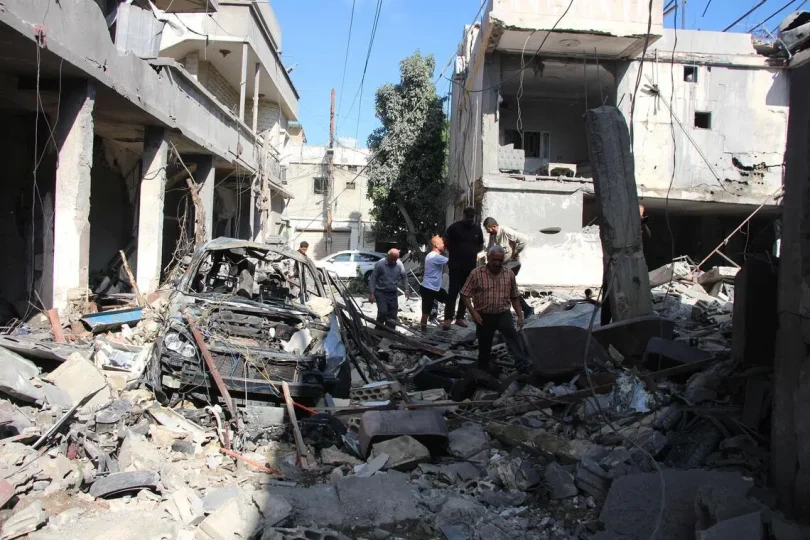
When Hezbollah did so, firing rockets at Israel on June 7, Netanyahu ordered a strike on the Dahiyeh, a Hezbollah stronghold on the southern outskirts of Beirut.
Hours later, Iran responded by firing the first of around 30 missiles at Israel. And on June 8, Iran’s ally in Yemen, the Houthis, fired one missile into Israel and threatened to attack Israeli and Israeli-affiliated ships transiting the Red Sea.
Danny Citrinowicz, a retired Israeli military intelligence officer who specialises in Iran, said Iran and Israel were both trying to impose their own “equation” on the battlefield.
“Israel is saying that any attack on our cities and border communities will be a reason to attack in the Dahiyeh,” Citrinowicz said. “For Hezbollah, that’s not the case. Hezbollah says, ‘The Dahiyeh is for Tel Aviv, and your northern villages are for our southern villages.’”
In a recorded video message early in the evening pf June 8, Netanyahu said the new Iranian and Hezbollah equation was “unbearable, and unacceptable to me”.
“I insist on our right to act against our enemies,” he said.
Israel’s air strikes on June 7 and June 8 gave Netanyahu at least one useful talking point. They showed his restive political base that he was willing to stand up to Trump, who had scolded Israel for bombing the Dahiyeh and then argued that Israel should exercise restraint against Iran.
Showing spine against Trump was meaningful to Netanyahu, who is trailing in the polls heading into a difficult reelection fight. Just a week ago, Trump had humiliated him in an angry, profanity-laced phone call in which, the president later confirmed, he had called Netanyahu “crazy”,
On June 8, however, Netanyahu was reduced, again, to rooting for Trump to somehow deliver in peace talks what Israeli analysts say appears increasingly hard to imagine: a deal with Iran that would definitively prevent the Islamic Republic from developing a nuclear weapon.
Many Israelis fear that an eventual deal between the United States and Iran might be far less than ironclad in deterring Iran’s nuclear programme, while significantly reviving its economy and, with that, its ability to exert influence in the region and threaten Israel.
Some analysts speculated that Netanyahu might have believed that renewed fighting with Iran would escalate fast enough and violently enough to disrupt those talks. Instead, a June 8 social media post from Trump demanding that Israel and Iran “immediately stop ‘shooting’” – and a request made in a phone call with Netanyahu – appeared to bring the fighting to a quick end.
“Unfortunately, it’s obvious that Trump strategically has an interest to reach an agreement,” Citrinowicz said.
That underscored what has continued to vex many Israelis since Netanyahu led Israel into war with Iran alongside the United States back in February.
“Certainly, it had a lot of advantages, because it enabled Israel to enjoy the military might of the United States,” Zimmt said. “But the very, very significant disadvantage was that it was clear from the beginning that any decision on when and how to end this war rests with President Trump. And so as long as President Trump doesn’t want to resume hostilities with Iran, Israel can really do nothing.” NYTIMES