
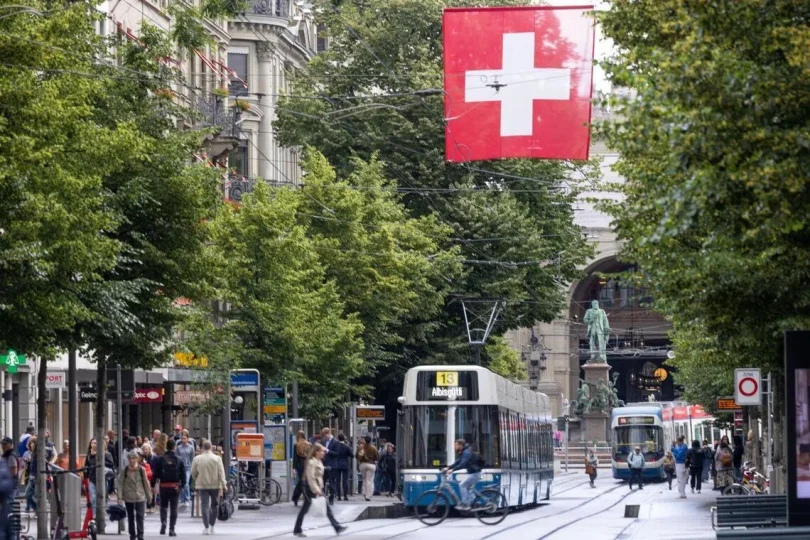
BERN – Switzerland lost its position as the world’s most competitive economy to Singapore, slipping to third place in the ranking as high US trade tariffs and a strong Swiss franc hurt investment flows.
While Switzerland remained the highest-ranked European nation, it was also leapfrogged by Hong Kong in the 2026 IMD World Competitiveness Ranking published on June 18.
Business efficiency was key to Singapore rebounding to first place, a position it last held in 2024.
The IMD said Switzerland’s decline underscores how even the world’s strongest economies remain vulnerable to shifting capital flows and heightened geopolitical uncertainty.
The setback comes as Switzerland faces intensifying competition, with Hong Kong recently overtaking the country as the world’s largest cross-border wealth hub, according Boston Consulting Group.
“With an expensive currency obviously we see the deterioration in price ranking” and that hurts capital attraction, said Arturo Bris, director of the IMD’s World Competitiveness Center.
“And you see the biggest decline in the attraction of foreign investment, the under-performance of Switzerland has been really significant.”
Switzerland’s inward direct investment flows flipped to a negative US$60.7 billion (S$78.2 billion), putting it bottom of the IMD’s 70-country ranking for that metric. IMD said the move may reflect valuation adjustments and capital repatriation rather than a lasting structural change.
Some of those flows are volatile and reflect investments into finance and holding companies, according to Ivo Germann, who heads the Foreign Economic Affairs Directorate at the State Secretariat for Economic Affairs in Switzerland.
“Switzerland faces challenges, like many other countries, in an increasingly unstable geopolitical environment that it must address in the coming years,” Germann said.
“In the face of protectionist tendencies and weakening of the multilateral trading system and it must further improve and diversify its access to foreign markets by continuing our free trade agreements agenda which has been very successful in the past.”
Over the past 12 months, Switzerland’s appeal as a haven of political and economic stability has had to contend with referendums spanning a vote to cap the country’s population at 10 million to a pitch for a 50 per cent inheritance tax on super-rich residents.
The small nation, home to financial institutions such as UBS Group AG and food giant Nestle SA, also incurred the wrath of the Trump administration for its large trade surplus and was slapped with the highest tariff rate among western countries for some time.
Those tariffs dented sentiment toward the Swiss private sector, according to Bris.
“So the tariffs are certainly affecting more those small countries that are more isolated and Switzerland is a victim of that,” he said.
The report also highlighted challenges in Switzerland’s labour market and business environment.
Remuneration for high-skilled professions, female representation in management and early-stage entrepreneurial activity were cited among the country’s weaker-performing indicators.
Despite the drop, Switzerland retained its position as the world leader in government efficiency and infrastructure, while business efficiency remained sixth.
IMD’s statistical measures are primarily driven by the 2025 macroeconomic data, and do not fully incorporate the impact of the Iran war. BLOOMBERG