
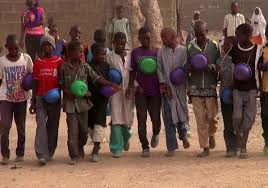
(Almajiri boy. Photo Credit: X.com)
Eight-year-old Lawan is an almajiri boy who wanders the streets of Jos, Plateau State, every day searching for food and handouts.
Originally from Katsina State, he was brought to Jos by his own father and handed over to an Islamic teacher commonly referred to as a Mallam to receive Quranic education.
Instead, Lawan has been left to survive on his own while also generating income for his teacher and the teacher’s household.
Together with other almajiri children, Lawan is out on the streets every single day begging for food, a reality that exposes him and his peers to a range of dangers including kidn@pping, physical abuse, discrimination, and the ever-present risk of being hit by a vehicle.
He has little access to basic hygiene or medical care, no formal education, and must navigate a street environment filled with both helpful and harmful individuals.
While clutching his unwashed purple plastic bowl, he endures daily insults from children heading to school, and watches with silent heartbreak as other families enjoy outings he can only dream of.
According to Lawan, his Mallam sets a daily financial target that he and the other children must meet or face a beating upon returning.
Previous administrations, particularly that of former President Goodluck Jonathan, attempted to bring the almajiri system in line with Nigeria’s formal education framework by establishing dedicated schools.
However, those efforts were largely undermined by several northern state governments and prominent Islamic scholars, resulting in underfunded or completely non-functional institutions.
In 2024, the federal government unveiled an education reform roadmap with targets to be achieved by 2027, including a 25 percent annual reduction in out-of-school children, the reabsorption of 15 million children into the education system, and the creation of learning centres to enrol 500,000 overage out-of-school children each year through specialised curricula and vocational training.
Despite these policy intentions, inadequate monitoring has allowed the almajiri system to drift far from its original purpose, with millions of boys between the ages of 5 and 18 effectively becoming street beggars. Poverty has compelled many Mallams to send children out to beg in order to sustain themselves and their families.
Islamic scholars spoken to on the matter offered sharp criticism of the system’s current state. Alfa Ishaq Mustapha, Chief Imam of a mosque in Angwa Tipper, Jos, noted that the almajiri system has been corrupted by teachers who have turned their students into virtual slaves, sending them out to beg while their families benefit from the proceeds.
He said religious leaders have spoken out against the practice but their voices have gone unheeded.
Sheikh Shehu Danjuma echoed similar sentiments, acknowledging that the system was originally designed to nurture young Muslims in Quranic knowledge, but has since been twisted by unscrupulous teachers who exploit children for financial gain.
He called on governments at all levels to put in place policies that would put an end to the practice of sending vulnerable children onto the streets.
Dr. Abdul Aliyu, an Islamic scholar and educator, urged the government to take deliberate steps to expand foundational literacy, numeracy, and digital skills training within the almajiri framework, so that these children can hold their own alongside peers in conventional schools.
He stressed the need to redefine what constitutes an out-of-school child in Nigeria’s policy conversations, pointing out that almajiri children already operate within an existing educational structure.
He advocated for the integration of almajiri schools into the formal basic education system, with the inclusion of literacy, numeracy, and vocational training components to ensure a seamless transition.