
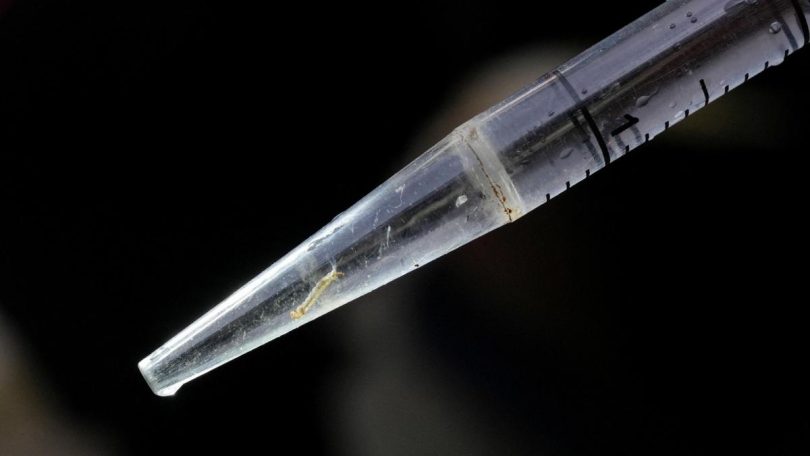
Dengue mosquito larvae inside a pipette tube after being collected during an inspection of houses in Colombo, Sri Lanka. File
| Photo Credit: Reuters
Sri Lanka has decided to appoint a military-led team to monitor the sudden surge in Dengue cases across the island, even as hospitals report overcrowding and mounting pressure on the public health system.
According to a statement from the President’s office, the decision was taken at a meeting chaired by Minister of Health and Mass Media, Dr. Nalinda Jayatissa, at the Presidential Secretariat on Monday (June 22, 2026). The monitoring unit will strengthen legal enforcement measures and further reinforce dengue prevention activities through the “Community Empowerment and Public Safety Committees” established at the local level, the statement said.
As of June 20, 2026, the island’s health authorities have reported a total of 46,037 cases, with nearly 10,000 of those reported from the capital, Colombo. As many as 28 dengue deaths have so far been reported this year. The monitoring unit, “under the leadership of the Tri-Forces “, will strengthen legal enforcement measures and further reinforce dengue prevention activities through the Community Empowerment and Public Safety Committees established at the local level, the statement said.
Last week, Sri Lanka’s Health Ministry said hospitals had exceeded their capacity due to a rapid spike in dengue patients being reported. According to reports in the local media, Health Minister Dr. Jayatissa warned that the island’s hospital system could come under severe strain if dengue cases continued to rise.
Sri Lanka is widely credited with one of the best public health systems in the region. The country was certified malaria-free by the World Health Organization [WHO] in 2016, and the last indigenous malaria cases were reported over a decade ago, in 2012. However, the island grapples with chikungunya, which had experienced a large outbreak in 2025, and dengue outbreaks from time to time, especially around its monsoon seasons.

Sri Lanka witnessed a massive dengue outbreak in 2017, when a total of 186,101 cases, the largest outbreak so far, and 440 dengue-related deaths were reported. The years 2019 and 2023, too, saw an outbreak, prompting authorities to launch a “National Strategic Plan’ for the prevention and control of dengue in Sri Lanka.
The number of dengue patients increases during the second and fourth quarters of each year, coinciding with the two monsoonal rains. “Large-scale outbreaks of dengue have occurred every three to four years with high intensity resulting in increased levels of disease endemicity in the country,” a 2024 report of the Ministry of Health pointed out.
Published – June 23, 2026 07:41 pm IST