
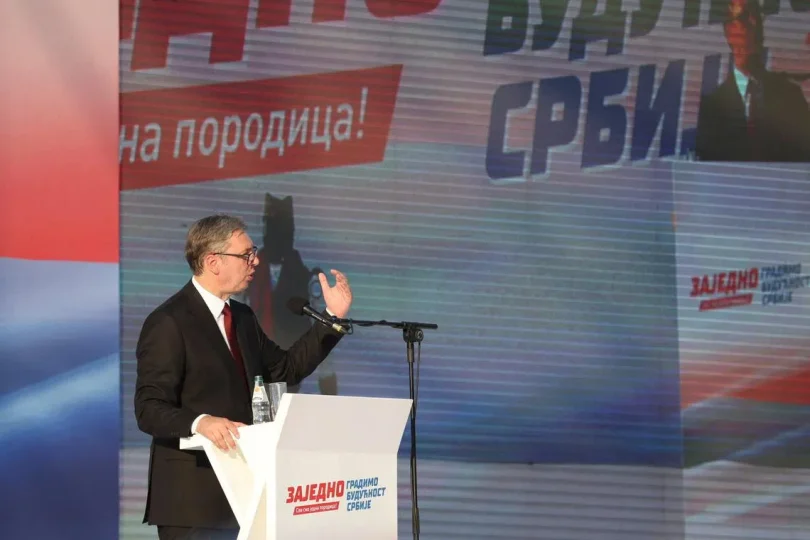
BELGRADE, June 29 – When Aleksandar Vucic announced that he will step down as president of Serbia, cutting short his mandate and likely triggering early elections, few believed that he would disappear from politics.
The populist leader, who has ruled as prime minister or president since 2014, has overseen a chapter of economic development but also growing rancour against perceived corruption and authoritarianism. He has declared in the past he was quitting politics, only to change his mind.
Vucic told a packed pro-government rally in the capital Belgrade on Saturday that he would resign within weeks, a move that follows 18 months of mass anti-government protests against graft and what critics say is Vucic’s hard grip on power in the European Union candidate country.
The demonstrations, the biggest since the fall of Slobodan Milosevic in 2000, were triggered by the collapse of a train station awning in November 2024 that killed 16 people and became an emblem of what critics say is widespread corruption and weak oversight.
Analysts expect Vucic to return to his conservative and populist Serbian Progressive Party and run as prime minister. Even protestors who have called for his departure do not expect wholesale changes while he remains near the levers of power – thousands gathered on Sunday even after he said he would step down.
“He has in the past announced multiple times that he plans to withdraw from politics. Yet, he consistently seeks to remain in power and the whole system of power he created is built around him,” said Florian Bieber, professor for Southeast European History and Politics at the University of Graz.
VUCIC SAYS HE ACHIEVED GREAT THINGS
Vucic, who is 56 and nearly 2 metres tall, has towered over Serbian politics for more than a decade. After an early period as a hardline nationalist, he served as deputy prime minister from 2012-14 and prime minister from 2014-17. When he moved to the normally ceremonial role of president in 2017, he took the power with him and kept strong control of his party.
Serbia’s economy has expanded markedly since 2012. Unemployment fell from about 26% to around 8–9%, while nominal GDP nearly tripled to around €90 billion ($102 billion). Annual foreign direct investment inflows rose from roughly €800 million in 2012 to a record €5.2 billion in 2024, according to official data.
The country has fostered closer ties with China, including through the sale of a failing copper mine and a steel smelter that were turned around. Chinese relations culminated in a state visit by Xi Jinping to Serbia in 2024 and Vucic visits to China in 2023 and 2026.
He has strived to maintain relations with Moscow, and hosted Russian leader Vladimir Putin in Belgrade in 2014 and 2019, while also taking steps to join the European Union, although obstacles relating to the rule of law, judiciary, free and fair elections and the environment remain.
“We managed to achieve great things and change the face of our country, despite constant external and internal pressures,” he told supporters on Saturday.
ALLEGATIONS OF CORRUPTION AND AUTHORITARIANISM
Still, critics point to a lack of transparency in public procurement, including for the reconstruction of the concrete awning that collapsed in Novi Sad.
Opposition parties including the Democratic Party and the Green-Left Front, local media outlets and watchdogs accuse the government of awarding that contract through emergency procedures that bypassed competitive tenders and proper oversight. The government has repeatedly denied this, although several officials, including two ministers, were arrested or resigned after the incident.
Rights groups also speak of a creeping authoritarianism under Vucic’s rule, especially amid the recent protests in which protestors say they have been beaten and unfairly detained.
Press freedom is in jeopardy, they say. In the 2026 World Press Freedom Index, Serbia ranks 104th out of 180 places, Serbia’s lowest rank yet, and lower than any other nation in the EU or the Balkans.
Experts say reporters receive death threats and are frequently intimidated and assaulted.
“You have an entirely hostile environment for free expression or open debate,” said Jelena Sesar, Balkans Researcher for Amnesty International.
Vucic has repeatedly denied silencing opposition voices or the press.
Still, many point to his past as information minister under former strongman Milosevic, during which he oversaw media restrictions during a NATO bombing campaign in 1999.
In 1995, as a deputy of the ultranationalist Serbian Radical Party, he said of NATO in an address to parliament: “Come and bomb us, kill one Serb and we will kill 100 Muslims.”
The statement came just days after the Srebrenica massacre, in which around 8,000 Bosniak Muslim men and boys were killed by Bosnian Serb forces.
Vucic said the remark was taken out of context.
In 2015 he attended a ceremony held to mark 20 years since the Srebrenica massacre, but was forced to flee when mourners hurled stones and bottles at him. “I’m sorry some did not recognize my sincere desire to build friendship between Serbs and Bosniaks,” Vucic said, calling the events “an organised attack.” REUTERS