
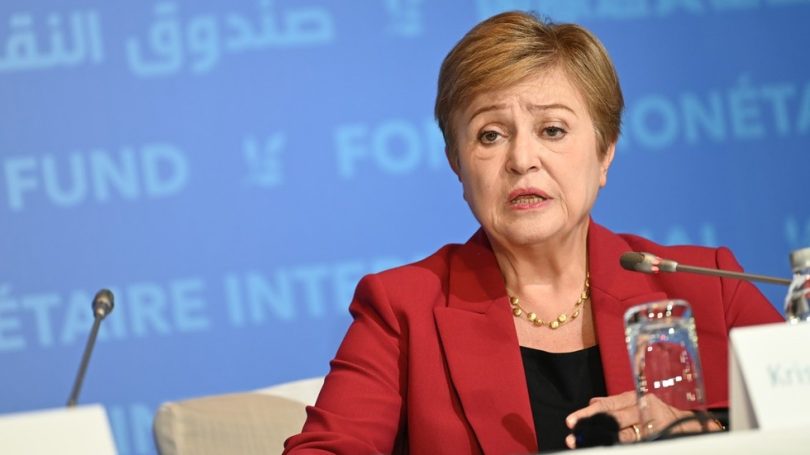
The world has yet to fully “internalize” the fact that major disruptions are becoming the norm, Kristalina Georgieva has said
The world is likely to face further global shocks in the foreseeable future, with no respite in sight, International Monetary Fund Managing Director Kristalina Georgieva has warned.
Appearing on Bloomberg’s podcast ‘Leaders with Francine Lacqua’ on Monday, Georgieva expressed concern that “we are not completely internalizing yet that this is how the world is going to be.”
“We are not going to get to a place where shocks are gone,” she added.
The IMF chief said, “we collectively did not appreciate the backlash against globalization.” She noted that communities around the world have been “hollowed out because their jobs disappeared and there was not enough attention to them,” warning that the rapid introduction of AI into business and production processes could exacerbate these trends.
In its World Economic Outlook released in mid-April, the IMF downgraded its global growth forecast for 2026 from the previous projection of 3.4% to 3.1%, citing the steep rise in oil prices caused by the US-Israeli war against Iran.
The IMF said it expected slower growth in both the US and the Eurozone, with the latter facing the “negative impact of the Middle East conflict” and the “lingering effects” of higher energy prices following the escalation of the Ukraine conflict.
By contrast, the forecast for Russia saw an upward revision of 0.3 percentage points compared to the IMF’s January estimate.
The US-Israeli war against Iran and the country’s retaliatory strikes across the Middle East sent global oil prices sharply higher. Hostilities in the region have disrupted traffic through the Strait of Hormuz, a key route for global oil and gas supplies.
Faced with rising energy prices, officials across the EU have suggested restoring energy ties with Russia. Brussels, however, has refused to walk back its plan to completely phase out Russian fossil fuels by 2027.
Kremlin envoy Kirill Dmitriev predicted last month that the EU and UK would be deluged by the “energy crisis tsunami.”