
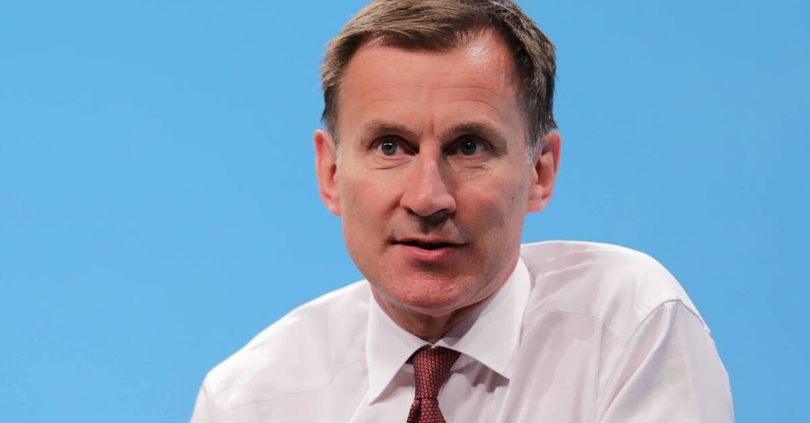
Former Conservative chancellor Jeremy Hunt says that one of the “greatest paradoxes of politics” is how sensitive so many politicians are.
Hunt is no stranger to experiencing public backlash, particularly during his tenure as health secretary between 2012 and 2018, when the UK Department of Health announced a controversial new junior doctors’ contract, resulting in a series of strikes.
“One of the greatest paradoxes of politics is that politicians actually need thick skins, but they have thin skins,” says Godalming and Ash MP Hunt.
“Part of the reason people go into politics is they want to change the world for the better, and I give credit to all my parliamentary colleagues, I think they all have a strong grain of altruism – but they want to be on a stage being applauded as they make the world better.”
Hunt tells the Press Association that politicians are “human”, adding: “I don’t mind criticism as long as it comes from someone who doesn’t know me, but the criticism that hurts me is from someone who knows me.”
His latest book, Can We Be Rich Again?: The Surprising Potential Of Britain’s Economy, looks at the potential to boost all different areas of Britain’s economy, and there are plenty of personal anecdotes sprinkled throughout.
Hunt writes about radio presenters “routinely” mispronouncing his last name, and talks about the impact his career had on his family – mentioning how his wife, Lucia, and their three children (Jack, now aged 15, Anna, 14, and Eleanor, 11) had to leave their Downing Street home fairly quickly after the Conservatives lost the 2024 general election.
“Politics is very tough on families. I saw a Netflix biopic of Ronald Reagan, in which Nancy Reagan says that being married to a public figure is like having a third person in the marriage – and I knew immediately what she meant,” he says.
“It’s not a job that you can leave behind in the office at the end of the day, it’s with you 24/7, it’s with you weekends.”
Hunt suggests that one of the hardest aspects of the job is the instability, saying: “When you’re in cabinet, you have no job security, so you’re thinking: I am doing the most important job I will ever do in my entire life, and it could be over tomorrow.

“So you’re basically saying to your family, bear with me guys, I love you dearly, but I’ve got to focus on the job for now, because I’m never going to have a chance like this again.
“That’s why you’re not really as good a husband or a dad as you would like to be, and I think that’s something that affects everyone in politics.”
Of the incident when the family had to leave Downing Street after the general election, Hunt says: “I tried to position it as something that was an adventure. It was an adventure when we moved in, and it was an adventure when we moved out.
“When we all left Downing Street on the morning after the election in the bright July sunshine with our dog Poppy, someone posted on X: ‘My goodness, he’s got a labrador. Can I change the way I voted?’ That was very, very British.”

Hunt is a keen runner, having completed his fourth London Marathon this year, raising money for Sarcoma UK, the charity that addresses the disease which led to the death of his older brother Charlie in 2023.
He says running helps him get a “moment of calm” amidst a demanding job. He started at boarding school, where he was “completely unco-ordinated” so was “relegated to the cross-country running team, which is where they shoved everyone who couldn’t play football or hockey” and “something stuck”.
He says: “I’m one of those slightly crazy people who tips out of bed in the morning at 6 o’clock, 6.30, and literally the first thing I do is put on my trainers and I get out. I don’t listen to music or podcasts, I just allow my thoughts to wander.
“It’s basically a moment of perspective… If you’re running a regular route, your mind does wander, but sometimes solutions to problems pop out – and that’s happened to me many times.”
Hunt’s 2025 book Can We Be Great Again? was “the book I wish I had been given on the day I became Foreign Secretary”, he says, while Can We Be Rich Again? is “the book I wish I had been given the day I became chancellor”.
Former prime minister Liz Truss called him into the position in October 2024, after the market backlash to her first chancellor Kwasi Kwarteng’s mini-budget. He had been foreign secretary, health secretary, and culture secretary in past Tory governments, and while he was praised for being culture minister during the final stages of planning for the London 2012 Olympics, he became a controversial figure during the 2015 junior doctors contract dispute, and was criticised for arms sales to Saudi Arabia amid the kingdom’s ongoing conflict with Iranian-backed rebels known as Houthis in Yemen during his tenure as foreign secretary in 2018.
Recalling when he stepped into the role of chancellor, Hunt says: “Markets were collapsing around my ears, we had 11% inflation, the economy was going into recession, we had a £72 billion black hole in public finances, and I had never studied economics to any depth, and never had any ministerial jobs where I was responsible for the economy.”
He acknowledges that people might ask why he didn’t make all of the changes laid out in the book, saying: “The truth is, you learn on the job. You don’t know everything the moment you arrive. Some things you uncover while you’re doing the job, some things you realise after you stop doing it.”
Hunt writes about feeling “a dose of imposter syndrome” when he first entered 11 Downing Street, something he’s only experienced once before, during his first week as foreign secretary.
“On day four, I had to go to Chequers for a bilateral meeting with Donald Trump and Theresa May, and there were a dozen people in the meeting,” he remembers.
“I’d been health secretary for six years, so you could have asked me anything you like about health and I would have known what to say – I did think, how am I going to add any value here at all? But actually, it was fine.”
He suggests his latest book might be useful to the person who might find themselves in the job “if we have a new chancellor in the next six months” – plus, he will “certainly be sending a copy to Keir Starmer and Rachel Reeves”.
Hunt says he’s “naturally” a glass half full person, adding: “I try and make the case in this book that we have overdone the doom and gloom about Britain. We’ve got loads of very big problems, but when it comes to the economy, the Centre for Economics and Business Research is saying that by 2030 we will overtake Japan and become the fifth largest economy in the world.
“What we forget is other people have problems too, and we’ve got some amazing things in this country. Treatments and vaccines discovered in the UK during the pandemic save more lives globally than those from any other country, and that is because of the most amazing research that happens not just at Oxford and Cambridge, but across our universities. In the age of AI, we are the third largest AI powerhouse after the United States and China.
“We have got a lot going for us, and I think there’s all to play for.”

Can We Be Rich Again?: The Surprising Potential Of Britain’s Economy by Jeremy Hunt is published in hardback by Swift Press. Available June 4th.