
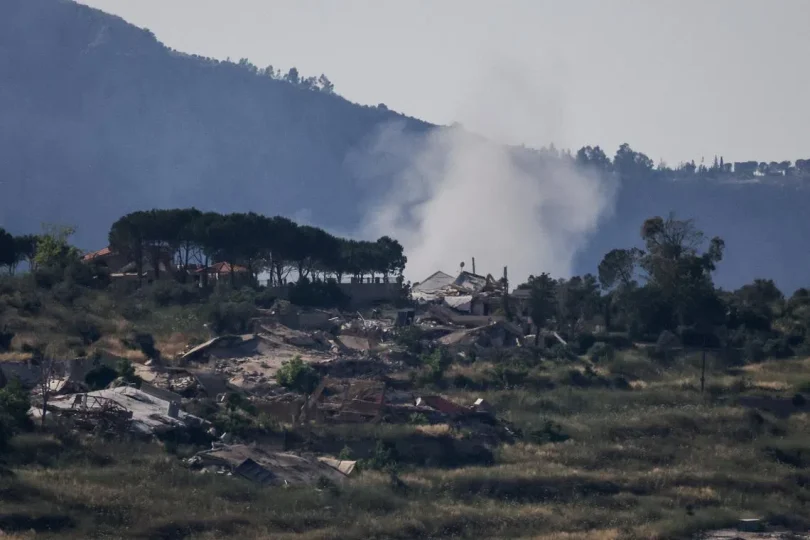
BEIRUT, June 11 – Iran is waging a calculated campaign to preserve Lebanon as its last bastion of influence on the Mediterranean, tying the country’s fate to a grand bargain with Washington as it seeks to end Hezbollah’s war with Israel on its own terms, not Beirut’s.
That effort is colliding with a historic U.S.-sponsored negotiating track between Lebanon and Israel aimed at ending decades of conflict along their frontier and redefining the balance of power in a country long caught between regional foes.
Yet Beirut is not backing down. President Joseph Aoun told Reuters on Wednesday that “Lebanon’s future is in the hands of the Lebanese, not Iran — nor Israel,” casting the negotiations as a struggle for Lebanon’s sovereignty.
“Cooperation with Iran is one thing, but we do not accept that the Iranians dictate to us,” Aoun said. “We are a sovereign state. Iran cannot speak in our name. We do not accept that Lebanon becomes a field for other people’s wars.”
“I am determined to proceed with the diplomatic track,” he added. “There is no military solution. We have no choice but to negotiate to end this conflict, and neither do the Israelis.”
Still, Lebanon finds itself at an impasse.
Hezbollah has publicly rejected direct talks with Israel, calling them shameless, but Aoun said the group had not presented the government with its own roadmap to end the crisis.
He warned that if Hezbollah chose to remain on a war footing, the Shi’ite group would harm the very community it claims to defend, prolonging a conflict that erupted on March 2 in parallel to the Iran war and has strained Lebanon’s sectarian and political faultlines.
Tehran, meanwhile, has made a ceasefire in Lebanon a condition for any broader deal with Washington, giving it leverage over a process from which it is formally excluded.
LEBANON ‘GROUND ZERO’ FOR IRAN
Lebanon has become all the more important for Iran since the ouster of Syrian President Bashar al-Assad, a main pillar of Tehran’s “Axis of Resistance”, in late 2024.
“Lebanon is the ground zero of Iran’s resistance narrative,” said Andreas Krieg at the School of Security Studies at King’s College London, describing it as Tehran’s primary frontline against Israel and a base for operations across the Levant.
This week’s Iranian strike on Israel, in retaliation for an attack on Beirut’s southern suburbs, underlined that posture, signalling Tehran’s willingness to enforce red lines, particularly in Lebanon, Krieg said. It marked the first time Tehran has intervened directly in a Hezbollah-Israel war.
An Iranian official said those red lines include any effort to weaken Hezbollah, normalise strikes on Lebanon or target Shi’ite areas. The message has been conveyed to Washington and Tel Aviv, the official said, along with a warning that continued hostilities could derail ceasefire efforts and risk wider regional fallout, including threats to maritime chokepoints.
A Lebanese source familiar with the U.S. talks said Tehran was angered by Beirut’s decision to negotiate independently with Israel, which it saw as stripping Iran of a key bargaining chip in its standoff with Washington.
TORTUOUS TALKS IN WASHINGTON
Meanwhile, the talks in Washington have produced little visible progress.
At their core lies a stark divide. Lebanon is demanding a durable ceasefire as the basis for negotiations leading to a full Israeli withdrawal and the return of hundreds of thousands of displaced civilians under Lebanese army supervision.
Israel wants Hezbollah dismantled as a military force — at least in southern Lebanon — and proof of its removal before relinquishing occupied territory.
Two Lebanese officials, speaking on condition of anonymity, described the talks with Israel as tortuous. Five hours into a meeting last week, Lebanese negotiators concluded Israel was not prepared to make concessions. Chief negotiator Simon Karam informed U.S. mediators that talks should be paused and left the room. The meeting resumed only after the direct intervention of U.S. Secretary of State Marco Rubio and Vice President JD Vance.
That produced what the Lebanese officials described as a “last-minute, take-it-or-leave-it proposal”, short on detail.
It proposed a ceasefire contingent on Hezbollah’s cessation of hostilities and withdrawal from southern Lebanon as a first step. Like an earlier ceasefire announcement in April, it did not explicitly refer to Israeli troop withdrawal.
Rubio accused Iran this month of trying to stymie the talks.
For upcoming talks this month, Beirut is proposing parallel tracks: an Israeli withdrawal and the gradual extension of Lebanese state authority. Lebanese officials say both tracks must proceed simultaneously.
A ceasefire would trigger a 24-hour deadline for Hezbollah to begin withdrawing to allow for “pilot zones” to be established, beginning around Beaufort Castle, they said. Zone by zone, Israeli troops would withdraw, Lebanese troops would deploy and displaced civilians would begin returning, backed by international reconstruction efforts.
Hezbollah swiftly rejected the plan, publicly describing it as surrender to Israeli terms.
HEZBOLLAH UNLIKELY TO PLAY BALL AS WAR RAGES, SOURCE SAYS
A Lebanese source familiar with Hezbollah’s position said the Washington track would lead nowhere, pitting an Israel unwilling to halt its offensive against a Lebanese delegation with no authority over the group.
The real negotiations, he said, would only begin once a ceasefire emerges from a U.S.-Iran deal, when Lebanon would push for Israeli withdrawal and Israel for security arrangements that address Hezbollah’s weapons — an issue the group’s leadership is not ready to confront while war continues.
Beirut’s position, the two officials say, is fortified by growing Western and Arab backing and rare domestic consensus outside the Shi’ite community supporting an independent national track free from Iranian tutelage.
The government must now try to navigate a path between Israel’s insistence on dismantling Hezbollah and Iran’s determination to preserve it as a regional lever.
Continued deadlock risks entrenching a new reality in south Lebanon, potentially preventing the return of large segments of the Shi’ite population. REUTERS