
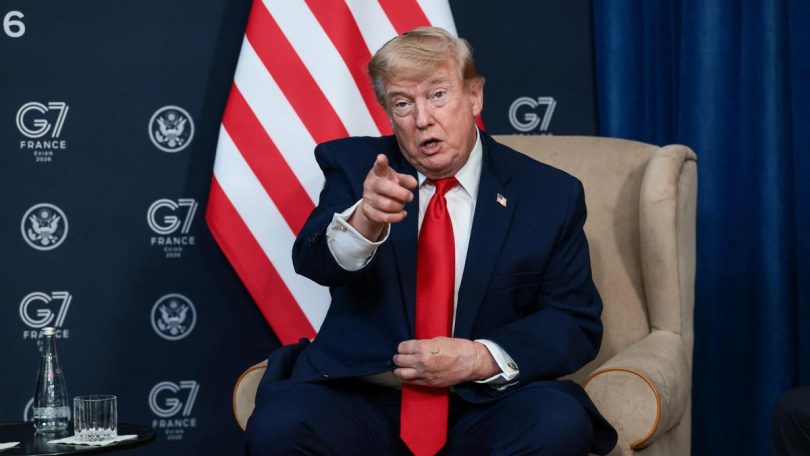
U.S. President Donald Trump attends a bilateral meeting with the Emir of Qatar, Sheikh Tamim bin Hamad Al Thani, on the sidelines of the G7 summit, in Evian-les-Bains, France on June 16, 2026.
| Photo Credit: Reuters
U.S. President Donald Trump maintained on Tuesday (June 16, 2026) that an interim accord with Iran makes clear that Tehran would never be allowed to develop a nuclear weapon, and he also suggested Syria could be better positioned to disarm Iran-backed Hezbollah.
Speaking ahead of talks with Qatar’s Emir Sheikh Tamim bin Hamad Al Thani on the sidelines of the G7 summit in France, Mr. Trump defended the 14-point memorandum of understanding with Iran that has yet to be made public. “The only thing that really matters to me is Iran will never have a nuclear weapon, and it says it loud and clear,” he told reporters, warning that “all hell will rain down” on Iran if it sought to acquire one.
West Asia LIVE updates
U.S. and Iranian officials are due in Switzerland on Friday (June 19, 2026) to begin detailed negotiations, opening a 60-day window for complex technical talks. These are expected to cover issues such as the future of Iran’s highly enriched uranium and the lifting of sanctions.
European allies have voiced concern that an inexperienced U.S. negotiating team could struggle to secure a robust agreement, potentially leading to a prolonged standoff.
In 2015, former U.S. President Barack Obama secured a nuclear deal with Iran in exchange for sanctions relief, a process that took two years to finalise. Trump withdrew the United States from that accord during his first term.
“This deal is a wall to a nuclear weapon. His (Obama) deal was a road to a nuclear weapon. My deal, they can’t have a nuclear, they get blown up,” Mr. Trump said.
Diplomats and analysts note that Iranian negotiators are highly skilled in nuclear diplomacy, often exploiting weaknesses in their counterparts and buying time to advance their agenda, making the prospect of a comprehensive agreement within 60 days challenging.
One key factor in whether the interim accord holds will be the situation in Lebanon, where Israeli Prime Minister Benjamin Netanyahu has said his troops would remain in the south as long as needed to tackle Hezbollah. Tehran has demanded an Israeli withdrawal.
Mr. Trump appeared critical of Israel’s strategy in Lebanon and also suggested that neighbouring Syria — which under President Ahmed al-Sharaa is struggling to stabilise the country after years of civil war — could be best placed to intervene.
“I suggested to Israel to let Syria take care of Hezbollah because to be honest, I think they do a better job of doing it,” he said.
Published – June 16, 2026 04:40 pm IST