
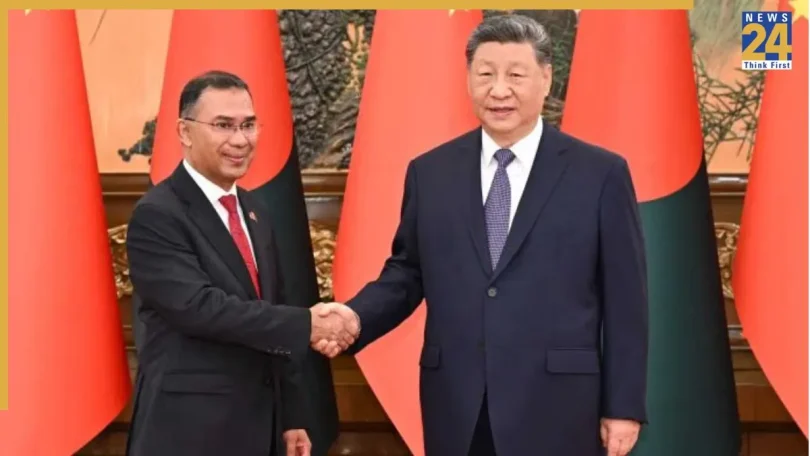
Bangladesh Prime Minister Tarique Rahman recently concluded his visit to China, during which the two countries signed several bilateral agreements. Among them, the Teesta River Comprehensive Management and Restoration Project has attracted significant attention.
China has pledged its full support for the project, making it one of the key symbols of growing strategic cooperation between Beijing and Dhaka. The development is also expected to be closely monitored by India because of the Teesta River’s cross-border importance.
Why the Teesta Project matters
According to a report by The Telegraph India, China’s involvement in the Teesta project comes at a time when water-sharing issues between India and Bangladesh remain unresolved.
While China has extensive expertise in large-scale infrastructure projects, questions remain over whether such a project can succeed on an international river whose upstream flow is largely controlled by another country.
Read More: China builds world’s most powerful supercomputer, know who owns top 5 supercomputers in world, is India, Pakistan on list?
The Teesta River originates in the Himalayas, flows through Sikkim and West Bengal before entering Bangladesh. For decades, the river’s flow has been regulated by India’s Gajoldoba Barrage and several upstream hydropower projects.
Bangladesh banking on large-scale river engineering
Bangladesh aims to reduce the impact of floods and water shortages through an ambitious river management plan being developed with Chinese assistance.
The multi-billion-dollar project includes dredging more than 100 kilometres of the river, constructing embankments for flood protection, developing inland reservoirs to store seasonal water and building modern irrigation canals to improve water management.
The objective is to make better use of the water available within Bangladesh and improve agricultural productivity.
India’s role will remain crucial
Experts believe the proposed engineering works may improve water management inside Bangladesh, but they cannot increase the amount of water flowing into the country.
Read More: China in big trouble, brought to its knees for first time in 6 months as…, why it’s a big opportunity for India, what is this all about?
If India continues its current level of water usage or increases upstream withdrawals during the dry season, the effectiveness of Bangladesh’s planned reservoirs and irrigation canals could be significantly reduced.
This makes India’s future water management decisions an important factor in the long-term success of the project.
Bangladesh is also facing broader concerns over long-term water security as uncertainty grows around future water-sharing arrangements with India.
While all the planned construction under the Teesta project will take place within Bangladeshi territory and has been presented by Dhaka as a sovereign development programme, experts believe the country’s dependence on upstream river flows makes cooperation with India essential.
Strategic concerns near India’s ‘Chicken’s Neck’
The report also highlights India’s strategic concerns over China’s increasing presence near the Siliguri Corridor, commonly known as the Chicken’s Neck. This narrow strip of land connects mainland India with its northeastern states and is considered strategically vital.

Indian defence planners are reportedly uneasy about Chinese-backed infrastructure projects gaining proximity to this sensitive region.
Analysts believe China’s growing role in the Teesta project could encourage India to revive long-pending water-sharing negotiations with Bangladesh or offer alternative infrastructure funding to maintain its strategic influence in the region.
First published on: Jun 28, 2026 03:55 PM IST
Get Breaking News First and Latest Updates from India and around the world on News24. Follow News24 on Facebook, Twitter.
End of Article
Related Story


