
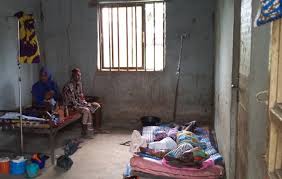
(poor infrastructure. Photo by Guardian Nigerian News)
For many residents of Taraba State, accessing quality healthcare in public hospitals has become an increasingly difficult task.
Across several general hospitals in the state, a shortage of qualified medical personnel and deteriorating infrastructure are raising alarm among patients and health experts, who have warned that the situation could worsen without urgent intervention.
Findings reveal that many healthcare facilities in the state are struggling to cope with growing patient demands amid inadequate staffing and poor medical infrastructure.
Residents described a system under serious strain, where patients endure long waiting periods, delayed medical procedures, and limited access to specialist care.
One resident, Yerima Ato of Wukari Local Government Council, alleged that the General Hospital in Wukari lacks sufficient qualified doctors to attend to patients, forcing authorities to rely on medical personnel from the Federal Medical Centre (FMC) in Jalingo to fill the gap.
“To my knowledge, doctors are being hired from the Federal Medical Centre, Jalingo, to cover up for the shortage of doctors in the general hospitals,” he said.
He recounted a personal experience in which a scheduled surgery was delayed due to the unavailability of the required medical personnel at the hospital.
“There was a time I was scheduled for surgery at the general hospital, but I had to wait for the doctors to come from the FMC. So, the same doctors you find at the FMC are the ones you find in the general hospitals,” he said.
Another resident, Hajara Thomas, noted that hospitals in Takum, Ussa, Gassol, Gashaka, Bali, and several other local government areas face similar challenges, adding that many communities depend heavily on general hospitals and primary healthcare centres.
She called on the state government to embark on aggressive recruitment of doctors, nurses, laboratory scientists, and other health workers to bridge the existing gaps.
“Our hospitals need more qualified personnel. People in rural communities deserve quality healthcare just like those living in urban centres,” she said.
Beyond staffing shortages, poor infrastructure has also been identified as a major obstacle to healthcare delivery in the state.
A resident of Lau Local Government Council lamented the deteriorating condition of the only government hospital in the area, noting that despite the presence of prominent politicians from the council, accessing healthcare remained burdensome due to dilapidated structures and the absence of medical personnel.
Health expert John Mayo noted that many public hospitals operate in aging structures with inadequate facilities and obsolete equipment, adding that poor conditions not only affect patient care but also discourage healthcare workers from accepting postings to certain facilities.
“When healthcare facilities are poorly maintained and lack essential equipment, it becomes difficult for medical personnel to perform optimally.
This ultimately affects the quality of service patients receive,” he said.
He stressed the need for government investment in hospital rehabilitation, modern medical equipment, and improved working conditions for healthcare professionals.
Healthcare analysts say the challenges facing Taraba’s health sector reflect a broader national problem, with many states grappling with a shrinking healthcare workforce driven by migration, retirement, and inadequate recruitment compounded further by rising demand, population growth, and limited funding for public health institutions.
Experts argue that strengthening primary healthcare centres, improving welfare packages for medical personnel, and investing in modern infrastructure could significantly improve health outcomes across the state.
Residents are urging the Taraba State Government and relevant stakeholders to prioritise healthcare reforms, recruit additional medical staff, and upgrade hospital facilities to ensure accessible and efficient services for all citizens.
The state government is yet to respond to the concerns raised.