
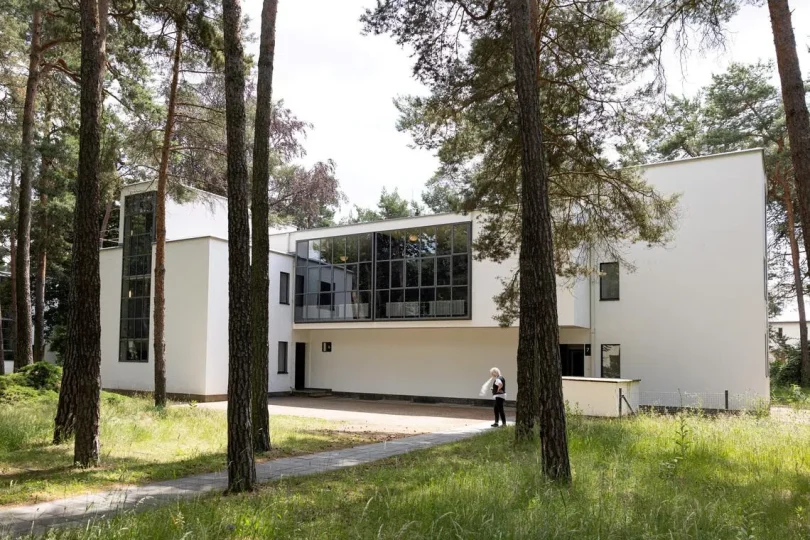
DESSAU, Germany, June 22 – A century after its birth as a radical centre of modernist design, Germany’s historic Bauhaus school has become a symbol of a brewing culture war ahead of a state election that could see the far-right AfD party win power for the first time.
The Alternative for Germany, favoured to win the election in the eastern state of Saxony-Anhalt in September, has pledged a “new patriotic cultural policy” aimed at restoring German self-confidence and has singled out Bauhaus as one of its targets.
“Bauhaus stands for deracination. Bauhaus stands for dislocation of architecture,” Hans-Thomas Tillschneider, the AfD’s cultural spokesperson, told Reuters. “Bauhaus is the architecture of globalisation – of ‘Anywhere’s’, so to speak.”
Founded in eastern Germany after World War One as a social utopian project aimed at uniting form and function in design, the Bauhaus school helped spread the use of concrete, glass and steel as building materials in spare, straight-edged designs that transformed world architecture.
The influence on domestic design of Bauhaus figures including Marcel Breuer and Ludwig Mies van der Rohe has been just as great, from their tubular steel chairs to lamps and coffee makers now found in households across the world.
Banned under the Nazis, its sites in Weimar, Dessau and Bernau were included on the UNESCO World Heritage List in 1996.
The attack on one of Germany’s most recognizable cultural exports underlines the nation-centred vision of the AfD, a party set up during the euro zone crisis around a decade ago that opposes mass immigration into Germany.
‘IDEAS OF GERMAN HISTORY’
The AfD is targeting not only the institution of Bauhaus “but also a diverse cultural landscape”, said Barbara Steiner, director of the Bauhaus in Dessau, in Saxony-Anhalt.
“Bauhaus and everything it stands for does not match the AfD’s ideas of German history,” she told Reuters.
Instead of the ferment of the Weimar Republic, where the Bauhaus was founded by architect Walter Gropius, the AfD programme says its values stem from mediaeval rulers Heinrich I and Otto I as well as from Church reformer Martin Luther and the 19th century “Iron Chancellor” Otto von Bismarck.
It takes aim at soulless modern architecture, theatres it says do not put on German plays, and state subsidies for what it calls “anti-German art and culture”. It singles out Bauhaus in particular for “avoiding any sign of national rootedness”.
In place of glass and concrete, it says it would take a lead from U.S. President Donald Trump’s 2020 order promoting classical and traditional architecture for government buildings.
But Tillschneider said the Bauhaus institute, which is funded through a mix of federal, state and municipal subsidies, would be safe under an AfD state government.
“We have very clear ideas about what we want to support and what we don’t want to support, but we don’t want to forbid anything,” he said.
ALARM
The AfD is currently polling at around 40% in Saxony-Anhalt, well ahead of any other party but probably still just short of what it would need to govern alone. Nationally, it stands at around 28%, against some 22% for Chancellor Friedrich Merz’s conservatives.
In a country struggling with a stalled economy and uncertain of its future, according to opinion polls, cultural politics alone may not be decisive in the election.
But the party’s focus on identity issues — it says eastern Germany represents “the better Germany” — signals the potential for further-reaching changes in the future, said Michael Kolkmann, a political scientist at Martin Luther University Halle-Wittenberg.
“The AfD would certainly try to use Saxony-Anhalt as a sort of blueprint, to test out something that might also be applicable to other federal states,” he said.
Under the German federal system, state governments have wide powers in cultural affairs and education, and the prospect of the AfD winning power in Saxony-Anhalt has alarmed cultural institutions and universities, which have also been in the party’s sights.
While the AfD says it will protect universities, it says it wants to see courses on gender studies and post-colonialism scrapped and wants to remove the influence of what it sees as leftist 1960s radical teaching.
“That, of course, does threaten the freedom and autonomy we enjoy, in the sense of academic freedom,” said Claudia Becker, rector of Martin Luther University. Scientific research has to be “driven and guided by science itself, rather than by ideologies,” she said.
Germany’s constitution and the distribution of powers between federal and state government limit changes to regulations in universities and many cultural institutions.
Kolkmann said “protracted legal proceedings” were likely to challenge any concerted attempt at radical change.
For the Bauhaus as well, the huge popularity of the movement’s museum in Dessau and the carefully restored buildings in the town that attract tens of thousands of visitors every year, offer further protection.
Bauhaus director Steiner said it was hard to predict what – if anything – might happen under an AfD administration, but added, “Bauhaus is world-renowned, and so any attack on it, or any attempt to disparage it or call its very existence into question, is guaranteed to attract worldwide attention.” REUTERS