
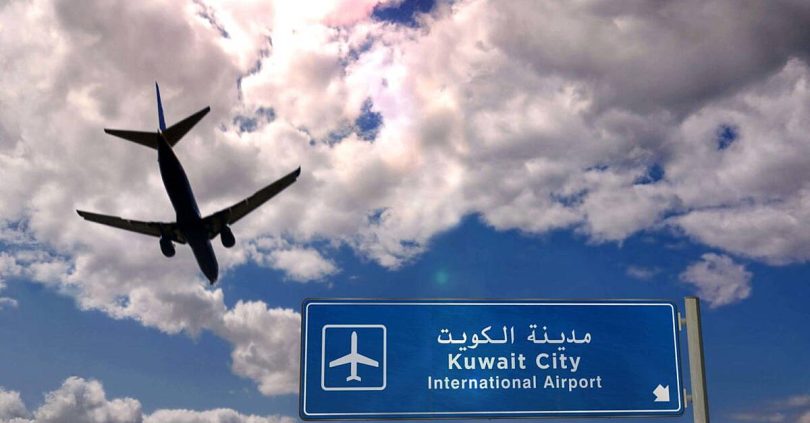
Kuwait said it has suspended commercial flights after an Iranian drone attack hit the country’s airport, injuring a number of people hours after Iran and the United States traded missile strikes in the region.
The attacks came after Iran stopped communicating with mediators about extending a ceasefire in the war with the US and Israel, according to reports on Tuesday from two semi-official Iranian news agencies.
US President Donald Trump disputed that claim and said talks were continuing.
Defence Ministry spokesperson Brig Gen Saud Abdulaziz Al-Otaibi said that “a number of hostile drones” had targeted Kuwait International Airport’s passenger building, severely damaging the building and injuring “a number of individuals.”
The airport reopened on June 1 after closing due to the Iran war. State media reported that Kuwait Airways was suspending its operations until further notice.
Late Tuesday, the US military said it had launched strikes on an Iranian military facility in retaliation for Iranian missiles fired at Kuwait and Bahrain.
It said Iran had fired two missiles at Kuwait that fell apart en route, while US and Bahraini forces intercepted missiles aimed at Bahrain.
Bahrain’s Defence Ministry said its military had intercepted and destroyed three missiles and a number of drones fired by Iran at the Gulf island country.
US Central Command also said it had “downed multiple drones” targeting American forces in Kuwait.
Iran’s paramilitary Revolutionary Guard said it had targeted the headquarters of the US Navy’s 5th Fleet in Bahrain and another country in its attack, without naming Kuwait.
It said it launched its attack in response to the US firing a missile into the engine room of an oil tanker that was trying to reach Iran despite the US blockade.
“We had previously warned that in case of aggression, the response would be different and more severe, and we acted accordingly,” the Revolutionary Guard said in its statement.
Central Command said it responded with strikes on an Iranian military ground control station on Qeshm Island in the Strait of Hormuz.
Iran’s Fars and Tasnim news agencies, both believed to be close to the Revolutionary Guard, reported that Iran’s negotiators have stopped communicating with ceasefire mediators as tensions flared in Israel’s separate but related fight against the Iranian-backed Hezbollah militia in Lebanon.
A regional official involved in the mediation told the Associated Press that Iran had not communicated at all on Tuesday after saying that a ceasefire needed to be enforced in Lebanon for negotiations to continue.
Mr Trump called reports of a cessation in talks “false and erroneous”.
“The conversations between us have been going on continuously, including four days ago, three days ago, two days ago, one day ago and today,” Mr Trump said in a social media post. “Where they lead, one never knows, but as I told Iran, It’s time, one way or another, for you to make a Deal.”
US secretary of state Marco Rubio did not address the reported cut-off in communications as he gave ecidence at a congressional hearing in Washington.
Instead, he sounded an optimistic note about the nuclear dimension of the negotiations, while cautioning that there’s no guarantee of reaching “a deal that’s acceptable”.
As talks continue, the US is attempting to loosen the Islamic Republic’s chokehold on the Strait of Hormuz and the oil, gas and other commodities that normally pass through it.
The war with Iran has increasingly become conjoined to Israel’s war in Lebanon, as Iran insists that any potential truce in the war there must also quell the fighting in Lebanon.
Israeli forces have moved deeper into the country than at any time in more than a quarter of a century.
Mr Trump could potentially push Israeli Prime Minister Benjamin Netanyahu to halt or slow the advance of his forces, but Israel and the US maintain that the fighting in Lebanon is separate from the Iran war talks.