
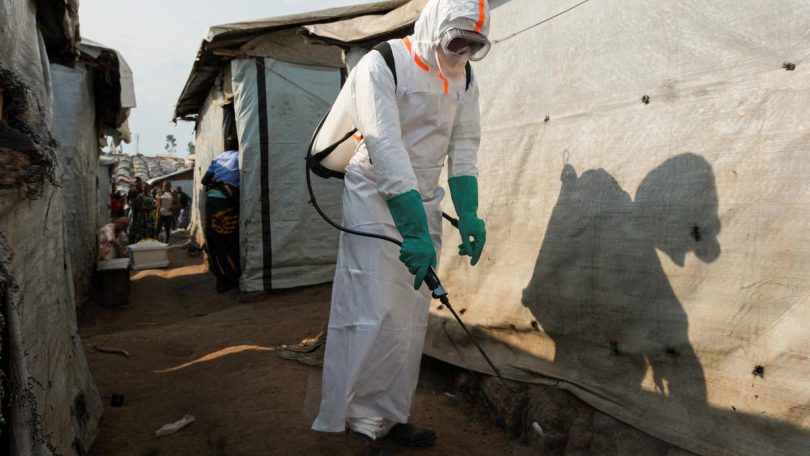
Confirmed cases in the Ebola outbreak in eastern Congo have reached 1,003, including 254 deaths, officials said, as tracing those who had been in contact with patients remains a major challenge.
A total of 100 people have recovered in the outbreak concentrated in the Ituri Province since it was declared on May 15, Congo’s Ministry of Health said on Sunday (June 21, 2026). At least 365 patients are in hospitals or in isolation, it said.
Displaced people attend a mass before the burial of suspected Ebola victims at the Kigonze displaced persons camp, one month after an outbreak was declared, in Bunia, eastern Democratic Republic of Congo, June 18, 2026.
| Photo Credit:
Reuters
The Ebola outbreak caused by the rare Bundibugyo virus, which has no vaccines or treatment, was the worst ever in its first month. Officials admit there could be far more cases they still don’t know about and that the peak of the outbreak is still ahead.

Contact tracing remains a key issue for local authorities, who have only achieved a 55% coverage rate, the Ministry said.
“If you want to control an outbreak, especially Ebola outbreak, you must know the index case. We don’t have confidence on when this outbreak started,” the Africa Centres for Disease Control and Prevention Director-General Dr. Jean Kaseya told The Associated Press last week.

A drone view of displaced people from the Kigonze camp attending the burial of suspected Ebola victims at Nyamurongo Cemetery, one month after an outbreak was declared, in Bunia, eastern Democratic Republic of Congo, June 18, 2026.
| Photo Credit:
Reuters
Officials also are yet to identify the patient zero and trace more than 35,000 people who have come in contact with infected individuals as of last week, authorities said.
That’s partly because eastern Congo is also battling ongoing violence from rebels. In Ituri, attacks by the Islamic State (IS) group-backed Allied Democratic Force have cut off access to many villages and forced people to flee their homes, including those sheltering in overcrowded camps and others constantly on the move.
More than a month into the outbreak, officials believe the disease continues to outpace response efforts and no one knows its true scale.
At the Kigonze displacement camp in Bunia, the capital of Ituri Province, camp officials said on Friday (June 19) that 10 people had died last week in unusual circumstances, raising the fear of a possible outbreak in the camp of over 20,000 displaced people.

Health workers in full personal protective equipment (PPE) disinfect a coffin while preparing for the burial of suspected Ebola victims at the Kigonze displaced persons camp in Bunia, eastern Democratic Republic of Congo, on June 18, 2026, one month after the outbreak was declared.
| Photo Credit:
Reuters
There had been no Ebola case confirmed at the site, camp officials said, but added that the death rate was unprecedented and called for investigation.
The UN refugee agency has said at least 2 million people forcibly displaced from their homes, including over 3,20,000 refugees, live in areas at risk of Ebola in Congo.
In a statement on Friday (June 19), the agency said it was “deeply concerned by the accelerating spread” of the virus and “the growing risks it poses to displaced communities across the region”.
“If a disease or epidemic were to spread among the thousands of people living at this [Kizonge] site, it would be a real catastrophe given our already very precarious living conditions,” said Charite Banza, a civil society leader in Ituri.
Published – June 22, 2026 04:11 pm IST