
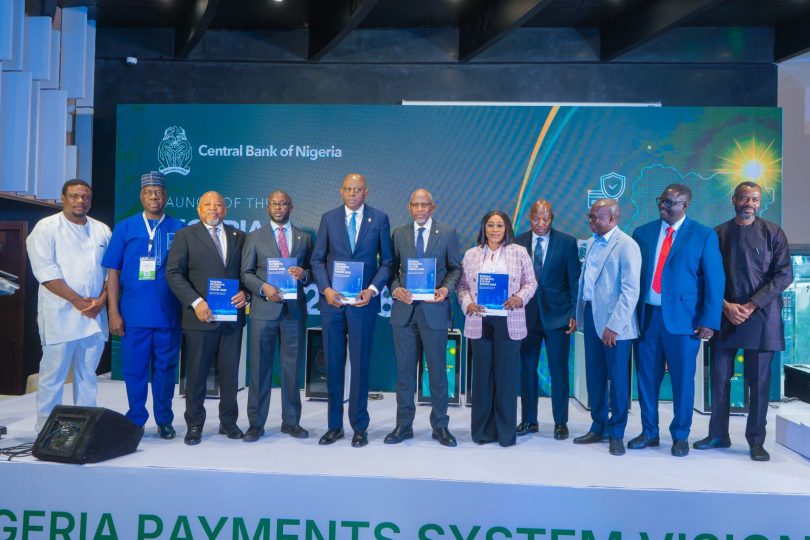
The Central Bank of Nigeria (CBN) has unveiled an ambitious plan to reduce fraud losses in digital transactions to less than 0.001 per cent of total transaction value by 2028, as part of a broader strategy to build trust in the country’s payment ecosystem and accelerate financial inclusion.
Speaking at the launch of the Payments System Vision 2028 (PSV 2028) in Abuja on Monday, the Governor of the apex bank, Mr Yemi Cardoso, said the target would be achieved through stronger identity verification systems, including the integration of the National Identification Number (NIN) and Bank Verification Number (BVN), as well as artificial intelligence-powered fraud detection tools.
“By 2028, we must commit to reducing fraud losses to less than 0.001 per cent of all transactions. With NIN, BVN, intelligent systems, and AI fraud detection, people’s money must be safer in the digital system than under their mattresses.
“By 2028, Nigerians will pay digitally, safely, and cheaply. A payment system is only as strong as the trust people place in it,” Mr Cardoso stated.
He quipped that people’s money must become safer in the digital system than under their mattresses.
The CBN governor said the new payments vision seeks to transform how Nigerians transact, save, trade and participate in the economy, with trust and security forming the foundation of the framework.
Mr Cardoso disclosed that the apex bank is targeting 95 per cent financial inclusion by 2028, a move expected to bring an additional 15 million Nigerians—particularly market women, farmers and young people—into the formal financial system.
According to him, digital financial access is critical to reducing poverty and expanding economic participation, stressing that cash should no longer determine whether citizens can engage in economic activities.
He said PSV 2028 aims to make financial transactions “faster than a blink” by eliminating existing inefficiencies, interoperability challenges and settlement delays across payment platforms.
“Today’s payment systems process millions of transactions every day, with most completed in less than 10 seconds. By 2028, every Nigerian should be able to send and receive money faster than they can blink,” he said.
Mr Cardoso described payment infrastructure as the “invisible roads that move money”, noting that efficient payment systems have become essential for economic growth, competitiveness and poverty reduction.
He added that the framework would strengthen payment infrastructure, deepen inclusion, support innovation, improve resilience and enhance Nigeria’s integration into regional and global payment systems.
The CBN governor also linked payment system efficiency to economic growth, arguing that improved payment infrastructure would boost productivity, lower transaction costs, expand trade and strengthen investor confidence.
Mr Cardoso said the vision builds on two decades of transformation in Nigeria’s payments landscape, driven by the growth of instant payments, fintech innovation and rising digital adoption.
He further stated that PSV 2028 is designed to position Nigeria as a global fintech hub, with open banking reforms already unlocking more than 100 application programming interfaces (APIs) to support innovation and new financial products.
According to him, Nigeria must evolve from being primarily a fintech adoption market to becoming a producer and exporter of globally competitive fintech solutions.
While unveiling the framework, Mr Cardoso cautioned against Nigeria’s long-standing pattern of policy discontinuity, insisting that successful implementation, not documentation, would determine the success of the vision.
“The success of this vision will not be measured by the document, but by execution,” he said.