
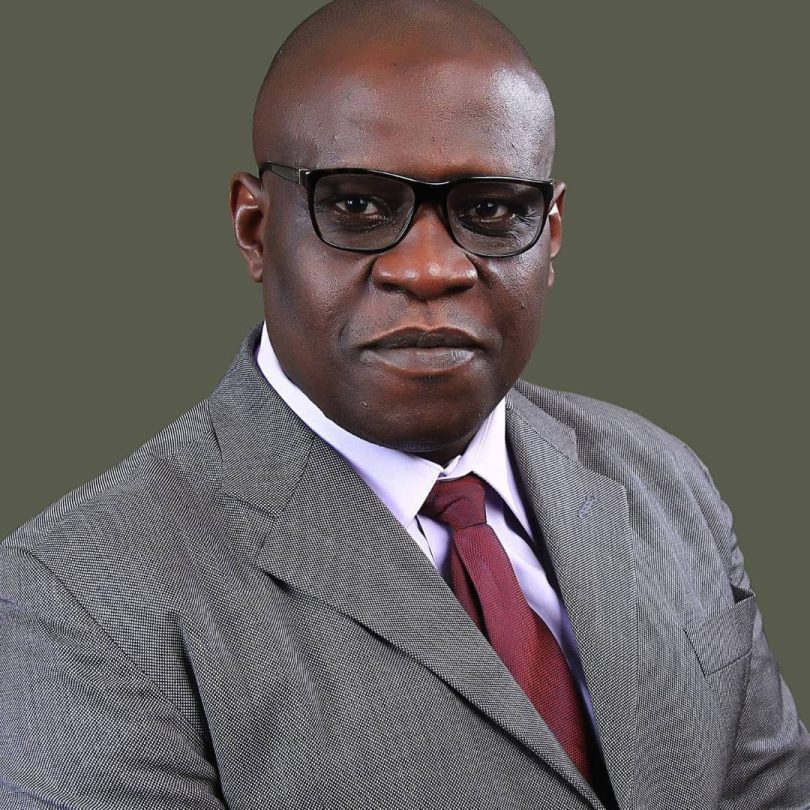
Executive Director/CEO of the National Film and Video Censors Board (NFVCB), DR. SHAIBU HUSSEINI, can be described as a round peg in a round hole. Husseini made his mark as a film and culture journalist with The Guardian Nigeria. He is a creative, even as he holds a PhD in Mass Communication from the University of Lagos (specialising in Nollywood film studies). It is therefore no surprise that he has made much progress since he took office, despite the many challenges the NFVCB is confronted with. He spoke to the Publisher of Frontline News Online, KEMI YESUFU, on why he has prioritised reforms and the restructuring of the NFVCB, promoting accurate film production data to attract investors, and sanitisation of the industry by prohibiting the glamorisation of money rituals and smoking in films. He also spoke on the amendment of the enabling Act of the NFVCB and how it will improve the regulatory role and funding of the agency. Excerpts:
How would you describe your transition from the newsroom to the classroom and now to the red tape of the public service?
I wouldn’t say it has been easy, and I wouldn’t say it has been difficult too, working in government. I’ve been slightly exposed to government bureaucracy. I had the privilege of being the Personal Assistant and later, Special Assistant to the Artistic Director and General Manager of the National Theatre (now the Wole Soyinka Centre for Culture and Creative Arts), Dr. Ahmed Yerima. I worked with him for 10 years. I understood how the civil service works. So, when I came here and some civil servants viewed me as a politician or as someone who had just come from the creative industry, I explained to them that I know the rules of the civil service. My earlier experience prepared me for the office I am in today. And of course, as a journalist, I followed the activities of the agencies responsible for the film industry in the country, namely, the Nigerian Film Corporation and the National Film and Video Censors Board (NFVCB). As a journalist, I did periodic reviews of the agencies to see if they were delivering on their mandate and whether they were impacting the industry and stakeholders positively. Sometimes, the review showed that they were doing well; sometimes, it showed that they didn’t meet up to expectations, especially when compared to their counterparts. I had a deep knowledge of what the NFVCB’s role was in the film industry. So, when I was appointed as the head of NFVCB, it was like I was being called to look at the reviews I had written because they contained suggestions. Aside from my reviews, I was always abreast with developments in the industry, so I told myself that when I resume, I would bridge the gaps I’ve highlighted in the past and move forward steadily. Thus far, it has not been easy; we have been confronted with challenges, but we have dealt with them as they come.
You didn’t explain the challenges you have faced. But looking at budgeting for the creative sector over the years and the recent problem of overlapping budgets, aside from funding, what other challenges have you had to overcome?
As you mentioned, funding is a major challenge. We are in an era where we have gone digital in film production. We are no longer in the analogue era. Now, the industry is so wide that people can upload their film online without approaching the censors board, and this is wrong. The law says that if you produce a film to be exhibited or distributed here, you must pass it through the board for classification. So, we are grappling with this challenge, but we are getting somewhere through engagement. We are engaging them. Another challenge I met is the board operating from a rented building. I had to move the board from the building where it operated for like 28 years. I was able to approach our Minister, and the Minister took our case to the President, and the President expressly approved that we be given a permanent headquarters. We have secured the place, but now, we have to fix it. We had a situation where, by the time our staff needed to work, they were being pursued by bailiffs. We had to move our things out. The items that are dear to me were the 28,000 film collection that we have. We had to move them safely because it is our heritage. Another challenge is the number of staff in the Board. Yes, you hear that we are about 436 staff, but I need more than this figure to ‘police’ the industry. This industry is large with production centres across the country. It is also an all-comers affair. Someone can stay wherever he or he is and shoot a film. In fact, these days, you can shoot a film and edit it with a good phone. But what I have also tried to do is to make staff combine roles and move to areas where we need more hands. The bottom line is that we need more funding to move at the same pace as our counterparts across the world, who are moving. Now, everything you do is technology and data-based. Even to convert films to the formats that people can see, we need storage and facilities to do our job. I know that I will need to seek funding and support from the private sector. For example, in our Lagos office, we have a projector we use to screen movies; the projector has been bad for like 12 years. The projector costs about £25,000. I have put the item in our budget, but we haven’t received funding for it. For an important piece of equipment like the projector, I would have to look to the private sector for funding. In some other parts of the world, where the role of the censors board is better appreciated, two or three production companies can come together to assist us in purchasing the projector because they know it helps us serve them better. In some countries, you have industry players supporting the government to fight piracy, but here, they write to us asking for support. I understand the situation we are in as a country, as it is, the Federal Government has competing needs. So I have to be creative in sourcing financial support in the NFVCB.
Above all, our Act is very old. It was last amended in 2006. As of 2006, what we heard about was mobile technology; we didn’t envisage this digital explosion, so some of the provisions in our Act need updating. Some of our fines are as low as N500 and N5,000. So the first step I took was to approach the National Assembly for the amendment of our Act, and they graciously worked on it, and, it has been transmitted to the President for assent. One of the things that the new Act will bring is a name-change for the board. You will no longer hear censorship in our name. This is because, firstly, our job is the classification of films, not that we will not censor a film if need be, but our first role is the classification of films. When we find a film that may divide the nation or go against national security, we can advise the filmmaker on what to do. When I represent the country at international events and introduce myself as the head of Nigeria’s Film and Video Censors Board, some ask what we censor films for. You know the board was conceived under the military. Now that we are a full-blown democracy, we will play down censorship, though the new Act will give us more regulatory powers, especially over platforms that came in the digital era. I am talking about streaming platforms. We are expecting Mr. President to sign the Amended Act as it will give us more sources of funding without relying solely on the statutory budget.
What is it like working with creatives as their regulator?
It is quite difficult dealing with creatives. But when you engage them, they cooperate with you more. For example, my predecessor worked with Corporate Accountability and Public Participation Africa (CAPPA) on the control of tobacco in the film industry. Unfortunately, they didn’t make much progress. However, when I came in, I told CAPPA, that we can push the control of tobacco in the industry, but we have to meet with stakeholders to see the need for a smoke-free and ritual-free Nollywood. We now worked on the regulation, we sent it to our Minister, and we also sent it to the Federal Ministry of Justice. We got their approvals, and after the approvals, we organised a meeting with the major guilds in Enugu. We spoke to them, that we don’t want to completely ban rituals or smoking in our films, because how many societies in the country are not involved in smoking or rituals? We explained to them that the idea is to control the depiction and glamorisation of rituals and smoking in films. I took the engagement to the South-South, to the north, the North-Central and at that forum, some people said that if they knew what smoking does to the body, they would find props to use in place of smoking. Now, you are expected to use a proper disclaimer at the beginning of the film to indicate that you are not promoting smoking.