
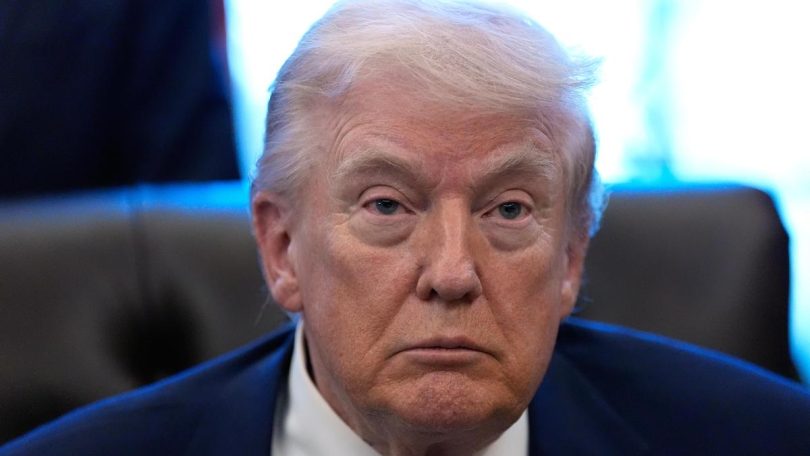
A file image of U.S. President Donald Trump.
| Photo Credit: AP
In the first week of February, the Donald Trump administration of the United States unveiled Project Vault, an independently governed and operated public-private partnership aimed at establishing a strategic domestic reserve of critical mineralsin the United States. The partnership, backed by $10 billion in financing by the Export-Import Bank of the United States (EXIM) and an additional $2 billion in private funds, aims to store 60 critical minerals listed in the U.S. Geological Survey’s 2025 Critical Minerals List to strengthen the resilience of civilian industries against supply chain disruptions. Under this development model, EXIM provides long-term loans to purchase and store critical minerals in the country. This stockpile build-up represents a whole-of-government transformative approach to reduce dependence on foreign-controlled supply chains prone to geopolitical risks and economic coercion, complementing other major policy efforts to build substantive domestic production and processing of critical minerals.
The concept of strategic reserves in the United States goes back to 1975 when it established its Strategic Petroleum Reserve to protect its economy from the energy shocks caused by the 1973 Arab oil embargo. In the 21st century, critical minerals are foundational to modern economic and technological power, and China dominates different stages of mineral production such as mining, processing, and magnet manufacturing. In 2025, China retaliated against U.S. tariffs by restricting exports of rare earth magnets, causing a near shutdown of the operations of car manufacturing in the United States and across the world. The unprecedented disruption forced production lines to rethink shifting some production to China, whose finished exports had minimum restrictions. Importantly, the disruption laid bare the vulnerabilities in the supply chain and caused a decisive blow to the Trump administration’s plan to shore up manufacturing in the United States. Therefore, the project to maintain critical mineral strategic reserves is underlined by the growing risks posed by the concentration of critical minerals and rare earth elements in the hands of one player, which directly affects access, affordability, and geopolitical leverage.
Published – February 18, 2026 04:48 am IST