
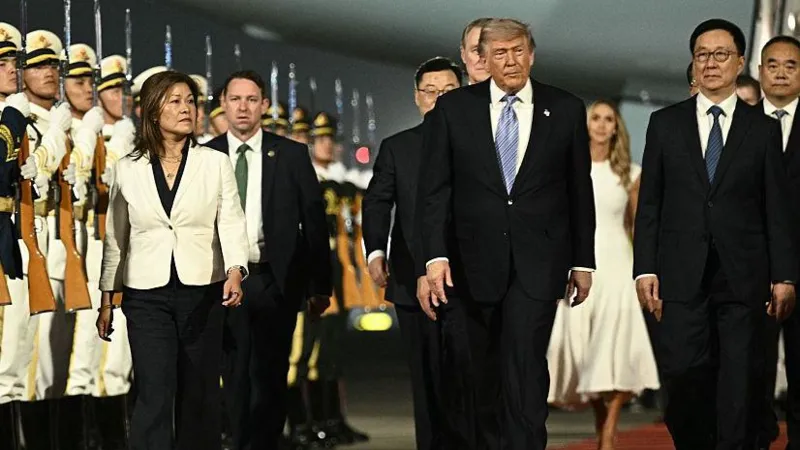
The United States President Donald Trump descended the steps of Air Force One in Beijing on Wednesday evening, greeted with pomp and pageantry ahead of a high-stakes summit with his Chinese counterpart, Xi Jinping.
During his two-day visit, the global superpowers are expected to discuss tariffs, competition over tech, the Iran war and America’s relationship with Taiwan.
Trump returns to a more assertive China since his last visit in 2017, as he faces growing scrutiny of his military campaign in the Middle East.
The president was originally scheduled to make the trip in March, but it was delayed because of the US and Israel’s war in Iran, which continues to roil the global economy.
Trump was greeted on the red carpet by Chinese Vice-President Han Zheng, one of China’s top leaders.
The move is being read as a show of respect for the US president from Beijing, after a lower-level leader received Trump on his last visit.
A brass brand and flag wavers holding Chinese and American flags chanted “welcome welcome, a warm welcome”, as the president gave his signature fist pump to the large greeting party, standing by the dozen in tight, uniformed rows.
The US president was accompanied by his son Eric Trump and a slew of US tech industry titans, including Tesla’s Elon Musk and Nvidia’s Jensen Huang among them.
Other CEOs expected to be travelling with Trump include Tim Cook of Apple, Larry Fink of BlackRock, and Kelly Ortberg of Boeing.
“I will be asking President Xi, a Leader of extraordinary distinction, to ‘open up’ China so that these brilliant people can work their magic, and help bring the People’s Republic to an even higher level,” Trump said in a post on social media ahead of his landing.
Trump said that will be his “very first request” when he meets the Chinese leader.
Trade between the two countries has declined in recent years amid an escalating tariff war and other restrictions.
Last year, bilateral trade totalled $414.7bn (£307.3bn), a sharp decline from the $690.4bn (£511.6bn) recorded in 2022.
Trump is also hoping to bring down the trade deficit between the two countries. Last year, the US imported more than $200bn worth of goods from China than it exported there.
China, for its part, has sought to present itself as formidable competitor in the global AI arms race, increasing its demand for US-made computing chips.